9 dicembre forconi

lunedì 15 ottobre 2018

Market Crash? Another 'Red Card' For The Economy

A few months ago I wrote this article at the World Economic Forum called “A Yellow Card For The Global Economy“. It tried to serve as a warning on the rising imbalances of the emerging and leading economies. Unfortunately, since then, those imbalances have continued to rise and market complacency reached new highs.
This week, financial markets have been dyed red and the stock market reaction adds to concerns about a possible impending recession.
The first thing we must understand is that we are not facing a panic created by a black swan, that is, an unexpected event, but by three factors that few could deny were evident:
  1. Excessive valuations after $20 trillion of monetary expansion inflated most financial assets.
  2. Bond yields rising as the US 10-year reaches 3.2%
  3. The evidence of the Yuan devaluation, which is on its way to surpass 7 Yuan per US dollar.
  4. Global growth estimates trimmed for the sixth time in as many months.
Therefore, the US rate hikes – announced repeatedly and incessantly for years – are not the cause, nor the alleged trade war. These are just symptoms, excuses to disguise a much more worrying illness.
What we are experiencing is the evidence of the saturation of excesses built around central banks’ loose policies and the famous “bubble of everything”. And therein lies the problem. After twenty trillion dollars of reckless monetary expansion, risk assets, from the safest to the most volatile, from the most liquid to the unquoted, have skyrocketed with disproportionate valuations.
(courtesy Incrementum AG)
Therefore, a dose of reality was needed. Monetary policy not only disguises the real risk of sovereign assets, but it also pushes the most cautious and prudent investor to take more risk for lower returns. It is no coincidence that this policy is called “financial repression“. Because that is what it does. It forces savers and investors to chase beta and some yield in the riskiest assets.
Three examples of the market lunacy: Iraq, a country that has been all but devastated and in constant turmoil, issues a 2028 bond at 5.8% yield, lower than some developed markets only six years ago.
Argentina issued a 100 year bond  with an 8.5% yield. A country that in the previous 100 years before issuing this bond defaulted more than eight times. The $2.5bn issue was oversubscribed 3.5 times, which shows how credit investors are more than hungry for any kind of yield, as global negative yield bonds currently surpass the $6.5 trillion figure. With Europe and Japan giving negative nominal and real yields, and central banks buying a combined $200 bn a month of assets, there was massive real demand for some yield.
None of the eurozone countries’ sovereign debt yields show a realistic combination of risk and return. With 19 countries yielding negative real returns, the evidence that there is no real demand for those bonds at these levels is that the ECB is considering an “operation twist” to avoid the inevitable reckoning of rising real yields as the quantitative easing unwinds.
In Europe, no investor would buy bonds of the eurozone states with these coupons in a normalized environment. This has led to higher risk assets in fixed income discounting a spread of only 290 basis points over a sovereign bond that is already massively inflated. That is the creation of a huge bubble instigated by central banks with its reckless policy of ignoring the risks that they encourage in the markets.
With more than 6.5 trillion dollars in bonds with a negative yield, the global bubble remains huge. Stock markets on fire, infrastructure multiples soaring, junk bonds at the lowest yields in thirty-five years… 
And it burst. 
China reminded us that the tale of synchronized growth was false and that what we have been seeing in recent years has been synchronized growth … of debt .
(courtesy IIF)
When China devalues the yuan and introduces the biggest tax cut in 38 years and a constant monetary stimulus to bail out its banks, what is it really telling us? That everything is fine? No, that things are not going well with the Asian giant  No economy launches a massive undercover bailout of the financial sector, cuts rates and implements huge tax cuts as well as devaluing if everything goes smoothly.
The realization of the fallacy of synchronized growth has also brought down expectations of global growth. And with it, corporate profit estimates.
Markets, suddenly, look as expensive as many have warned when the combination of China devaluation and soaring US yields shows the extent of the accumulation of risk of the past years.
The cracks in the building always appear first with currencies. Countries that have become accustomed to the idea that “this time is different” and that debt does not matter, started to multiply their indebtedness in foreign currency. Debt in dollars from emerging countries soared to 41% of their total debt.
In the first three months of 2018, global debt rose 11% to a record of 247 trillion dollars (according to the IIF), and that of emerging markets soared by 2.5 trillion to an all-time high of 58.5 trillion. .
When the lowest risk bond, the United States 10-year, went to 3.1%, the synchronized growth and complacent veil lifted, and t many assets showed how risky they truly are.
Markets woke up to a reality that we had decided to ignore. That rates do rise. And if the safest bond gives a return of 3.2% … Am I willing to buy bonds from much riskier countries with negligible spreads?
Add to that “sobriety” effect, another one. The inevitable devaluation of the yuan , which soared to almost 7 against the dollar. Am I willing to buy emerging markets and commodities when China exports its imbalances sending disinflationary pressure to the rest of the world?
One, the US 10-Year, shows us the risk in the assets that we perceive as “safe”. And the other, the yuan, reminds us that China exports global disinflation and warns of impossible growth expectations.
This reminds us that this time is not different. It is the same as all the previous ones. A bubble created from monetary policy gives way to a deep hangover .
The US technology sector, which soared thanks to very low rates and high liquidity began to show signs of weakness, and the US market reacted by losing support levels as a continuation of the five-year lows in China and emerging markets as well as ongoing weakness in Europe, showing that the United States was not immune to the problem of excesses in other markets and that “value” in Europe or emerging markets was inexistent. These markets fell with the US -and more in some cases-. The US market might be expensive, but others are optically cheap but very expensive in reality, and as such, they fall in tandem.
What is the problem?
If we look at the 180 most important economies in the world, only six have in their estimates of 2018, 2019 and 2020 an evident improvement of their fiscal and commercial imbalances. In other words, almost no government in the world plans to reduce the rate of debt increases. If we look at the corporate sector and families, the situation is much better, because private debt is somehow more contained -except in China- and especially in terms of solvency, compared to profits and assets.
Given that it is more than likely that central banks will continue to Japanize the economies through financial repression, these “red cards” are becoming more frequent and, in addition, there comes a point at which the saturation of monetary and debt measures stops working even as a placebo.
Governments and their central banks always start from a wrong diagnosis. They always believe that the problems of their economies are due to lack of demand and that turmoils are caused by external enemies, not by their policies. By appointing themselves as a solution to the problems they create, they only perpetuate the imbalances, and the solution is increasingly complex
Above all, the tools that central banks and governments have always used (lowering rates, increasing liquidity and increasing spending), generate very evident diminishing returns. In the past eight years, for every $1 of GDP, there were $3 of debt created. 
This week’s tantrum will probably recover because the incentive to continue inflating the risky assets is high. But we already have had several warning signs and we keep ignoring them . Even worse, episodes of volatility are being used to increase imbalances and generate further problems in the long-term.
When societies are based on incentivizing spending and debt and not saving and prudent investment, we are always going to throw ourselves into a bigger problem based on the conviction that nothing is happening. When it bursts, governments and central banks will blame anyone except themselves. And repeat.

Has “It” Finally Arrived?

With the recent plunge in the S&P 500 of over 5%, has the long-anticipated (and long-overdue) market correction finally begun?
It’s hard to say for certain. But the systemic cracks we've been closely monitoring definitely got an awful lot wider this week.
After nearly a decade of endless market boosting, manipulation and regulatory neglect, all of the trading professionals I personally know are watching with held breath at this stage. The central banks have distorted the processes of price discovery and market structure for so many years now, that it’s difficult to know yet whether their grip on the markets has indeed failed.
But what we know for certain is that bubbles always burst. Inevitably. Each is built upon a fallacy; and when that finally becomes apparent to enough people, the mania ends.
And today, there are currently massive bubbles in stocks, bonds and real estate. Every one courtesy of the central banks (as we have written about in great detail here at PeakProsperity.com over the years).
And with no Plan B in place to gracefully exit the corner they have painted themselves -- and thereby the global economy -- into, the only option available to them is to double-down on the pretense that we'd all be screwed without their stewardship. They have to do this I suppose. To admit the truth would throw the world into panic and themselves out of a job. 
Who knows what they think privately? But in public, they give us real gems like these:
Williams Says Fed Rate Hikes Helping Curb Financial Risk-Taking
U.S. interest-rate increases will help reduce risk-taking in financial markets, Federal Reserve Bank of New York President John Williams said.
"The primary driver of us raising interest rates is just the fact that the U.S. economy is doing so well in terms of our goals,” Williams said Wednesday in a reply to questions after a speech in Bali, where the annual meetings of the International Monetary Fund and World Bank are taking place. “But I would also add that the normalization of monetary policy in terms of interest rates does have an added benefit in terms of financial risks.”
"A very-low interest-rate environment for a long time does, at least in some dimension, probably add to financial risks, or risk-taking, reach for yield, things like that," he said.
"Normalization of the monetary policy, I think, has the added benefit of reducing somewhat, on the margin, some of the risk of imbalances in financial markets."
And with that, our award for “Finally closing the barn door after the horse left 8 years ago,” goes to John Williams of the US Federal Reserve.
Come on, Mr. Williams. Your historic 'very-low interest-rate environment' didn't merely lead to a slight degree of higher risk at the margins here.
Instead, it has lead to an explosion of excessive risk everywhere today, including:
  • Junk bonds trading near their most expensive prices ever
  • Covenant lite loans out the wazoo
  • The highest levels of corporate debt ever
  • The most expensive stock markets ever, by several measures
  • The highest margin debt on record
  • Real estate bubbles across the globe
  • Pensions highly exposed to the stock market
And the central banks' policy over the past decade hasn't merely been to create a “very low interest rate environment”. It has been nine long years of intense and deliberate financial repression.
The resultant risk-taking didn’t happen “in some dimension”. It happened right here on Planet Earth, in real time, and in public and private portfolios alike, across the globe.
Pensions have been monkey-hammered by this policy, forced to throw away 100 years of accumulated investment wisdom and flip from traditional allocations of 60/40 bonds-to-stocks to the opposite in a desperate chase for yield.
The mathematically-certain insolvency of much of the pension system lies on your shoulders Mr. Williams. And those of your other Fed colleagues. 
Moreover, the other malignant market responses to the Fed’s distorting policies didn’t “probably add to financial risks”. It absolutely guaranteed a future crisis -- one that will dwarf any prior.
In my assessment, the biggest crime of the Fed was the decision under Greenspan to try to eliminate the business cycle by replacing it with a credit cycle. Here’s what that looks like in chart form:
If you can't clearly spot the absurd Fed-blown asset bubbles in the above chart, you may as well stop reading here. With that kind of blindness, nothing can help you plan for what's coming next.
Now, why would central banks prefer credit cycles? Easy! They're a lot more fun. When they're expanding, everybody loves you. You get invited to Davos and people love celebrating you at parties.
Just as good, when the bubbles burst, as they always must, you get to ride to the rescue and play the role of savior. And when the dust settles, you get feted as a “hero” by the mainstream media (even though you were no better than an arsonist putting out his own fire).
Case in point:
Yes, I blame the central banks for the breakdown about to come. They are the villain to blame for their horse-whipping of stocks, bonds and real estate into dangerously over-valued asset price bubbles. Nobody else.
Former Fed chairs Greenspan, Yellen and Bernanke have to shoulder nearly all of the culpability. It remains to be seen what Powell does, but so far he seems less interested in bailing out stock market declines than his predecessors. If indeed so, he’s an enormous improvement.
Already, under Powell, for the first time in a decade, we are emerging out from underneath the miserable thumb of financial repression, the key cornerstone of which is having to accept negative real yields on saved money.  Today the rate of interest on a 3-Mo T-bill is higher than the (stated) rate of inflation. It’s also higher than the dividend yield on US equities. So savers finally have an option that doesn't unjustly punish them.
If we can thank Powell for that, then he’s already done more good than all three of his predecessors combined. And if he allows this last ill-conceived credit cycle to finally die of its own accord, he'll actually deserve that "hero" accolade. Especially because doing so will not only be the right thing to do, it will be deeply unpopular with the Powers That Be, and require an inordinate amount of courage to effect.
Heck, Trump was already gunning for Powell on Wednesday after just the first -3% decline:
“The Fed is making a mistake, they’re so tight. I think the Fed has gone crazy.”
~ Donald Trump, 10/10/18
But if Trump was concerned on Wednesday, he must have been spitting nails on Thursday as the market carnage continued:

Is this really it?

Has the worm really turned?  Is it not possible that the authorities will once again rescue these “markets” driving them ever higher in their quest for printed-up prosperity?
Again, anything is possible, but our view is that until and unless the central banks decide to reverse their QE wind-down operations the faux gains that resulted from the money flood will evaporate as well.
Our view is that things progress from “the outside in” reflecting the fact that it is always the cash strapped zombie company that fails before the AAA rated company, and it is the weaker emerging market economy that suffers before the core OECD economy.
This table of various year to date stock market returns perfectly illustrates that the “outside in” dynamic has been in place for a while.
It’s not a perfect detection mechanism certainly (Germany is down 4x more than Portugal?) but the pattern is more than directionally adequate.  The money flood has reversed and we’re seeing that in the losses that have been mainly concentrated at the periphery --  but are fast rippling into the strongest "core" markets

Time For Safety

Admittedly, we’ve been mostly out of the markets for a long while, preferring cash, gold, some core real estate holdings; while slowly building a small short position.
Our main strategy for surviving bubbles is to not get caught up in them in the first place. We've long advocated the wisdom of amassing cash, to have 'dry powder' capital to deploy at much better valuations after the bubble's bursting. In our opinion, everyone should be working on ‘buy list’ for that day.
Sadly, the expansion of the Everything Bubble has gone on for far too long as the central banks have all but destroyed true price discovery and well-informed capital allocation. Heck, most Millennial adults weren't old enough to experience the 2000 and 2008 episodes -- to them, today's Frankenmarkets are 'normal'. Most seem to have exactly zero clue of the role of the central banks have played in fostering the lion’s share of the stock and bond market gains that have occurred during their short adult lives.
The investment chat sites I lurk through to gauge the mood are awash with folks telling each other to “buy the dip” and “stand firm.”  Many are parroting the Wall Street/CNBC mantra that "This time is different!", so it’s best to just keep putting money in, staying long and fully invested.
We disagree. And we think those blindly marching to Wall Street's tune will be the first and worst victims when the next major correction hits.
Which is why we encourage everyone reading this to crash-test their portfolio with their professional financial advisor. If indeed we're entering another 2008-style correction, how will your current holdings fare? How risk-managed are your positions? Are your potential losses hedged to the downside? And once the dust settles, what's your plan for re-entering the market?
These are critical questions to be asking right now. And the time to address them may indeed be very scarce (the Dow has dropped another 100 points as I've been writing this).
If you don't have a financial advisor, or are having difficulty finding one willing to address the risks discussed here, consider scheduling a portfolio crash-test consultation (it's completely free) with the advisor Peak Prosperity endorses.
Just please, whatever you do, make sure you've taken prudent steps to prepare for a major market downturn. Don't leave your hard-earned wealth exposed, unless that's an intentional decision on your part.

Conclusion

The recent market sell-off was not at all unexpected by us. We began observing the first tremors at the periphery many weeks ago.
Last week, on October 5th, we sent out a market warning to our premium subscribers under the banner The Markets Are Suddenly Looking Very Sick.
Whether the central banks blink here and ride to the rescue is the big question.
While we'll have to wait and see to learn the answer, in all of our interviews with experts (e.g. Axel Merk) who know the Fed and its staffers personally, the consensus is that Powell is a different animal from his predecessors. He'll tolerate quite a lot of stock weakness before he's moved to act.  Is his line in the sand -20%?  -30%? 
Whatever it is, it’s likely a lot more than the -6% we’ve seen so far.
Further, the ECB is in a bind because it, too, are publicly committed to tapering its balance sheet expansions to zero by the end of 2018. And as the EU is also locked in a budget battle with Italy, and it would be very politically difficult for the ECB to both play dove and hawk at the same time by bailing out the markets with more QE while also not buying any more Italian government debt or helping Italian banks.
The Bank of Japan is pretty much done, too. It has recently even (gasp!) shrunk its balance sheet a few times in recent months.
China is busy fighting its own battles with slowing growth and history's largest ever-real estate bubble. It's also in very delicate trade negotiations with the US, complicated enormously recently with the revelation that the Chinese PLA had a role in inserting hardware hacks (chips) onto high tech products supplied to the US.  So the PBoC is probably not going to be in the business of doing anything dramatic in terms of balance sheet expansion right now.
Add it all up, and the “outside in” contagion we’ve been observing over the past few months seems to have finally reached the core.
12/10/2018
Fonte: qui
In Part 2: Preparing For The 'Big One' we examine what a true market "crash" would look like.  We’ll be looking at bonds, stocks, gold, the gold miners, currencies as well as discussing potential candidates to consider for your post-crash 'buy list'.
Ready or not, developments are escalating. Be as ready as you can for what's coming.
Click here to read Part 2 of this report (free executive summary, enrollment required for full access

Germania, elezioni in Baviera. Alleati Merkel crollano, boom Verdi. Csu perde maggioranza assoluta


Tonfo Spd. L'ultradestra all'11%


Ansa- Alle elezioni bavaresi, stando alle ultime proiezioni pubblicate dall'emittente tv Ard alle 19.57, la Csu ha preso il 37,3%, l'Spd il 9,5%, i Freie Waehler l'11,6%, i Verdi il 17,8%, l'ultradestra di Afd il 10,7% e i Liberali il 5. Resta fuori dal Parlamento la sinistra della Linke.
"Un risultato storico"Queste le parole di Katharina Schulze. Robert Habeck, leader federale del partito ha invece ammonito: "Gli elettori hanno dato un segnale chiaro, non si può andare avanti così", ha affermato parlando a Ard.
"Un risultato amaro, ma abbiamo un chiaro mandato a governare", ha detto il segretario generale della Csu, parlando alla tv Ard, subito dopo gli exit poll. "Non è un giorno facile della Csu, e questo è un risultato doloroso. Lo accettiamo e ci confrontiamo. Lo analizzeremo. Ma una cosa è chiara: non solo siamo il partito più forte, ma abbiamo anche un chiaro mandato a governare", ha spiegato il candidato presidente della Csu Markus Soeder. "Adesso bisogna costruire un governo stabile per la Baviera", ha aggiunto. "Parleremo con tutti i partiti. Non tratteremo con Afd", ha anche spiegato Markus Soeder. Soeder ha poi affermato che "le liti non hanno aiutato" e che bisogna adesso andare avanti "con spirito costruttivo e maggiore ottimismo".
Il leader della Csu bavarese Horst Seehofer si è detto "abbattuto per il risultato" emerso dalle urne, "quando io ero qui era qualcosa di diverso", ha anche detto, "ma dall'altra parte abbiamo avuto un chiaro segnale per formare il governo". Il leader del partito ha promesso un'analisi del voto, "lavoreremo per capire da dove viene questo risultato". Seehofer ha ringraziato la base del partito e l'impegno di Markus Soeder, e ha poi aggiunto: "Nelle prossime tre quattro settimane dobbiamo concentrarci per formare il governo".
"È una sconfitta molto amara per il nostro partito", ha detto il segretario generale dell'SPD Lars Klingbeil. "Analizzeremo questi risultati in Baviera e a Berlino", ha affermato. "Quel che già si può dire è che si tratta di un chiaro segnale al governo di Berlino", ha aggiunto, criticando lo "stile sbagliato" e le troppe liti nel governo federale.
"Con questo risultato abbiamo l'aumento più significativo di tutti", ha detto Joerg Meuthen, di Afd, che vedono il partito di ultradestra entrare nel parlamento regionale con un 11%. Meuthen ha sottolineato che i Freie Wäehler hanno costituito una forte concorrenza per la destra in Baviera. "Non è realistico trattare per una coalizione con la Csu", ha aggiunto. 
"In Baviera ha vinto il cambiamento e ha perso l'Unione europea, il vecchio sistema che malgoverna da sempre a Bruxelles", ha commentato il leader della Lega e vicepremier Matteo Salvini. "Sconfitta storica per democristiani e socialisti, mentre entrano in tanti, e per la prima volta nel Parlamento regionale, gli amici di Afd. Arrivederci Merkel, Schultz e Juncker", aggiunge. "A maggio l'Europa cambierà volto! Vi ho sempre detto che stava per arrivare un terremoto politico anche in Europa. Il voto in Baviera è solo un anticipo di quello che succederà",  scrive su Facebook il leader M5s Luigi Di Maio. "L'Italia, ora possiamo dirlo, è precursore dell'Europa che cambia. Così come abbiamo contribuito a fondarla, saremo protagonisti nel rifondarla. Sarà la fine dell'austerità e l'inizio della solidarietà. Sta per arrivare la Manovra del Popolo anche a livello europeo".
È stata molto alta l'affluenza al voto in Baviera, con il 72,5% della partecipazione, rispetto al 63,6% del 2013. È quanto emerso dai dati divulgati da Ard. 

Circa 9,5 milioni di elettori chiamati alle urne. L'Unione dei Cristiano Socali (Csu), alleata di governo della cancelliera Angela Merkel, ha mantenuto la maggioranza assoluta in questa prospera regione del Paese negli ultimi 56 anni, con la sola eccezione di cinque.


Baviera, crollano Csu e Spd, boom dei Verdi. Seehofer non fa autocritica


Merkel: 'Governo riguadagni fiducia elettori'


Ludwig Hartmann e Katharina Schulze © EPA

Ansa - Le urne provocano l'atteso terremoto in Baviera, dove i cristiano-sociali di Horst Seehofer perdono la maggioranza assoluta, crollando al 37,3%. Sfondano i Verdi, che diventano la seconda forza del Land, mentre è drammatico il tonfo per i socialdemocratici, spodestati proprio dagli ecologisti. Anche nel sud della Germania infine avanza l'ultradestra, con l'ingresso nel parlamento regionale di Alternative fuer Deutschland, che conquista sì le due cifre ma non i risultati clamorosi che sperava.
Questo terremoto politico locale propagherà le sue onde anche a Berlino, e si temono effetti sulla politica federale. Per valutare la tenuta della Grosse Koalition occorrerà comunque aspettare le amministrative in Assia, il 28 ottobre, fra due domeniche. Persi sul terreno oltre 10 punti rispetto al 2013 (quando il partito svettava al 47,7%), Markus Soeder, candidato presidente della Csu, ha comunque rivendicato il diritto al governo: "Non è una giornata facile e abbiamo avuto un risultato doloroso. Ma una cosa è chiara: non solo siamo il partito più forte, ma abbiamo anche un chiaro mandato a governare". Soeder ha anche annunciato di "voler parlare con tutti i partiti, ma non con l'Afd".
"Il governo della Grosse Koalition deve recuperare la fiducia persa", ha detto Angela Merkel, commentando i risultati delle urne bavaresi, intervenendo alla giornata dell'associazione del commercio estero BGA. "I risultati economici migliori e la disoccupazione ai minimi livelli alla gente non bastano, se non c'è la fiducia negli attori politici", ha affermato. "Da ieri traggo questo insegnamento: come cancelliera devo fare in modo che la Grosse Koalition recuperi la fiducia e che i suoi risultati siano visibili", ha aggiunto.
"Non affronto neppure oggi alcuna discussione su di me", ha detto Horst Seehofer, leader della Csu e ministro dell'Interno tedesco, prima della seduta del presidio del partito a Monaco, dove si discuteranno gli esiti delle elezioni in Baviera. La Csu è crollata al 37,2% e ha perso la maggioranza assoluta. L'analisi degli sconfitti (anche i socialdemocratici hanno dimezzato i loro consensi) è che a pesare sul collasso dei grandi partiti siano state le liti a Berlino, provocate proprio da Seehofer, che ha mandato in crisi il governo due volte in pochi mesi.
Il segretario generale dell'Spd Lars Klingbeil vede nei risultati delle urne bavaresi un "chiaro segnale" che pesa fortemente sulla Grosse Koalition. Dopo il voto di ieri dovranno esserci delle "conseguenze", ha aggiunto parlando alla tv Ard. Lo stile del governo comporta che la gente si allontani dall'Spd e dall'Unione, nell'analisi di Klingbeil. "Dobbiamo ammettere - questo è il chiaro segnale arrivato ieri - che la situazione è difficile e per questo adesso dobbiamo avere un nuovo stile di governo nella Grosse Koalition", ha commentato.
Il governo della Grosse Koalition deve recuperare la fiducia persa, ha detto Angela Merkel. "I risultati economici migliori e la disoccupazione ai minimi livelli alla gente non bastano, se non c'è la fiducia negli attori politici", ha affermato. "Da ieri traggo questo insegnamento: come cancelliera devo fare in modo che la Grosse Koalition recuperi la fiducia e che i suoi risultati siano visibili", ha aggiunto.

DEBITO PUBBLICO: CHI SAREBBERO GLI IDIOTI?


SECONDO TE, TRA IL CITTADINO ITALIANO E L'INVESTITORE STRANIERO, CHI E' L'IDIOTA?

In questi giorni ci sono molti cittadini ed "esperti" che scherniscono l'invito a comprare titoli di stato rivolto dal governo ai cittadini italiani.

Risate su fb, denigrazioni e frasi del tipo: « il governo ci vuole fregare... che pensano che siamo degli idioti? Vediamo quanti idioti li comprano....».


Purtroppo sono in molti a credere al terrorismo mediatico a reti unificate cui stiamo assistendo in questi giorni.

Chi avrà ragione?

Nel 1988 il debito pubblico italiano era c.ca 525 miliardi e gli stranieri ne detenevano il 4%; gli stranieri quindi detenenvano c.ca 21 miliardi di titoli del nostro debito pubblico. Gli italiani invece ne detenevano il 57%.

Nel 2018 il debito pubblico ammonta a c.ca 2.300 miliardi e gli stranieri ne detengono il 32%;gli stranieri oggi detengono c.ca 740 miliardi di titoli del nostro debito pubblico. Gli italiani invece ne detengono il 6%.

Quindi gli stranieri, negli ultimi 30 anni, da 21 miliardi sono passati a possedere 740 miliardi dei nostri titoli.

Contestulamente la quota di debito pubblico detenuta dagli italiani è passata dal 57% del 1988 al 6% del 2018.

Qui le cose sono 2: o gli italiani sono furbi e gli investitori stranieri non ci hanno capito un cazzo, oppure il contrario! Non se ne esce.....

Si narra che per molti anni gli intermediari bancari abbiano disincentivato i cittadini italiani a comprare titoli di stato del nostro paese, consigliandoli di acquistare altri prodotti finanziari come ad esempio, AZIONI e OBBLIGAZIONI BANCARIE che poi, in diversi casi, si sono rivelati carta straccia bruciando i risparmi di una vita di molti cittadini.

E mentre le banche ti offrivano quella merda, loro investivano in titoli di Stato italiani passando dal detenerne c.ca 110 miliardi nel 1988 al detenerne c.ca 1.600 miliardi nel 2018

Ma non pensare male... probabilmente è solo una coincidenza.

Quindi, chi sarebbero gli idioti????????

AVEVAMO LA GALLINA DALLE UOVA D'ORO IN CASA... MA NON CE NE SIAMO ACCORTI.... GLI STRANIERI SI!

14 ottobre 2018 
Fonte: qui

Italy Declares War On Merkel And The EU

If there were ever any doubts that the leaders of the Euroskeptic coalition that now runs Italy has a plan to defy the European Union its proposed budget should quell them. Both Deputy Prime Ministers, Luigi Di Maio of Five Star Movement and Matteo Salvini of The League, were adamant about locking horns with European Union leadership over all issues of sovereignty between now and May’s European Parliamentary elections.
Their budget proposal which included both tax cuts and universal income blew past the EU budget limit of 2.0% of GDP, coming in at 2.4%. It has put their Finance Minister, Giovanni Tria, in a difficult position because Tria doesn’t want to negotiate this budget with Brussels, preferring a less confrontational, read more pro-EU, approach.
Salvini and Di Maio, however, have other plans. And since I began covering this story last year on my blog, I’ve said that it was imperative that Salvini force the issue of the Troika’s demands – the EU, European Central Bank and the International Monetary Fund – back down their throats on debt restructuring/forgiveness.
What I meant then, and I was focused on Salvini’s emergence as the leader of this fight, was that Salvini and Italy, because they are more than technically insolvent, have all the leverage in the negotiations. The size of their outstanding debt and the liabilities existent on the balance sheets of banks across Europe, most notably the nearly $1 trillion in TARGET 2 liabilities, are something Juncker, Draghi, Merkel and Christine LaGarde at the IMF simply cannot ignore.
But, to do this Salvini and now Di Maio have to make a good faith effort to negotiate a good deal for Italy with Brussels, Berlin and the IMF. This is why the budget squeaked past the 2.0% limit and then they walked it back to 2.0% but with provisions they knew would anger the EU finance ministers.
The point of this is to push Brussels and paint them as the bad guys to shift public sentiment back towards an Italeave position. Italy’s problems are not solvable with Germany holding the purse strings for all the EU countries.
So, the first prong of their assault on the power structure of the EU is this, challenge them on their budget while making strong statements to the rest of Europe that they are not looking to exit the euro. If they do, it will be Germany forcing that situation.
The other prong of the assault is to remake the EU from within, which Salvini has openly stated is one of his goals.
It started more than a month ago when he met with Hungarian President Viktor Orban who agreed on a strategy of creating a ‘League of Leagues’ to unite the opposition to the current technocratic rule on the European Commission.
They were clear then that the goal was to wrest control of the European Commission Presidency from the coalition backing current President Jean-Claude Juncker.
With the rise in the polls of Euroskeptic parties across Europe, Salvini and Orban can drive real change in the structure of the parties within the European Parliament. The European People’s Party, which Orban’s Fidesz party is a member of, is vulnerable to losing its senior position in any coalition because of the huge change in Italy’s electoral make-up along with that in Austria with the less radical Sebastian Kurz.
But, the big swing is on the table in Germany. Alternate for Germany (AfD) is now pushing up towards 20% nationally and the next hurdle for its growth is this weekend’s Bavarian state elections. If AfD out polls the Greens and denies the CSU a path to a coalition government without them then that could have spillover effects for Angela Merkel.
The latest polls have AfD averaging around 11% versus a strong push up to 18% by the Greens. The CSU has collapsed to just 35%. How accurate these polls are are anyone’s guess at this point, but given recent history I would not be surprised to see AfD outperform their polling numbers on Sunday.
Figure 1: Source Wahlrecht.de
Because if they do and the CSU/Green total is less than 50%, the CSU may be forced to form a three-headed coalition to freeze out AfD. And this is assuming that the CSU and the Greens could form any workable coalition in the first place.
That would truly upset CSU leaders and the cries to break the Union with Merkel’s CDU would grow louder.
And with Merkel dealing with internal CDU disloyalty the possibility rises quickly that her national coalition could collapse amid external pressure from Salvini and Di Maio over budget and debt issues.
The markets are beginning to wake up to the fact that this political battle is not going to go as smoothly for Germany and the Troika as it did for Greece. Salvini and Di Maio are not Varoufakis and Tsipras and Italy is simply way more important than Greece.
The euro is weakening by the day while Italian bond yields are spiking. Traders do not know what to do as each statement by an official associated with this fight moves Italian debt markets by 20 basis points.
And, I shouldn’t have to say this too many times but 20 basis point moves in sovereign debt markets is the definition of ‘not normal.’
Populist forces within the EU are angry and their power is growing. The technocrats in Brussels still seem to think that the old rules apply but they do not. Scare tactics will not work on these men because they know that the ultimate move is to simply make preparations for a new currency, be it the mini-BOT that has been floated previously by Salvini or a new lira.
My read on the current state of affairs is as follows. Since the ECB is the only marginal buyer of Italian debt, which has been the case for more than a year now, any sharp rise in bond yields is a result of the ECB simply backing off that buying and market forces taking over.
This is the ECB’s biggest weapon. It will try to scare everyone by allowing Italy’s fiscal position to erode quickly making it impossible for them to issue debt at sustainable yields. But, it does so at the expense of the value of the bonds it and other European banks already hold. Because they are dropping in value, undercutting the solvency of those banks.
If the Italian leadership holds the line and refuse to back down, then they call the ECB’s bluff on allowing rates to rise. The ECB has to come back in, begin buying to support the price, and the regroup for the next battle.
That’s what we’ve been seeing for a few months now in the Italian bond market. That’s where this war is being waged as well as the headlines. And Salvini and Di Maio understand it. Because if they didn’t they would have already folded.
Instead they have doubled down on their opposition to Brussels and Berlin and added new vectors to their attacks.
This will not end well.

Da amministrazione americana monito alla Cina

Gli Stati Uniti non tollereranno minacce contro i propri soldati da parte della Cina a seguito dell'ingresso delle navi della Marina militare americana nel Mar Cinese Meridionale, ha affermato il consigliere della Casa Bianca sulla sicurezza nazionale John Bolton in un'intervista con il giornalista Hugh Hewitt di Salem Radio Network.
"Non tollereremo minacce alle forze armate statunitensi, intendiamo mantenere aperte le rotte marittime internazionali, questo i cinesi devono capirlo", ha dichiarato Bolton nell'intervista, il cui testo è riportato sul sito web del giornalista della radio.
Ha rilevato che la Cina ha "abusato dell'ordine internazionale da troppo tempo", ma ora è giunto il momento per gli Stati Uniti di dare un freno. Secondo il consigliere, il Regno Unito e l'Australia hanno aumentato la navigazione nel Mar Cinese Meridionale e gli Stati Uniti stanno prendendo in considerazione lo sfruttamento delle risorse naturali di questa regione indipendentemente dalla cooperazione con Pechino.
"Non è una provincia cinese e non lo sarà", ha aggiunto Bolton.
La Cina e diversi Paesi della regione — Giappone, Vietnam e Filippine — hanno controversie territoriali rispetto alle frontiere marittime e alle zone di sovranità nel Mar Cinese Meridionale e nel Mar Cinese Orientale. Negli ultimi due anni si sono verificati diversi episodi di tensione con i cacciatorpedinieri americani. Gli Stati Uniti li inviano regolarmente mezzi navali per pattugliare le acque del Mar Cinese Meridionale vicino alle isole contese, che la Cina rivendica. Nonostante le proteste di Pechino, i funzionari di Washington fanno sapere che gli Stati Uniti continueranno a navigare ovunque lo permetta il diritto internazionale, facendo così capire di non riconoscere la sovranità della Cina sulle isole, altrimenti risulterebbe che le navi statunitensi entrano nelle acque territoriali cinesi senza permesso. Fonte: qui

CHI POSSIEDE LE AGENZIE DI RATING?


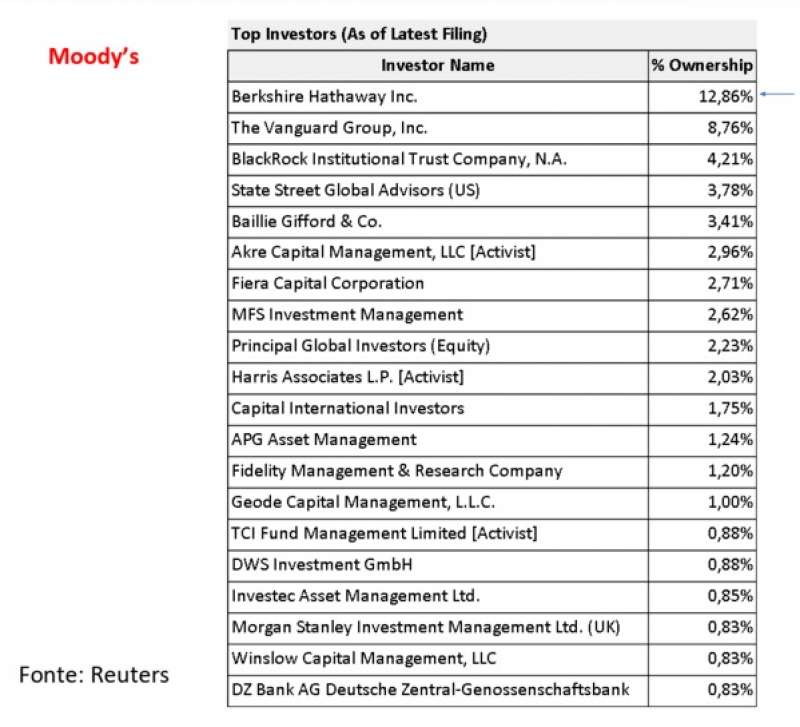
FITCH È DEL GRUPPO EDITORIALE HEARST (''COSMOPOLITAN''), MENTRE DIETRO STANDARD & POOR'S E MOODY'S CI SONO I FONDI, TRA CUI BLACKROCK, VANGUARD E BERKSHIRE (BUFFETT). CIOÈ PRIMA LE AGENZIE AMMAZZANO LA CREDIBILITÀ DEI PAESI, POI PASSANO I FONDI E SI COMPRANO A PREZZO DI SALDO GLI ASSET...

VIDEO - ''STASERA ITALIA'' DI LUNEDI' SCORSO: CHI POSSIEDE LE AGENZIE DI RATING? DIETRO CI SONO I PRINCIPALI FONDI CHE POI INVESTONO NEI PAESI COLPITI DAI GIUDIZI DI QUESTE SOCIETA'


''Stasera Italia'': chi possiede le agenzie di rating?


MOODY’S, STANDARD&POOR’S E FITCH. ECCO TUTTE LE MAGAGNE DELLE AGENZIE DI RATING
L’analisi di Mario Lettieri e Paolo Raimondi sulle agenzie di rating, pubblicata da www.startmag.it

agenzie di rating le proprietaAGENZIE DI RATING LE PROPRIETA
Arrivano le nuove pagelle delle agenzie di rating sull’Italia! 

La maggioranza dei media e tanti politici sono contenti come a Natale, sotto l’albero. Finalmente sapremo che i nostri titoli si avvicinano sempre più al livello di «spazzatura» e la cosa sembra consolare molti.
In passato, abbiamo più volte messo in guardia da queste «incursioni». Lo abbiamo fatto quando al governo c’era Silvio Berlusconi e le opposizioni usavano i rating per provare che tutto andava male. Lo abbiamo fatto quando al governo c’erano i vari governi del centrosinistra e le opposizioni sventolavano le pagelle negative. Lo facciamo anche ora con il nuovo governo e le nuove opposizioni.
I rating di Moody’s, Standard&Poor’s e Fitch non sono valutazioni fatte da enti indipendenti ed eticamente impeccabili. Le agenzie sono imprese private con base negli Usa che hanno la pretesa di giudicare le economie del resto del mondo. In America, invece, sono annualmente tenute d’occhio dalle istituzioni di controllo per scovare eventuali conflitti d’interesse e non sono per niente amate dalle autorità di governo. Il loro ruolo nefasto e corresponsabile nella Grande Crisi del 2007-8, i loro trascorsi e i legami con le grandi banche e con la finanza speculativa, non depongono bene.

agenzie di rating le proprietaAGENZIE DI RATING LE PROPRIETA
Fitch è posseduta dal colosso della comunicazione Hearst, che ha capitali e partecipazioni in centinaia di differenti business privati. Tra i suoi executive vanta dirigenti che hanno lavorato con banche e finanziarie come Merryl Linch, Lehman Brothers, Goldman Sachs, l’inglese Lloyd Bank, la Beneficial Corporation, ecc.
Moody’s Corp. ha un fatturato di 4,2 miliardi di dollari per i suoi servizi finanziari e di rating. I suoi grandi azionisti sono fondi d’investimento e grandi banche. I suoi dirigenti si sono fatti le ossa nella Federal Reserve, nella City Group, nella JP Morgan Chase, nelle multinazionali della farmaceutica e del petrolio, come l’ExxonMobil.
La S&P Global controlla anche l’omonima agenzia di rating. Prima era controllata dal conglomerato Mc Graw Hill Financial, una multinazionale dei servizi finanziari, che ha cambiato nome. I grandi azionisti sono i chiacchierati fondi d’investimento Black Rock e Vanguard. Vanta dirigenti che sono stati in posizioni di comando alla City Bank, alla JP Morgan Chase, alla banca olandese ING, al francese Credit Agricole, al Credit Suisse, e anche in grandi corporation tra cui la PepsiCo, la Lockeed Martin (tecnologia militare), ecc.
barbara palombelli stasera italiaBARBARA PALOMBELLI STASERA ITALIA
Basterebbe una veloce occhiata ai loro siti internet per farsi un’idea precisa dei tanti passaggi dal mondo della grande finanza e della speculazione a quello delle grandi corporation che dominano i mercati e viceversa. È più che opportuno, quindi, ricordare quanto detto su di loro dalle massime autorità americane.
Il documento «The financial crisis inquiry report», preparato da una Commissione bipartisan e pubblicato dal governo americano nel 2011, evidenzia in oltre 650 dettagliatissime pagine le nefandezze perpetrate prima e durante la Grande Crisi finanziaria del 2007-8.
ratingRATING
Così sintetizza: «Noi affermiamo che i fallimenti delle agenzie di rating sono stati delle cause essenziali della distruzione finanziaria. Le tre agenzie sono state le provocatrici chiave del meltdown finanziario. I titoli legati alle ipoteche immobiliari, centrali nello scatenamento della crisi, non potevano essere valutati e venduti senza il marchio di approvazione delle agenzie. Gli investitori, spesso in modo cieco, hanno fatto affidamento sui loro rating. In alcuni casi erano persino obbligati a comprare tali titoli, pena un aggravamento degli standard relativi alle regole sui capitali loro impostogli. La crisi non sarebbe potuta avvenire senza le dette agenzie. I loro rating, prima alle stelle e poi repentinamente abbassati, hanno mandato in tilt i mercati e le imprese».
Anche il dossier del Senato americano «Wall Street and the financial crisis: anatomy of a financial collapse», pubblicato nel 2011, sulla base di approfondite indagini e di numerose audizioni, dettaglia il ruolo centrale e nefasto delle agenzie nel provocare la Grande Crisi. Evidenzia, in particolare, il loro ruolo fraudolento nel propinare titoli taroccati dai loro rating.
agenzie ratingAGENZIE RATING
Non deve quindi sorprendere se nel 2015 solo la S&P ha pagato 1,5 miliardi di dollari di multa per simili comportamenti fraudolenti. Una sanzione monetaria molto conveniente, sia per il modesto importo, sia perché l’agenzia ha evitato che le indagini andassero più a fondo, facendo eventualmente emergere risvolti più scabrosi e penalmente perseguibili. Evidenziamo tutto ciò certo non per occultare gli evidenti problemi economici del nostro paese. Ci sembra, però, insopportabile la mancanza di critiche nei confronti delle citate agenzie private di rating, che, dopo aver contribuito grandemente a provocare la crisi finanziaria più grande della storia, di cui il mondo e l’Italia soffrono ancora, imperterrite, e riverite, proseguono a dare pagelle a tutti, governi e imprese.
agenzie di rating moodysAGENZIE DI RATING MOODYS
Se i loro rating fossero degli esercizi innocui di dispensare giudizi non richiesti, si potrebbe lasciarle giocare. Purtroppo i rating sono presi in considerazione dai mercati per giudicare le varie economie nazionali e, di conseguenza, per definire anche i tassi d’interesse sul debito pubblico. Si rammenti, inoltre, che la Bce li usa per definire l’affidabilità delle obbligazioni pubbliche dei paesi membri dell’Ue e per decidere se accettare o no tali titoli in garanzia per operazioni di credito e di finanziamento.Ciò, in verità, ci sembra una cosa del tutto «indigesta». Fonte: qui
TRIPLA A RATING STANDARD POORTRIPLA A RATING STANDARD POOR
(Articolo pubblicato su Italia Oggi)
BlackRockBLACKROCK