9 dicembre forconi: Florida
Visualizzazione post con etichetta Florida. Mostra tutti i post

martedì 9 ottobre 2018

L’ALABAMA, DOPO LA FLORIDA, HA DICHIARATO LO STATO DI EMERGENZA PER L’URAGANO MICHAEL CHE SI STA RAFFORZANDO


DOVREBBE COLPIRE LA PUNTA MERIDIONALE DELLO STATO MERCOLEDÌ, PORTANDO SINO A 30 CENTIMETRI DI PIOGGIA E ALZANDO IL LIVELLO DEL MARE DI 3,7 METRI


uragano michael 13URAGANO MICHAEL
Anche l’Alabama, dopo la Florida, ha dichiarato lo stato di emergenza per Michael, l’uragano che si sta rafforzando e che dovrebbe colpire la punta meridionale della Florida mercoledì, portando sino a 30 centimetri di pioggia e alzando il livello del mare di 3,7 metri.

Le forti piogge e le inondazioni nel weekend hanno già causato 13 morti nell’America centrale. 

Lo stato di allerta riguarda tutta la costa del Golfo del Messico, da Tampa, in Florida, fino a New Orleans, in Louisiana, per l’uragano che è atteso sul suolo americano a partire dalla zona di Panhandle, ovvero il nord ovest della Florida, con una categoria 3.  
uragano michael 6URAGANO MICHAEL 


Il governatore della Florida Rick Scott ha allertato la guardia nazionale che ha già 1250 uomini sul posto e 4mila a disposizione. Scott ha anche ordinato l’evacuazione degli abitanti della costa dichiarando lo stato di emergenza in 35 contee.

uragano michael 3URAGANO MICHAEL 

Michael si prepara a essere la più grave tempesta degli ultimi 15 anni a colpire la regione. Già oggi i venti potrebbero toccare i 160 km all’ora.  

Fonte: qui
uragano michael 2URAGANO MICHAEL 

mercoledì 5 settembre 2018

DUE SACERDOTI ARRESTATI A MIAMI PER ATTI OSCENI IN LUOGO PUBBLICO

UNO DEI DUE È STATO ACCUSATO ANCHE DI ESPOSIZIONE INDECENTE: ERA COMPLETAMENTE NUDO MENTRE STAVA...


diego berrio 1DIEGO BERRIO
Sono stati sorpresi a fare sesso in una macchina in sosta in un parcheggio di Miami Beach, in pieno giorno. Nulla di particolarmente strano, a parte gli atti osceni in luogo pubblico, se non fosse che i due focosi amanti fossero non una normale coppia ma due preti di Chicago.

edwin cortezEDWIN CORTEZ
Diego Berrio, 39 anni, ed Edwin Cortez, 30, come riporta il Mail Online, sono stati arrestati con l'accusa di comportamento osceno e lascivo. Cortez, sorpreso completamente nudo, è stato anche accusato di esposizione indecente. I due prelati intenti in un rapporto orale sono stati segnalati alla polizia da un passante. La macchina era parcheggiata vicino a un parco giochi per bambini.

il parco dove i due preti sono stati beccati a fare sessoIL PARCO DOVE I DUE PRETI SONO STATI BECCATI A FARE SESSO


La polizia arrivata sul posto ha sorpreso i due amanti in flagrante. Cortez e Berrio, che risiedono entrambi nella missione di San Juan Diego a Chicago, sono stati arrestati senza opporre resistenza. Si sono subito identificati come preti. «La loro professione è irrilevante" - ha detto il portavoce della polizia di Miami Beach - Stavano violando la legge alla luce del giorno e tutti potevano assistere a quella scena, compresi i bambini. C'è un tempo e un posto per tutto e questo certamente non era il tempo e il luogo adatto».

Fonte: qui

lunedì 27 agosto 2018

FLORIDA – UN UOMO ENTRA IN UNA PIZZERIA DI JACKSONVILLE E FA UNA STRAGE DURANTE UN TORNEO DI VIDEOGAME POI SI UCCIDE: 3 MORTI E 11 FERITI

È UNO SCONTRO TRA GANG DI STRADA RIVALI 
VIDEO: I 15 COLPI DI ARMA DA FUOCO TRASMESSI IN DIRETTA STREAMING DALLE TV LOCALI


Massimo Gaggi per il “Corriere della Sera”

Un' altra sparatoria con una strage di ragazzi in America. Stavolta a Jacksonville, nel nord della Florida, quasi al confine con la Georgia. Un uomo estrae una o più armi e spara all' interno di un locale della catena «Chicago Pizza» nel quale sono in corso le eliminatorie di una gara di videogames del torneo «Madden 19».

Nelle riprese della diretta streaming della gara, trasmesse dalle televisioni locali, si sentono circa quindici colpi d' arma da fuoco, ma probabilmente sono stati di più perché il primo bollettino della strage è di almeno quattro morti, compreso lo sparatore (che si sarebbe ucciso), e undici feriti.
DAVID KATZ, IL RAGAZZO CHE HA SPARATODAVID KATZ, IL RAGAZZO CHE HA SPARATO

Si è detto spesso in passato che i videogiochi che simulano carneficine elettroniche su uno schermo possono spingere menti deboli a traslare i comportamenti violenti nella realtà, ma al momento in cui scriviamo, con la polizia che sta ancora perlustrando il luogo della sparatoria per individuare eventuali complici (ma pare escluso che ce ne siano) e liberare le persone che si sono nascoste durante l' attacco, non vi è ancora alcuna certezza sulla dinamica del massacro e sui suoi motivi.

sparatoria jacksonville 1SPARATORIA JACKSONVILLE 


La pista più accreditata è quella della battaglia tra gang rivali, visto che Jacksonville è una città caldissima su questo fronte e che già due giorni prima, venerdì sera, c' era stata una sparatoria con un morto e due feriti tra bande in guerra tra loro alla fine di una partita di football americano tra due squadre di liceali. Le vittime, tra i 16 e i 19 anni, sono legati a street gang cittadine che da tempo si danno battaglia.
sparatoria jacksonville 3SPARATORIA JACKSONVILLE

ELI CLAYTON, UNA DELLE VITTIMEELI CLAYTON, UNA DELLE VITTIME


Né si tratta di un problema recente: le partite dei Riners contro la squadra dei Lee erano state già luogo di sparatorie: tre volte nel 2017 e una volta nel 2016. E il sindaco della città, Lenny Curry, aveva messo sotto accusa, per la nuova esplosione di violenza, la cultura delle armi che si va diffondendo. E aveva invitato tutti a una tregua. Non immaginava certo che la domenica sarebbe stata funestata da un vero e proprio massacro.

Una scena sulla quale sono arrivati per primi non i poliziotti, ma i pompieri che erano impegnati in esercitazioni domenicali a pochi isolati di distanza. Allertati dai ragazzi terrorizzati, in fuga, sono accorsi e hanno subito evacuato i feriti.

Il luogo della sparatoria, Jacksonville Landing, è un' area di ristoranti e locali sul lungofiume del St Johns River: uno dei posti preferiti per passare il tempo libero, in una calda giornata di sole, in questa turbolenta città della Florida. 

Fonte: qui

martedì 15 maggio 2018

VIDEO: NEGLI USA UN AGENTE SALVA LA VITA DI UN BIMBO DI 3 MESI CHE AVEVA SMESSO DI RESPIRARE

LA MAMMA ERA ALLA GUIDA QUANDO IL PICCOLO HA UNA CRISI RESPIRATORIA 

IL POLIZIOTTO FUORI SERVIZIO ENTRA IN AZIONE, FA UN MASSAGGIO CARDIACO E…

VIDEO: AGENTE SALVA LA VITA DI UN BIMBO DI 3 MESI


Francesca Bernasconi per www.ilgiornale.it

poliziotto eroe 8POLIZIOTTO EROE 
Negli Stati Uniti, un agente eroe ha salvato un bimbo di soli tre mesi, che aveva smesso di respirare.

Mercoledì pomeriggio Nechole Crowell era in macchina, sulle strade di Ocala in Florida, col suo bambino, il piccolo Kingston, quando lui ha iniziato ad avere difficoltà respiratorie.

poliziotto eroe 6POLIZIOTTO EROE 
La donna, presa dal panico, ha notato, ferma ad un incrocio, una macchina della polizia e ha svoltato nella sua direzione mettendo le quattro frecce, per segnalare l'emergenza.

Alla guida dell'auto c'era l'agente Jeremie Nix, che stava tornando a casa ed era fuori servizio, ma non ha esitato nemmeno un momento e ha fatto immediatamente inversione a u, dirigendosi verso Nechole.

poliziotto eroe 3POLIZIOTTO EROE 
Nix ha preso il piccolo in braccio e, dopo averlo adagiato sull'erba a bordo strada, gli ha praticato il massaggio cardiaco, mentre la mamma, secondo quanto riportato dal Messaggero, lo implorava: "Non lasciare che mio figlio muoia".

Tutta la scena è stata ripresa dalla dashcam, la videocamera posizionata sull'auto del poliziotto.

poliziotto eroe 5POLIZIOTTO EROE 


L'intervento di Jeremy, però, non è stato sufficiente a risolvere la situazione e l'agente ha caricato in macchina il piccolo, scortandolo fino all'ospedale Regional Medical Center, che aveva nel frattempo avvisato, nel corso del breve tragitto.

I medici, che hanno stabilizzato le condizioni di Kingston, hanno ammesso che la tempestività dell'agente si è rivelata fondamentale per la salvezza del bambino, che ora si sta riprendendo completamente.
poliziotto eroe 2POLIZIOTTO EROE 


Nechole, ha ringraziato l'agente anche tramite Facebook, postando alcune foto che ritraggono Nix e il figlio e raccontando la vicenda, perché vuole "che il mondo sappia quanto è stato grande questo agente", che mentre cercava di rianimare il bimbo aveva anche la forza di rassicurare la mamma, dicendole di non preoccuparsi, "non me ne andrò finché non ti avrò aiutata a salvarlo".

Fonte: qui

giovedì 15 febbraio 2018

SPARI IN UN LICEO DELLA FLORIDA - "ALMENO 17 MORTI E DECINE FERITI"

PRESO IL KILLER: SI TRATTA DI UN 18ENNE, EX STUDENTE DELLA SCUOLA, DESCRITTO COME "UN RAGAZZO DIFFICILE"


Usa, sparatoria in una scuola in Florida: almeno 17 morti e decine di feriti 

Sparatoria in una scuola superiore di Parkland, in Florida: ci sarebbero almeno 17 morti e decine di feriti. Ad aprire il fuoco, imbracciando un fucile da assalto, è stato un ex studente, Nicholas Cruz, espulso dalla scuola per motivi disciplinari. Dopo un'iniziale fuga, il ragazzo è stato fermato ed arrestato.
L'allarme alla Marjory Stoneman Douglas High School è scattato attorno alle 15.15, le 20.15 in Italia. Gli studenti dell'istituto, circa 3mila, sono stati evacuati.
Stando al racconto di alcuni testimoni tra le vittime ci sarebbe anche una professoressa che avrebbe protetto con il proprio corpo uno studente. In una conferenza stampa, lo sceriffo della contea ha confermato il bilancio di 17 vittime: dodici sono state uccise all'interno della scuola, tre all'esterno del fabbricato e due sono decedute in ospedale.
Lettore video di: Corriere Tv (Informativa sulla privacy)

Chi è il 18enne che ha aperto il fuoco - Il giovane arrestato sarebbe Nicholas Cruz, un ex studente di 18 anni, descritto come "ragazzo difficile". Alcuni testimoni hanno riferito che aveva aperto il fuoco mentre indossava una maschera a gas. Poi è emerso che aveva avuto contatti tramite i social media con diversi gruppi legati alle armi e che ha partecipato a diverse chatroom su YouTube sulla produzione di bombe, secondo Fox.
Trump: "Nessuno dovrebbe sentirsi insicuro a scuola" - "Nessun bambino, nessun insegnante o qualunque altra persona dovrebbe mai sentirsi insicuro in una scuola americana", ha twittato Donald Trump, esprimendo le sue condoglianze alle vittime "della terribile sparatoria in Florida". 
trump tweet
TRUMP TWEET

Da inizio anno 19 le scuole Usa in cui si è sparato - Con quella di queste ore in Florida sono almeno 19 le scuole americane in cui dall'inizio dell'anno si è verificata una sparatoria. I dati sono quelli di Everytown For Gun Safety, associazione che si batte per un maggior controllo sulla vendita delle armi da fuoco. L'episodio più grave finora era stato quello del 23 gennaio quando uno studente di 15 anni in un liceo del Kentucky uccise altri due studenti e ne ferì altri 20.
Fonte: qui


giovedì 7 dicembre 2017

This Time Is Different, It Just Ends The Same

This past weekend, I was in Florida with Chris Martenson and Nomi Prins discussing the current backdrop of the markets, economic cycles, and future outcomes. A bulk of the conversations centered around the current “everything bubble” that currently exists globally. Elevated valuations in stock prices, extremely low yields between in “junk bonds,” or intense speculation around “cryptocurrencies” all suggest we have entered once again into “bubble” territory.”
Let me state this:
“Market bubbles have NOTHING to do with valuations or fundamentals.”
Hold on…don’t start screaming “heretic” and building gallows just yet. Let me explain.
Stock market bubbles are driven by speculation, greed, and emotional biases – therefore valuations and fundamentals are simply a reflection of those emotions.
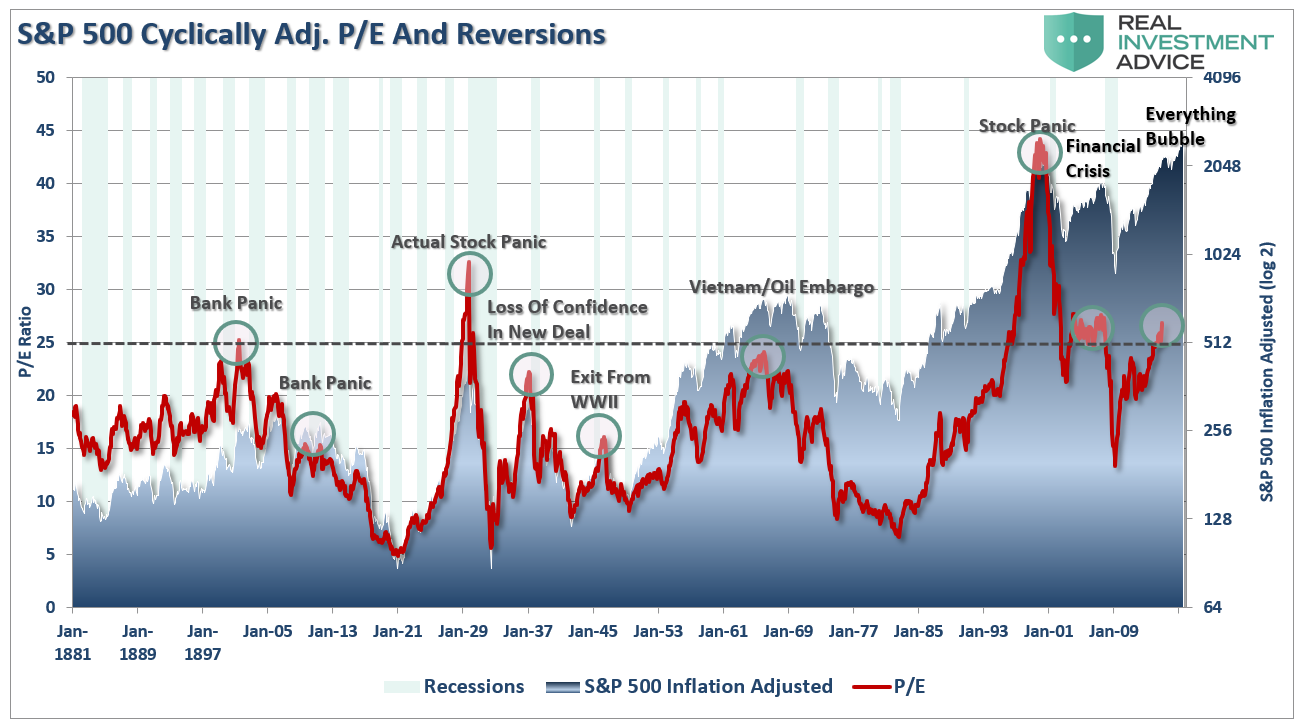
In other words, bubbles can exist even at times when valuations and fundamentals might argue otherwise. Let me show you a very basic example of what I mean. The chart below is the long-term valuation of the S&P 500 going back to 1871.
First, it is important to notice that with the exception of only 1929, 2000 and 2007, every other major market crash occurred with valuations at levels LOWER than they are currently. Secondly, all of these crashes have been the result of things unrelated to valuation levels such as liquidity issues, government actions, monetary policy mistakes, recessions or inflationary spikes. However, those events were only a catalyst, or trigger, that started the “panic for the exits” by investors.
Market crashes are an “emotionally” driven imbalance in supply and demand. You will commonly hear that “for every buyer, there must be a seller.” This is absolutely true. The issue becomes at “what price.” What moves prices up and down, in a normal market environment, is the price level at which a buyer and seller complete a transaction.
In a market crash, however, the number of people wanting to “sell” vastly overwhelms the number of people willing to “buy.” It is at these moments that prices drop precipitously as “sellers” drop the levels at which they are willing to dump their shares in a desperate attempt to find a “buyer.” This has nothing to do with fundamentals. It is strictly an emotional panic which is ultimately reflected by a sharp devaluation in market fundamentals.
Bob Bronson once penned:
“It can be most reasonably assumed that market are sufficient enough that every bubble is significantly different than the previous one, and even all earlier bubbles. In fact, it’s to be expected that a new bubble will always be different than the previous one(s) since investors will only bid up prices to extreme overvaluation levels if they are sure it is not repeating what led to the last, or previous bubbles. Comparing the current extreme overvaluation to the dotcom is intellectually silly.

I would argue that when comparisons to previous bubbles become most popular – like now – it’s a reliable timing marker of the top in a current bubble. As an analogy, no matter how thoroughly a fatal car crash is studied, there will still be other fatal car crashes in the future, even if the previous accident-causing mistakes are avoided.”
He is absolutely right. Comparing the current market bubble to any previous market bubble is rather pointless. Financial markets have already studied and adapted to the causes of the previous “fatal crashes” but this won’t prevent the next one.
I previously discussed George Soros’ theory on bubbles which is worth reviewing at this juncture:
“First, financial markets, far from accurately reflecting all the available knowledge, always provide a distorted view of reality. The degree of distortion may vary from time to time. Sometimes it’s quite insignificant, at other times it is quite pronounced. When there is a significant divergence between market prices and the underlying reality the markets are far from equilibrium conditions.

Every bubble has two components:
  1. An underlying trend that prevails in reality, and; 
  2. A misconception relating to that trend.

When a positive feedback develops between the trend and the misconception, a boom-bust process is set in motion. The process is liable to be tested by negative feedback along the way, and if it is strong enough to survive these tests, both the trend and the misconception will be reinforced. Eventually, market expectations become so far removed from reality that people are forced to recognize that a misconception is involved. A twilight period ensues during which doubts grow, and more people lose faith, but the prevailing trend is sustained by inertia.

As Chuck Prince, former head of Citigroup, said, ‘As long as the music is playing, you’ve got to get up and dance. We are still dancing.’ Eventually, a tipping point is reached when the trend is reversed; it then becomes self-reinforcing in the opposite direction.”
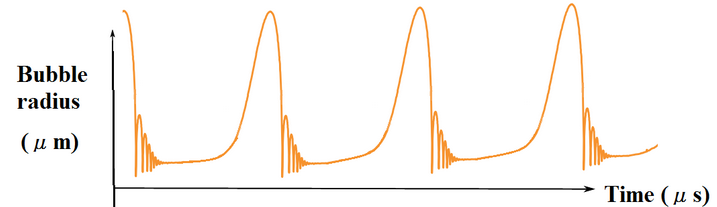
Typically bubbles have an asymmetric shape. The boom is long and slow to start. It accelerates gradually until it flattens out again during the twilight period. The bust is short and steep because it involves the forced liquidation of unsound positions.
The chart below is an example of asymmetric bubbles.
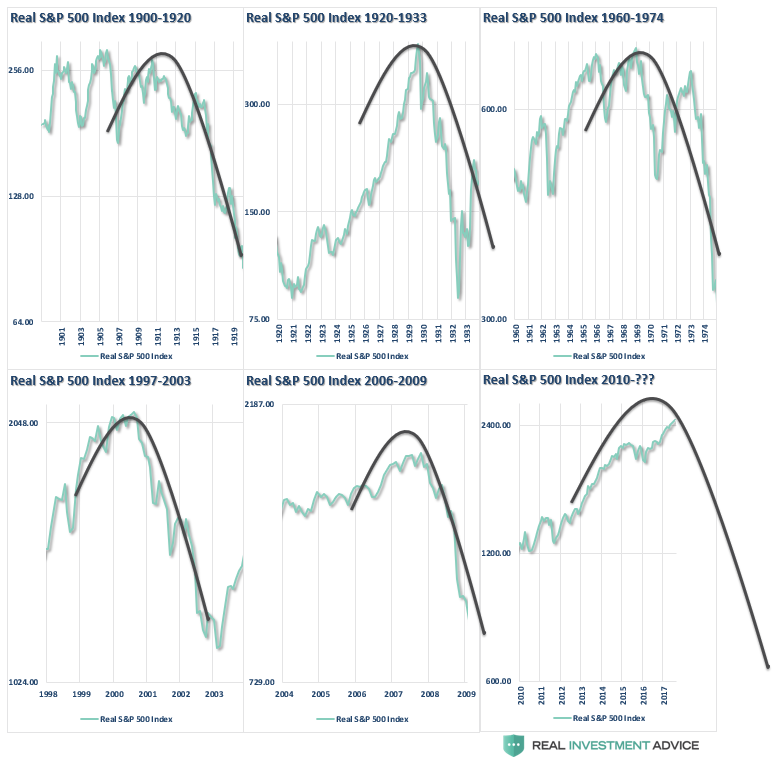
The pattern of bubbles is interesting because it changes the argument from a fundamental view to a technical view. Prices reflect the psychology of the market which can create a feedback loop between the markets and fundamentals.
This pattern of bubbles can be clearly seen at every bull market peak in history. The chart below utilizes Dr. Robert Shiller’s stock market data going back to 1900 on an inflation-adjusted basis with an overlay of the asymmetrical bubble shape.
There is currently a strong belief that the financial markets are not in a bubble. The arguments supporting those beliefs are all based on comparisons to past market bubbles.
The inherent problem with much of the mainstream analysis is that it assumes everything remains status quo. However, the question becomes what can go wrong for the market?
In a word, “much.”
Economic growth remains very elusive, corporate profits appear to have peaked, and there is an overwhelming complacency with regards to risk. Those ingredients combined with an extraction of liquidity by the Federal Reserve leaves the markets more vulnerable to an exogenous event than currently believed.
It is likely that in a world where there is virtually “no fear” of a market correction, an overwhelming sense of “urgency” to be invested and a continual drone of “bullish chatter;” markets are poised for the unexpected, unanticipated and inevitable reversion.
As Chris Martenson recently penned:
“I hate to break it to you, but chances are you’re just not prepared for what’s coming.

These bubbles – blown by central bankers serially addicted to creating them (and then riding to the rescue to fix them) – are the largest in all of history. That means they’re going to be the most destructive in history when they finally let go.

Millions of households will lose trillions of dollars in net worth. Jobs will evaporate, causing the tens of millions of families living paycheck to paycheck serious harm.

These are the kind of painful consequences central bank follies result in. They’re particularly regrettable because they could have been completely avoided if only we’d taken our medicine during the last crisis back in 2008.  But we didn’t. We let the Federal Reserve –the institution largely responsible for creating the Great Financial Crisis — conspire with its brethren central banks to ‘paper over’ our problems.
So now we are at the apex of the most incredible nest of financial bubbles in all of human history.”
I am not trying to scare the “bejeebers” out of you, but he is right.
“All financial assets are just claims on real wealth, not actual wealth itself.  A pile of money has use and utility because you can buy stuff with it.  But real wealth is the “stuff” — food, clothes, land, oil, and so forth.  If you couldn’t buy anything with your money/stocks/bonds, their worth would revert to the value of the paper they’re printed on (if you’re lucky enough to hold an actual certificate). It’s that simple.

But trouble begins when the system gets seriously out of whack.

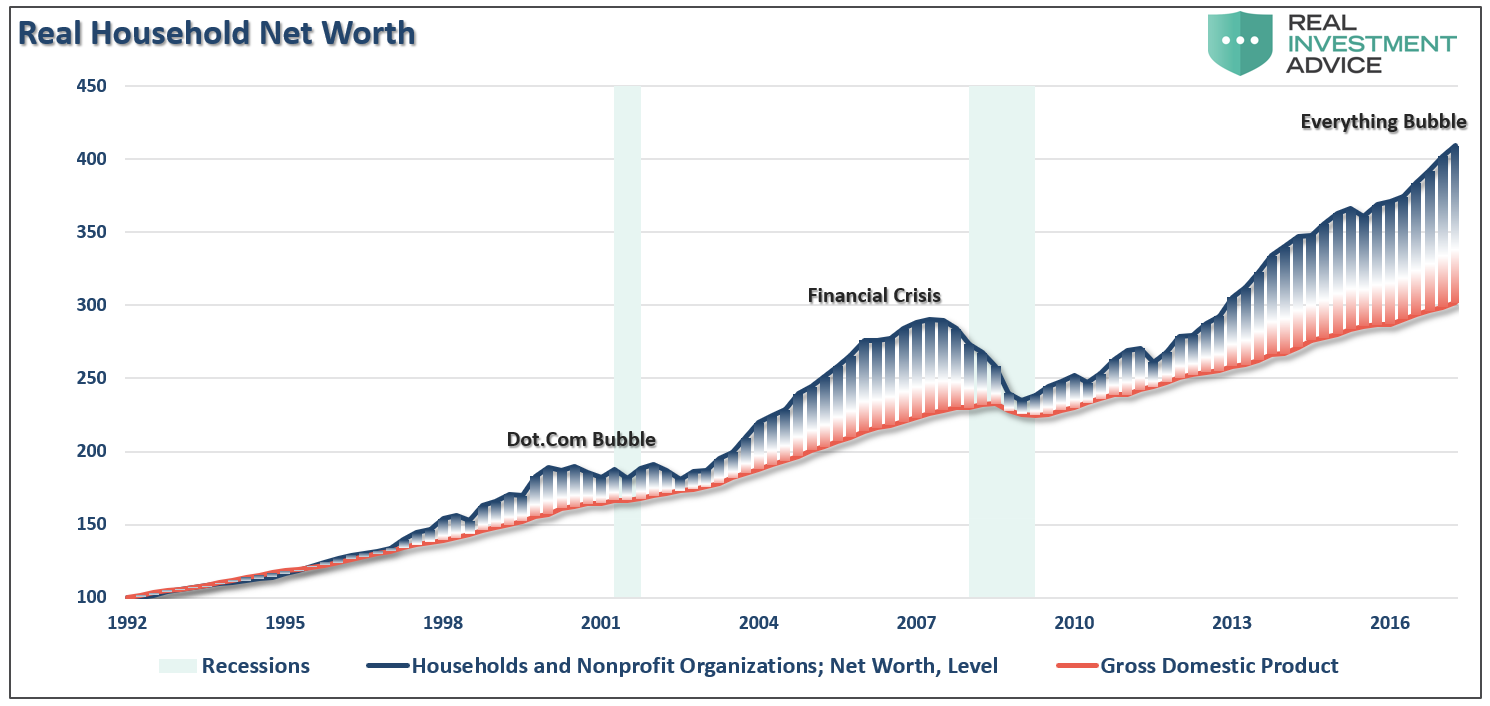
‘GDP’ is a measure of the number of goods and services available and financial asset prices represent the claims (it’s not a very accurate measure of real wealth, but it’s the best one we’ve got, so we’ll use it). Look at how divergent asset prices get from GDP as bubbles develop.
“What we see in the above chart is that the claims on the economy should, quite intuitively, track the economy itself.  Bubbles occurred whenever the claims on the economy, the so-called financial assets (stocks, bonds, and derivatives), get too far ahead of the economy itself.

This is a very important point. The claims on the economy are just that: claims.  They are not the economy itself!”
Take a step back from the media, and Wall Street commentary, for a moment and make an honest assessment of the financial markets today. If our job is to “bet” when the “odds” of winning are in our favor, then exactly how “strong” is the fundamental hand you are currently betting on?
This “time IS different” only from the standpoint that the variables are not exactly the same as they have been previously. Of course, they never are, and the result will be “…the same as it ever was.”