9 dicembre forconi

sabato 1 dicembre 2018

This Is How The "Everything Bubble" Will End

I think there’s a very high chance of a stock market crash of historic proportions before the end of Trump’s first term.
That’s because the Federal Reserve’s current rate-hiking cycle, which started in 2015, is set to pop “the everything bubble.”
I’ll explain how this could all play out in a moment. But first, you need to know how the Fed creates the boom-bust cycle…
To start, the Fed encourages malinvestment by suppressing interest rates lower than their natural levels. This leads companies to invest in plants, equipment, and other capital assets that only appear profitable because borrowing money is cheap.
This, in turn, leads to misallocated capital – and eventually, economic loss when interest rates rise, making previously economic investments uneconomic.
Think of this dynamic like a variable rate mortgage. Artificially low interest rates encourage individual home buyers to take out mortgages. If interest rates stay low, they can make the payments and maintain the illusion of solvency.
But once interest rates rise, the mortgage interest payments adjust higher, making them less and less affordable until, eventually, the borrower defaults.
In short, bubbles are inflated when easy money from low interest rates floods into a certain asset.
Rate hikes do the opposite. They suck money out of the economy and pop the bubbles created from low rates.

It Almost Always Ends in a Crisis

Almost every Fed rate-hiking cycle ends in a crisis. Sometimes it starts abroad, but it always filters back to U.S. markets.
Specifically, 16 of the last 19 times the Fed started a series of interest rate hikes, some sort of crisis that tanked the stock market followed. That’s around 84% of the time.
You can see some of the more prominent examples in the chart below.
Let’s walk through a few of the major crises…
• 1929 Wall Street Crash
Throughout the 1920s, the Federal Reserve’s easy money policies helped create an enormous stock market bubble.
In August 1929, the Fed raised interest rates and effectively ended the easy credit.
Only a few months later, the bubble burst on Black Tuesday. The Dow lost over 12% that day. It was the most devastating stock market crash in the U.S. up to that point. It also signaled the beginning of the Great Depression.
Between 1929 and 1932, the stock market went on to lose 86% of its value.
• 1987 Stock Market Crash
In February 1987, the Fed decided to tighten by withdrawing liquidity from the market. This pushed interest rates up.
They continued to tighten until the “Black Monday” crash in October of that year, when the S&P 500 lost 33% of its value.
At that point, the Fed quickly reversed its course and started easing again. It was the Chairman of the Federal Reserve Alan Greenspan’s first – but not last – bungled attempt to raise interest rates.
• Asia Crisis and LTCM Collapse
A similar pattern played out in the mid-1990s. Emerging markets – which had borrowed from foreigners during a period of relatively low interest rates – found themselves in big trouble once Greenspan’s Fed started to raise rates.
This time, the crisis started in Asia, spread to Russia, and then finally hit the U.S., where markets fell over 20%.
Long-Term Capital Management (LTCM) was a large U.S. hedge fund. It had borrowed heavily to invest in Russia and the affected Asian countries. It soon found itself insolvent. For the Fed, however, its size meant the fund was “too big to fail.” Eventually, LTCM was bailed out.
• Tech Bubble
Greenspan’s next rate-hike cycle helped to puncture the tech bubble (which he’d helped inflate with easy money). After the tech bubble burst, the S&P 500 was cut in half.
• Subprime Meltdown and the 2008 Financial Crisis
The end of the tech bubble caused an economic downturn. Alan Greenspan’s Fed responded by dramatically lowering interest rates. This new, easy money ended up flowing into the housing market.
Then in 2004, the Fed embarked on another rate-hiking cycle. The higher interest rates made it impossible for many Americans to service their mortgage debts. Mortgage debts were widely securitized and sold to large financial institutions.
When the underlying mortgages started to go south, so did these mortgage-backed securities, and so did the financial institutions that held them.
It created a cascading crisis that nearly collapsed the global financial system. The S&P 500 fell by over 56%.
• 2018: The “Everything Bubble”
I think another crisis is imminent…
As you probably know, the Fed responded to the 2008 financial crisis with unprecedented amounts of easy money.
Think of the trillions of dollars in money printing programs – euphemistically called quantitative easing (QE) 1, 2, and 3.
At the same time, the Fed effectively took interest rates to zero, the lowest they’ve been in the entire history of the U.S.
Allegedly, the Fed did this all to save the economy. In reality, it has created enormous and unprecedented economic distortions and misallocations of capital. And it’s all going to be flushed out.
In other words, the Fed’s response to the last crisis sowed the seeds for an even bigger crisis.
The trillions of dollars the Fed “printed” created not just a housing bubble or a tech bubble, but an “everything bubble.”
The Fed took interest rates to zero in 2008. It held them there until December 2015 – nearly seven years.
For perspective, the Fed inflated the housing bubble with about two years of 1% interest rates. So it’s hard to fathom how much it distorted the economy with seven years of 0% interest rates.

The Fed Will Pop This Bubble, Too

Since December 2015, the Fed has been steadily raising rates, roughly 0.25% per quarter.
I think this rate-hike cycle is going to pop the “everything bubble.” And I see multiple warning signs that this pop is imminent.
• Warning Sign No. 1 – Emerging Markets Are Flashing Red
Earlier this year, the Turkish lira lost over 40% of its value. The Argentine peso tanked a similar amount.
These currency crises could foreshadow a coming crisis in the U.S., much in the same way the Asian financial crisis/Russian debt default did in the late 1990s.
• Warning Sign No. 2 – Unsustainable Economic Expansion
Trillions of dollars in easy money have fueled the second-longest economic expansion in U.S. history, as measured by GDP. If it’s sustained until July 2019, it will become the longest in U.S. history.
In other words, by historical standards, the current economic expansion will likely end before the next presidential election.
• Warning Sign No. 3 – The Longest Bull Market Yet
Earlier this year, the U.S. stock market broke the all-time record for the longest bull market in history. The market has been rising for nearly a decade straight without a 20% correction.
Meanwhile, stock market valuations are nearing their highest levels in all of history.
The S&P 500’s CAPE ratio, for example, is now the second-highest it’s ever been. (A high CAPE ratio means stocks are expensive.) The only time it was higher was right before the tech bubble burst.
Every time stock valuations have approached these nosebleed levels, a major crash has followed.

Preparing for the Pop

The U.S. economy and stock market are overdue for a recession and correction by any historical standard, regardless of what the Fed does.
But when you add in the Fed’s current rate-hiking cycle – the same catalyst for previous bubble pops – the likelihood of a stock market crash of historic proportions, before the end of Trump’s first term, is very high.
That’s why investors should prepare now. One way to do that is by shorting the market. That means betting the market will fall.
Keep in mind, I’m not in the habit of making “doomsday” predictions. Simply put, the Fed has warped the economy far more drastically than it did in the 1920s, during the tech or housing bubbles, or during any other period in history.
I expect the resulting stock market crash to be that much bigger.
Authored by Nick Giambruno via InternationalMan.com


The Cracks Appear: A Record $90 Billion A-Rated Bonds Downgraded To BBB In Q4

Having written about it for over a year, it sometimes feels like the topic of "fallen angel" bonds, and the danger they present to the broader credit market and overall economy has been beaten to death (see most recently"The $6.4 Trillion Question: How Many BBB Bonds Are About To Be Downgraded").
But what if the market is focusing on the wrong tier when it comes to the upcoming downgrade deluge? What if instead of BBB credits, whose downgrade risk is, or should be, largely priced in by now (although the recent plunges in GE and PG&E bonds put this assumption to doubt) the real risk is just above the pre-fallen angel tier?
That's the point made by Goldman Sachs overnight, which argues that while some of the "BBB risks" warrant close monitoring, the bank's credit analysts "continue to struggle to see any recent developments that would make BBB-rated bonds a canary in a coal mine." To support their claim that BBB is not the time bomb many others claim it is, Goldman shows that BBB spreads have moved largely in line with their A-rated peers, while demonstrating that BBB bonds have not been an outsized source of weakness in IG.
The bank's assessment is that in the absence of a full-blown recession, downgrade risk among BBB-rated issuers is likely to remain  contained to structurally and cyclically challenged sectors and firms. As a result, Goldman's credit analysts view the risks as most pronounced in sectors including Food and Beverage, Retail/Consumer, and Autos. Meanwhile, they see value in other BBB-heavy  sectors such as Banks and Telecom.
In any case, the bottom line is that according to Goldman at least, investors should not be worried about BBB (that said, on Nov 1 Goldman told clients to buy oil; what followed next was the worst month for oil in 10 years).
So if not BBB, then where is the biggest credit risk in the investment grade space?
According to Goldman, the more pronounced risk facing IG investors, is a wave of downgrades among firms rated A and AA.
In our view, these companies are more likely to use their debt capacity for shareholder returns and/or M&A to diversify their businesses. In contrast, firms at the cusp of HY ratings should be inclined to manage their balance sheets more conservatively.
Is Goldman right this time? Who knows, but recent rating actions suggest that the bank may have a point: in the fourth quarter alone, a record $90 billion worth of "pre-fallen angel" were downgraded to BBB from A, and Goldman adds that the risk "remains skewed towards further negative actions."
But while rating agencies are clearly adding to the pre-fallen angel camp, there is no denying that the big threat is what happens if and when the BBB downgrade deluge begins. As Deutsche Bank calculated last week, when looking at those bonds most at risk of getting junked, $150bn of the $736bn of BBB- bonds are currently on negative watch/outlook with at least one rating agency, and in danger of imminent "junking."
And while Goldman remains clearly complacent about the BBB space at least until a recession hits, as Deutsche Bank warned last week, even before we get to an economic slowdown - some time in 2020 - or even before the market start pricing the slowdown in, "it feels like the tide might be turning and we start to see fallen angels outpace rising stars over the next year."

So there you have it: for those who believe a recession is either imminent or will soon be priced in, keep shorting the BBB space. Meanwhile, those who think it will take some more time before the rating agencies filter out the noise, the best place to be short is those "pre-fallen" A bonds who will first become BBBs, before they too join the deluge into the junk space some time around late 2019/early 2020.
Fonte: qui

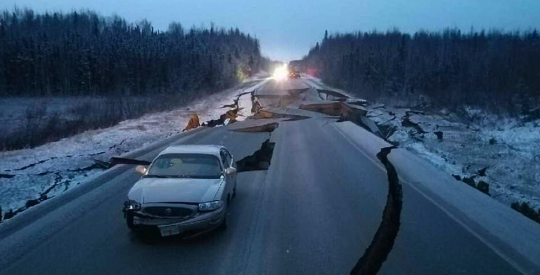
Alaska, terremoto di magnitudo 7.0. Distrutte strade e reti elettriche

La scossa alle 8,28 ora locale con epicentro a 13 chilometri dalla capitale Anchorage. Chiusa la Trans Alaska Pipeline

Un potente sisma magnitudo 7.0 ha scosso Anchorage, in Alaska, venerdì danneggiando case, palazzi e distruggendo strade e reti elettriche. La scossa è stata rilevata alle 8:28 ora locale. Il Servizio geologico Usa ha detto che l'epicentro era a circa 13 chilometri a nord della città e a 40 chilometri di profondità.


La polizia di Anchorage, che ha circa 300.000 abitanti, ha segnalato "danni ingenti alle infrastrutture" mentre le immagini e i video pubblicati sui media e sui social descrivono i momenti di panico vissuti dai residenti mentre la terra tremava con forza. "Molte case ed edifici sono stati danneggiati - ha fatto sapere il dipartimento di polizia in una nota - molte strade e ponti sono stati chiusi".

Terremoto di magnitudo 7,0 Anchorage, Alaska, Stati Uniti, 14 km dall'epicentro

Non si hanno per ora notizie di feriti gravi o di vittime. Anche l'iniziale allerta tsunami è rientrata. Almeno 10.000 utenti sono ancora senza elettricità in una città incredibilmente buia e fredda in questa stagione."Ho preso mio figlio di due anni che stava dormendo e ci siamo riparati sotto il tavolo della sala da pranzo. I pensili della cucina si sono staccati. Anche il lampadario è venuto giù ma noi stiamo bene. Mia moglie era in ufficio. Anche lei sta bene ma la casa è stata devastata", ha raccontato Karl Heidigi.


"Io sono sono abituato alle situazioni di pericolo, vado a caccia, a pesca, possiedo armi ma è stato terrificante. Ho avuto meno paura quando mi sono trovato faccia a faccia con un orso a Burrow, sul tetto del mondo. Ora ci siamo trasferiti a casa di un conoscente. La gente in Alaska è molto solidale. Vivendo in condizioni climatiche estreme siamo sempre pronti ad aiutarci".

Le scuole, l'università e l'aeroporto di Anchorage sono stati chiusi. I collegamenti aerei, interrotti per qualche ora, sono ripresi. La Trans Alaska Pipeline, condotta lunga 1.280 chilometri che collega Prudhoe Bay con il porto di Valdez e che è una delle principali arterie del petrolio statunitense, è stata chiusa per precauzione. Il presidente Donald Trump, in Argentina per il G20, è stato aggiornato sulla situazione ed assicurato che "il governo federale non baderà a spese" per aiutare la popolazione dell'Alaska.

Fonte: qui

Usa, terremoto di magnitudo 7.0 sconvolge l'Alaska. 


Trump dichiara lo stato d'emergenza


Le scosse sono state avvertite nel sud dello stato americano, vicino alla città di Anchorage, il centro più popoloso. 

Nella stessa zona, nel 1964, un episodio simile aveva ucciso 130 persone

Ha fatto crollare tratti di strada e ha danneggiato diversi edifici. Ma è dai social network e dalla televisione che sono arrivate le immagini più rilevanti, degli interni delle case e dei supermercati, dove mensole e ripiani sono finiti per terra dopo le forti scosse di terremoto che hanno sconvolto il sud dell'Alaska.


Secondo i dati pubblicati da USGS, il terremoto si sarebbe verificato alle 8.29, ora locale, a 41 chilometri di profondità. E sarebbe stato seguito da dozzine di scosse di assestamento, durate tutta la giornata di ieri. La violenta attività sismica, avrebbe spinto le autorità americane a lanciare un allarme tsunami nella zona, revocato dopo poche ore.
È stato un sisma di magnitudo 7.0 della scala Richter quello che hanno avvertito i cittadini di Anchorage, la città principale dello Stato americano, già abituato ai terremoti. L'epicentro è stato registrato a soli 13 chilometri a nord del capoluogo, dove vivono circa 300mila persone. "C'è stato un forte boato quando è successo, era chiaro che fosse qualcosa di molto più forte del solito", ha spiegato il sindaco della città alla Cnn.

Le raccomandazioni delle forze dell'ordine

Il sisma non ha ucciso nessuno ma ha provocato diversi feriti, tra cui uno grave. La polizia municipale ha ricevuto numerose segnalazioni per "danni significativi alle infrastrutture". "Molte case ed edifici sono stati danneggiati. Molte strade e ponti sono tagliati. Non mettetevi in viaggio, se potete evitarlo", ha raccomandato la polizia della città. Che, però, in poche ore, ha annunciato la riapertura di alcune strade principali.

Dichiarato lo stato d'emergenza

Donald Trump, intanto, in queste ore, ha dichiarato lo stato d'emergenza per l'Alaska, sbloccando gli aiuti federali. A renderlo noto è stata la Casa Bianca, precisando che il presidente avrebbe ordinato al dipartimento per la Sicurezza Nazionale e alla Fema (la protezione civile americana) di coordinare la distribuzione dei soccorsi.

Il precedente, nel 1964

Il 27 marzo del 1964, un terremoto di magnitudo maggiore, di 9.2, il più violento mai registrato negli Stati Uniti, aveva colpito la stessa regione. Durato diversi minuti, aveva provocato un'ondata di marea distruttiva sull'intera costa occidentale, uccidendo 130 persone. Ieri i soccorritori avevano temuto, soprattutto, la possibilità di incidenti provocati dalle linee elettriche o danneggiamenti alle forniture di gas, distrutte dal sisma.

Fonte: qui

venerdì 30 novembre 2018

I 49 FURBETTI DEL CARTELLINO INDAGATI IN SICILIA?


UNDICI PERSONE SONO STATE ARRESTATE: ECCO COME RIUSCIVANO A MANIPOLARE IL SISTEMA DELLE PRESENZE – VIDEO

Alessandro Camilli per www.blitzquotidiano.it
furbetti del cartellino in sicilia 5FURBETTI DEL CARTELLINO IN SICILIA 
Moglie gelosa aveva un rovello: e se il fedifrago mi mette le corna, quando lo fa? Il rovello a un certo punto si sposò con un sospetto, meglio con una intuizione: il tempo per mettermi le corna lo trova durante l’orario di lavoro. Impossibile? Nulla di più facile. La signora e moglie gelosa conosce il mondo dove vive: l’Italia, la Pubblica Amministrazione, Palermo, gli uffici e i dipendenti della Regione. Nulla di più facile che il tempo del lavoro fosse in realtà il tempo di tutt’altro, corna comprese.
E così la signora gelosa si rivolse alla Guardia di Finanza. Gelosa e vendicativa, la moglie tradita, non la Guardia di Finanza. Indagini, ma non c’era molto da indagare. Era evidente, si andava a colpo sicuro. Timbravano il cartellino e se ne andavano. A fare tutt’altro che lavorare. Sempre, d’abitudine. In tanti. E si aiutavano nell’impresa: se oggi non puoi o non ti va di prenderti il fastidio di timbrare e andartene, te lo timbro io e poi tu ricambi un altro giorno…
furbetti del cartellino in sicilia 4FURBETTI DEL CARTELLINO IN SICILIA 
Gli indagati sono 49, agli arresti domiciliari sono in undici. Disponibili i soliti video con quelli che strisciano il cartellino e se ne vanno. Volti oscurati a norma…a norma di qualcosa che deve essere giusto ma che indica che c’è qualcosa di falso in questa storia, in queste storie. Qualcosa di falso oltre la falsa timbratura del badge, oltre il finto rispetto dell’orario di lavoro, oltre il finto lavoro.
tradimento 1TRADIMENTO 
Di storie e cronache dei cosiddetti furbetti del cartellino ne sono ormai pieni i telegiornali e i giornali, è quasi una rubrica fissa. Quante volte? Alle cronache decine e decine. Dove? Ovunque. Da quanto tempo? Da anni e anni. Quante indagini? Una caterva. Quanti scoperti? Centinaia e centinaia.
Eppure si continua per ogni dove della Pubblica Amministrazione. Si continua a far finta di lavorare, a rubare di fatto lo stipendio, a truccare la firma del cartellino, ad amputare se non azzerare l’orario di lavoro. Si continua perché se va male, se scoperti, se indagati niente meno che arresti domiciliari.
furbetti del cartellino in sicilia 7FURBETTI DEL CARTELLINO IN SICILIA 
Durano un po’, poi passano. Dovrebbero essere una intollerabile vergogna civile, trascorrono tra la solidarietà più o meno espressa della comunità di lavoro e di quartiere, tra le frasi: una brava persona, una famiglia educata, non si rovina una famiglia per uno sbaglio…
Passati gli arresti domiciliari, più simili ad una vacanza forzata che ad una pena afflittiva, si paga sul luogo di lavoro la grave inadempienza, l’aver fatto finta di essere al lavoro, sistematicamente e in maniera organizzata? Insomma li licenziano? Solo sui giornali. Solo nei titoli dei giornali ci sono i licenziamenti. Nei titoli dei giornali e nelle dichiarazioni dei ministri competenti.
Nella realtà non li licenziano mai. Un cento approssimativo dice che in un anno di licenziamenti veri per chi truffava la Pubblica Amministrazione da dentro ce ne sono stati che non arrivano a dieci. Neanche dieci su centinaia e centinaia presi con le mani nella marmellata. Presi e ripresi dalle telecamere. A volto coperto, anzi pixellato dalle tv. Il che sarà anche omaggio alla privacy e sarà anche garanzia dovuta e attestata.
Però quel volto resi irriconoscibile annuncia che il furbetto del cartellino, una volta passato il momentaneo incidente dell’inchiesta, torna. Torna al posto di stipendio che occupava prima (parlare di posto di lavoro è parola grossa nel caso in specie) Torna, irriconoscibile tra gli altri. Torna tra gli altri.
nel tradimento parla il linguaggio del corpoNEL TRADIMENTO PARLA IL LINGUAGGIO DEL CORPO
Saranno le leggi dolci o la lenta applicazione di leggi non lasche…sarà la pigrizia prudente e in fondo complice della Pubblica Amministrazione  (se lo licenzio mi fa causa e perché proprio io dirigente devo prendermi questa rogna..?)…sarà che alla fine tutti a dire onestà, onestà, in galera, in galera ma solo fino a che non riguarda il vicino, il parente, l’amico, il collega.
furbetti del cartellino in sicilia 1FURBETTI DEL CARTELLINO IN SICILIA
Sarà quel che sarà, anzi quel che è. Ed è che nella Pubblica Amministrazione se a lavorare non ci vai, se sei assenteista di vocazione e professione lo stipendio non lo perdi praticamente mai. L’unico che ti può mettere nei guai è un partner geloso, ma sono guai che passano. Garantito. 

Eccolo cosa c’è di falso in queste storie tutte uguali, c’è di falso che imbrogliare lo Stato e il prossimo fingendo di lavorare comporti il rischio reale di essere licenziati. 

Quindi…continuano.    
Fonte: qui

PERCHE' SI E' SCHIANTATO IL BOEING NUOVO DI ZECCA DELLA LION AIR?


I DATI RECUPERATI DALLA SCATOLA NERA RIPORTANO CHE I PILOTI HANNO LOTTATO FIN DALL’INIZIO PER CONTROLLARE L’AEREO, TENENDO IN ALTO IL MUSO CHE, INVECE, PUNTAVA VERSO IL BASSO 

DIETRO ALLA TRAGEDIA POTREBBE ESSERCI UN'AVARIA AL SISTEMA AUTOMATIZZATO CHE RICEVEVA DEI DATI SBAGLIATI DAI SENSORI DI VOLO… (VIDEO)


lion air 6LION AIR

I piloti del volo Lion Air, che il mese scorso si è schiantato con 189 persone a bordo, tra cui un ragazzo italiano, lottarono quasi fin dall'inizio per controllare l'aereo. E' quanto scrive il 'New York Times', citando i dati recuperati dalla scatola nera.

I piloti tentarono più di una ventina di volte di mantenere in alto il muso dell'aereo, che invece puntava pericolosamente in basso, apparentemente a causa di un'avaria al sistema automatizzato, che riceveva dei dati sbagliati dai sensori di volo. 

lion air 4LION AIR
La Commissione nazionale dei trasporti indonesiana dovrebbe rendere pubblico in queste ore un rapporto preliminare sul disastro. Il Boeing 737 MAX 8 si è schiantato in mare a una velocità di 724 chilometri all'ora, 11 minuti dopo il decollo dall'aeroporto internazionale di Giacarta, lo scorso 29 ottobre. Tutte le 189 persone a bordo sono rimaste uccise.

LE IPOTESI Gli investigatori si stanno concentrando sul ruolo che nell'incidente potrebbe avere avuto una nuova funzionalità del Boeing, conosciuta come 'manoeuvring characteristics augmentation system' (MCAS).
lion air 3LION AIR

Il sistema è stato installato dalla Boeing sui suoi 737 di ultima generazione, per impedire che il muso dell'aereo punti troppo in alto, causando lo stallo del velivolo. Ma nell'incidente del mese scorso, scrive il Nyt, il sistema sembra aver spinto il muso del Boeing in basso, dopo aver ricevuto informazioni sbagliate dai sensori.

Fonte: qui