9 dicembre forconi: amazon
Visualizzazione post con etichetta amazon. Mostra tutti i post

lunedì 2 settembre 2019

Miliardari, Bezos e il vero grande fratello

Jeff Bezos è il proprietario del  Washington Post , che guida i media americani nel loro supporto e promozione di quasi il 100% del  neoconservatorismo,  dell'imperialismo americano e delle guerre. Ciò include sanzioni, colpi di stato e invasioni militari contro paesi che i miliardari americani vogliono controllare ma non  ancora  controllano, come Venezuela, Siria, Iran, Russia, Libia e Cina.
Queste sono guerre aggressive contro paesi che non hanno mai aggredito gli Stati Uniti. Non sono affatto difensivi, ma l'esatto contrario. Non è necessariamente una guerra senza fine (nemmeno Hitler non lo aveva pianificato), ma la guerra fino a quando l'intero pianeta non è passato sotto il controllo del governo degli Stati Uniti, un governo che è esso  stesso  controllato dai miliardari americani , i finanziatori del neoconservatorismo e  dell'imperialismo  - in entrambi principali partiti politici americani, gruppi di riflessione, giornali, reti televisive, ecc.
Bezos è stato una parte cruciale del neoconservatorismo, da quando,  all'incontro del Bilderberg del 6-9 giugno 2013 , ha organizzato con Donald Graham, il proprietario del  Washington Post ,  per acquistare quel giornale , per $ 250 milioni. Bezos aveva già negoziato, nel marzo dello stesso anno, con il neoconservatore direttore della CIA, John Brennan, per un contratto decennale di cloud computing di 600 milioni di  dollari  che trasformava la società di Amazon, da perdente in denaro, in un'azienda affidabile e redditizia.
Ciò ha portato il patrimonio netto di Bezos a salire ancora di più (e ad  un tasso di rialzo più netto ) rispetto a quanto aveva fatto mentre aveva perso denaro. È diventato il venditore più influente non solo per i libri, ma per la CIA e per le mega corporazioni come Lockheed Martin. L'imperialismo ha sovralimentato la sua ricchezza, ma non l'ha causata da sola. Bezos potrebbe essere l'uomo d'affari più ferocemente dotato del pianeta.
Alcuni miliardari americani non si preoccupano tanto della conquista internazionale quanto lui, ma tutti almeno accettano il neoconservatorismo; nessuno di loro, per esempio, stabilisce e dona grandi somme a,  anti- organizzazioni -imperialistic; nessuno dei miliardari americani è determinato a  porre fine  al regno del neoconservatorismo, né ad aiutare la lotta a porre fine a esso, o almeno a porre fine alla sua presa sul governo degli Stati Uniti. Nessuna. Neppure uno solo.
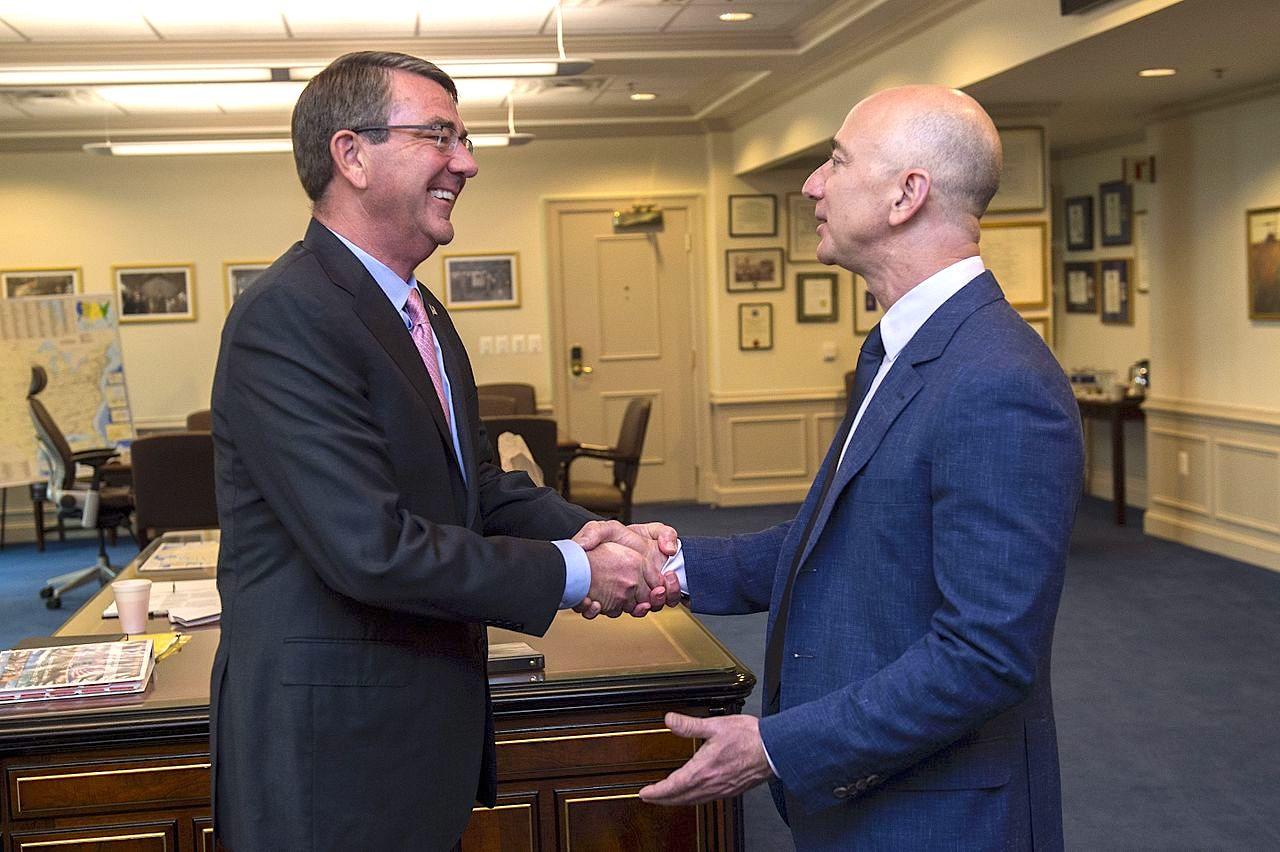
Plutocrate Bezos al Pentagono con l'allora segretario alla Difesa Ash Carter, maggio 2016. (Wikimedia Commons)
Ma molti di loro stabiliscono e donano ingenti somme a organizzazioni neoconservatrici o gestiscono organi neocon come  il Washington Post.   È così che sono i miliardari, almeno negli Stati Uniti. Tutti loro sono imperialisti. Lo sponsorizzano; lo promuovono e assumono le persone che lo fanno, e degradano o si liberano delle persone che non lo fanno. Espandere un impero è estremamente redditizio per i suoi aristocratici, ed è sempre stato, anche prima dell'Impero romano.
Bezos vuole privatizzare tutto il mondo che può diventare privatizzato, come istruzione, autostrade, assistenza sanitaria e pensioni. Più i miliardari controllano queste cose, meno lo fanno tutti gli altri; e prevenire il controllo da parte del pubblico aiuta a proteggere i miliardari dalla democrazia che aumenterebbe le loro tasse e le normative governative che ridurrebbe i loro profitti aumentando le spese delle loro corporazioni. Quindi, i miliardari  controllano il governo  al fine di aumentare le loro entrate dal pubblico.
Con l'aiuto della promozione di guerra del   Washington Post , Bezos è uno dei principali venditori personali al mondo del complesso militare-industriale degli Stati Uniti. Controlla ed è il principale investitore nella società Amazon, la cui divisione dei servizi Web fornisce tutti i servizi di cloud computing al Pentagono, alla CIA e  all'NSA . (Sta  guidando la carica anche  nella più avanzata tecnologia di riconoscimento facciale.)
Ad aprile c'era un titolo,  "CIA Considerando il contratto cloud degno di" decine di miliardi ", il  cui contratto poteva far salire la ricchezza personale di Bezos ancora più in alto nella stratosfera, specialmente se vincesse  tutto  (come aveva fatto in precedenza).
Domina anche a livello globale e aumenta costantemente il suo controllo sulla promozione e la vendita di libri e film, perché la sua Amazon è il più grande rivenditore al mondo (e ora anche uno dei maggiori editori, produttori e distributori). Anche questo può avere un enorme impatto sulla politica e sul governo, indirettamente, promuovendo le opere più neocon contribuendo a dare forma al discorso intellettuale (e ai voti degli elettori) nel paese.
Bezos sta schiacciando milioni di rivenditori per la sua brillantezza senza pari nel controllare un mercato dopo l'altro come Amazon o come intermediario essenziale per - e spesso anche un controllore - dei concorrenti al dettaglio di Amazon.
Crede fermamente nel "libero mercato", che forse ha padroneggiato meglio di chiunque altro. Ciò significa che Bezos supporta l'abilità senza limiti dei miliardari, attraverso i loro soldi, di controllare e infine assorbire tutti coloro che sono meno potenti di loro.
Poiché è così enormemente dotato di accumulare ricchezza, è stato finora in grado di raggiungere la vetta globale, essendo uno degli individui più potenti del mondo. Il più ricco di tutti è il re Salman, il proprietario dell'Arabia Saudita, la cui Aramco (la più grande compagnia petrolifera del mondo) vale da sola  oltre un trilione di dollari . ( Forbes  e  Bloomberg  escludono i monarchi dalle loro classifiche di ricchezza.)

Il presidente Donald Trump tocca il globo illuminato con il presidente egiziano Abdel Fattah al-Sisi e il re saudita Salman all'inaugurazione del Centro globale per la lotta all'ideologia estremista dell'Arabia Saudita il 21 maggio 2017. (Foto dalla TV saudita)
In effetti,  Bloomberg  è persino così fraudolento da essersi intitolato il 10 agosto,  "Le 25 dinastie più ricche del pianeta controllano $ 1,4 trilioni di dollari"  e ha violato la loro tradizione includendo nella loro lista un monarca, il re Salman, al quale si sono classificati # 4 in quanto detiene solo $ 100 milioni, una "stima" ridicolmente bassa, che sfacciatamente esclude non solo  Aramco  ma parte del patrimonio netto dell'Arabia Saudita.
Bloomberg  non ha nemmeno cercato di giustificare la loro stravagante metodologia, ma ha semplicemente presunto la creduloneria dei loro lettori per la sua accettazione. Quel re, quindi, è almeno sette volte più ricco di Bezos. Potrebbe essere potente quanto Bezos. L'erede supremo è molto più ricco di quanto lo sia il supremo miliardario o "imprenditore" fatto da sé.
Certamente, entrambi gli uomini sono tra i giganti che hanno conquistato il mondo nella nostra era. Ed entrambi gli uomini sono libertari - campioni della convinzione che i diritti di proprietà (di cui i miliardari hanno così tanto) sono la base di  tutti i  diritti, e quindi credono che le persone più ricche posseggano più diritti di tutti e che le persone più povere abbiano il minimo, e che tutte le persone il cui patrimonio netto sono  negative  (con più debiti che beni) non possiedono alcun diritto se non quello che le persone più ricche potrebbero donare o concedere loro, per gentilezza o altro (come i legami familiari).
Questo - privatizzazione di tutto - è ciò che è il libertarismo: il valore di una persona è il suo "patrimonio netto" - nient'altro. Questa convinzione è  puro  libertarismo. È una convinzione che molti, se non la maggior parte dei miliardari, detengono. I miliardari sono imperialisti perché cercano di massimizzare la libertà dei super ricchi, indipendentemente dal fatto che ciò significhi aumentare i loro introiti o, in definitiva, impoverire, tutti coloro che  non sono  super ricchi. Hanno un'ideologia coerente. Si basa sulla ricchezza. Il pubblico invece crede nei miti che i miliardari consentano di essere promulgati.
Come ogni miliardario, Bezos assume e mantiene dipendenti e altri agenti che fanno ciò che lui vuole che facciano. Questo è il loro potere diretto . Ma i miliardari possiedono anche un enorme potere indiretto per mezzo delle loro interdipendenze  reciproche, poiché ogni grande società è contrattualmente coinvolta con altre società, in particolare con quelle grandi come loro; e, quindi, qualunque potere possieda un particolare miliardario è in realtà un   potere condiviso , insieme agli altri. (Un esempio è stato l'accordo che Bezos ha fatto con Graham.)
Collettivamente, fanno rete insieme, anche con quelli che potrebbero non aver mai incontrato personalmente, ma solo attraverso i loro rappresentanti e persino con i loro principali concorrenti economici. Questo è un potere collettivo che i miliardari possiedono in aggiunta al loro potere individuale di assunzioni di dipendenti e altri agenti.
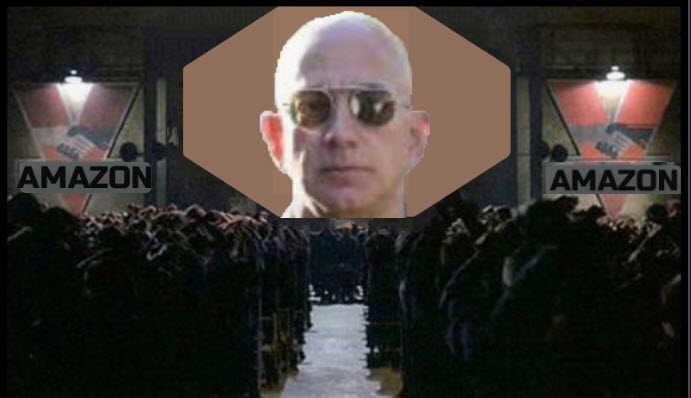
Mentre Winston Smith, nel profetico romanzo allegorico del  1984,  chiese al suo superiore e torturatore O'Brien: "Esiste il Grande Fratello?"
“'Certo che esiste. Il partito esiste. Il Grande Fratello è l'incarnazione del Partito. '
"Esiste nello stesso modo in cui io esisto?"
"Tu non esisti" disse O'Brien. "
Poster del Grande Fratello che illustra il romanzo di George Orwell sulla propaganda moderna, 1984.
Questo potere collettivo è incarnato da Bezos e da qualsiasi miliardario.  Alcuni altri potrebbero incarnarlo, come Bill Gates, Warren Buffett, Larry Ellison, Mark Zuckerberg, Charles Koch, Sergey Brin, Michael Bloomberg,  George Soros e  Jack Dorsey.   Competono l'uno contro l'altro e quindi hanno priorità diverse per il governo degli Stati Uniti; ma  tutti  concordano molto più di quanto non siano d'accordo su ciò che il governo "dovrebbe" fare (specialmente che l'esercito americano dovrebbe essere ampliato - a spese del contribuente, ovviamente, non proprio).
Fondamentalmente, Grande Fratello, nel   mondo reale è straordinariamente coerente e unificato - molto  più di quanto lo sia il pubblico - e questo è uno dei motivi  per  cui controllano il governo, aggirando il pubblico .

Ecco come tutto ciò accade, in termini di ciò che gli agenti di Bezos hanno fatto: 
  • La sua Amazon paga senza tasse federali  perché il governo federale ha scritto le leggi fiscali per incoraggiare le aziende a fare  i tipi di cose che Bezos ha sempre voluto che Amazon facesse.
  • Di conseguenza, il governo degli Stati Uniti incoraggia le mega corporazioni attraverso tasse e regolamenti a schiacciare le piccole imprese rendendo più difficile la loro crescita. Questo in qualche modo blocca l'aristocrazia esistente per essere meno fatta da sé (come lo stesso Bezos, ma i suoi figli non lo saranno).
  • I politici eletti sostengono in modo schiacciante questo perché la maggior parte dei fondi della loro campagna sono stati donati da individui super ricchi, dai loro dipendenti e altri agenti. È un sistema auto-rinforzante. La super-ricchezza controlla il governo , che (insieme ai super-ricchi e alle loro società) controlla il pubblico, il che riduce le opportunità economiche per loro. Il risultato finale è una forte disparità di ricchezza, istituzionalmente rafforzata, che diventa sempre più estrema.
I miliardari sono i veri grandi fratelli. E Bezos è il più grande di tutti.

lunedì 1 aprile 2019

L’INTELLIGENCE DELL’ARABIA SAUDITA DEL POTENTE PRINCIPE EREDITARIO MOHAMMED BIN SALMAN AVREBBE “INTERCETTATO” IL TELEFONO DI JEFF BEZOS, FACENDO FINIRE INFORMAZIONI RISERVATE E FOTO PRIVATE Al ‘’NATIONAL ENQUIRER’’

QUESTA MOSSA SAREBBE STATA UNA RISPOSTA ALL’AMPIO SPAZIO DEDICATO DAL ‘’WASHINGTON POST’’, DI PROPRIETÀ DI BEZOS, ALL’OMICIDIO DEL GIORNALISTA SAUDITA JAMAL KHASHOGGI, COLLABORATORE DEL QUOTIDIANO

mohammed bin salman foto luca locatelli per il timeMOHAMMED BIN SALMAN FOTO LUCA LOCATELLI PER IL TIME
Nessuno si salva dallo spionaggio digitale. L’intelligence dell’Arabia Saudita avrebbe «intercettato» il telefono di Jeff Bezos, facendo finire informazioni riservate e conversazioni private ai tabloid: lo ha denunciato il consulente per la sicurezza del patron di Amazon, Gavin de Becker. Secondo la sua ricostruzione, questa mossa sarebbe stata una risposta all’ampio spazio dedicato dal Washington Post, di proprietà di Bezos, all’omicidio del giornalista saudita Jamal Khashoggi, collaboratore del quotidiano, ucciso all’interno del consolato saudita a Istanbul il 2 ottobre del 2018.
JEFF BEZOS DICK PICJEFF BEZOS DICK PIC

lauren sanchez 14LAUREN SANCHEZ


De Becker ha spiegato in un articolo sul Daily Beast di aver indagato sui messaggi privati fra Bezos e l’ex anchor woman tv Lauren Sanchez pubblicati dal National Enquirer. Il patron di Amazon ha accusato American Media Inc. (Ami), il gruppo proprietario del National Enquirer, di «ricatto ed estorsione» per la minaccia di pubblicare sue foto intime. American Media è guidata dall’editore David Pecker, da sempre descritto come un amico stretto di Donald Trump, il quale ha più volte definito il Washington Post “nemico del popolo” e fonte di “fake news”.
JAMAL KHASHOGGIJAMAL KHASHOGGI


Ora l’indagine condotta dalla sicurezza di Amazon è giunta alla conclusione che «i sauditi hanno avuto accesso al telefono di Bezos e hanno ottenuto informazioni private». Per De Becker, però, «non è ancora chiaro» se la Ami fosse a conoscenza di queste informazioni e delle modalità con cui venivano reperite.

mohammed bin salman trump visit da cbcMOHAMMED BIN SALMAN TRUMP VISIT DA CBC


«I nostri investigatori e diversi esperti hanno concluso che i sauditi hanno avuto accesso al telefono di Bezos e ottenuto informazioni private», ha scritto de Becker, aggiungendo di aver trasmesso le conclusioni della sua inchiesta alle autorità federali americane. “È chiaro che Mbs considera il Washington Post un pericoloso nemico”, ha aggiunto l’investigatore, riferendosi al potente principe ereditario saudita Mohammed bin Salman, accusato di essere il mandante dell’assassinio di Khashoggi.

patrick whitesell, lauren sanchez e jeff bezosPATRICK WHITESELL, LAUREN SANCHEZ E JEFF BEZOS
L’investigatore incaricato da Bezos, tuttavia, non ha precisato chi nel governo saudita ritenga responsabile del pirataggio; e ha fornito pochi elementi sull’inchiesta effettuata, i cui risultati ha detto di avere “inviato alle autorità federali”.

Fonte: qui

giovedì 13 settembre 2018

he Amazon Business Model is A Job Killer: The Shift Towards E-Commerce. Artificial Intelligence (AI) and 31 Million Jobs Destroyed

Prominent in the news this past week was the report that Amazon and its CEO, Jeff Bezos, reached record levels of market valuation and wealth. Amazon is now worth more than $1 trillion and Bezos’s personal wealth stands at $165 billion. This of course is largely due to the stock price appreciation of the company, as investors in the US and worldwide pile into purchasing Amazon stock and thereby drive up its stock price, its market valuation and, in turn, Bezos’s share of that in terms of his own net worth.
Why so much investment money is surging into Amazon—and other tech company stocks like Google, Apple, and others—is a story in itself  but left here for another analysis.  Briefly, it has to do with the investor class’s accelerating capital gains from the $1 trillion a year distribution to them from Corporate America’s stock buybacks and dividend payouts. A trillion dollars a year, every year (2011 to 2017) for the past six years in buybacks and dividends by S&P 500 corporations alone. This year, 2018, buybacks and dividend payouts will set a record of more than $1.3 trillion in such distribution to investor-shareholders, pumped up by Trump tax cuts of more than $300 billion in 2018 that are doubling profits of S&P 500 companies.
According to a recent report by Zion Research, for the S&P 500 no less than 49% of their 2018 record profits has been due to the Trump tax cuts—a massive direct subsidy to corporate America without historical precedent in the US. For some sectors, like the telephone companies, 152% of their 2018 profits have been due to the Trump tax cuts.  The massive tax-driven profits are then redistributed to their shareholder-investors via stock buybacks and dividends well exceeding $1 trillion annually. The stockholder-shareholders then plow back the much of the $1 trillion back into the stock market, driving up stock prices further that are already rising due to the record profits and buybacks.  A good part of the ‘plowback’ into stocks has been going into the tech sector. The Apples, Googles, and of course Amazon especially—which leads to the company’s $1 trillion current market valuation and Jeff Bezos’s $165 billion personal net worth.


But to justify this obscene income subsidization of Corporate America by the US government—Trump and Congress—the political ‘spin’ is that it is creating jobs and wages are rising. But while wages are rising for a slice of workers in tech, healthcare, other high end professions, and salaries of managers, they are stagnant and falling for at least 133 million of the 165 million US labor force. (for more detailed analysis see my recent piece, ‘The Myth of Rising Wages’ at my blog, jackrasmus.com).
The other ‘spin’—that jobs are being created— is one that Amazon in particular has been promoting, as has most of the tech sector. But how true is that? What’s Amazon’s track record on jobs? And not just in 2018, but in recent years and, most importantly, in the decade to come?  How many jobs has Amazon created? How many has it destroyed in other companies? What’s been Amazon’s ‘net’ job effect?
Competitors Job Destruction
It’s no secret that Amazon’s business model has destroyed tens of thousands, perhaps hundreds of thousands, of jobs of US workers in industries like bookstores (independent and chains like Borders Inc.). Its business model then expanded beyond book selling to general retail and resulted in destruction of local electronic, toy stores, and other mom & pop retail. In recent years this effect has begun to expand to what are called ‘big box’ retail stores like Sears, JC Penny, and others. Severely weakened by Amazon competition, they have begun closing stores and thus eliminating thousands of jobs. Sears and others will likely not survive the next recession coming soon, and go out of business altogether.  While not totally due to Amazon competition, there’s little doubt that Amazon’s effect has been the ‘straw that broke the camel’s back’, as they say.
Amazon’s business model has not only contributed to job destruction directly by forcing companies to go out of business.  It does so indirectly as well. A good example is WalMart and Macys. They have been rapidly transitioning to Amazon’s model and emulating it by establishing their own online e-commerce sales. As they have begun to do so, they have also been shutting down hundreds of their brick and mortar stores in malls throughout the US. With those closures go tens of thousands of jobs. That’s indirect job destruction.
That process of forcing competitors to shift to e-commerce and close stores is soon to be replicated as well in the grocery store industry.  Regional grocery store chains are rushing to establish on line food sales and delivery. And once they do, good-bye to many of the tens of thousands of jobs in your local grocery stores (checkers, stockers, buyers)—as more reduce the items in them that are easily sold online as well as shut down many of their brick and mortar stores.
But what about jobs at Amazon itself? The spin is that Amazon is creating new jobs, replacing jobs being lost at its retail competitors, both large and small.  One hears of plans by Amazon to set up new warehouse outlets in the US (and abroad as well), in the process creating thousands of new jobs.  Cities across the US currently are intensely competing with each other in bidding for the new Amazon warehouse operations. They’re offering massive subsidies and tax cuts to Amazon to entice it to choose them as the company’s new warehouse locations. So doesn’t that mean new jobs replacing the old retail disappearing due to Amazon? Yes, but only in the very short term. In a soon-to-follow subsequent phase of operations, those jobs will disappear rapidly.
Amazon’s Job Destruction: Warehouse Automation
What Amazon doesn’t like to talk about is that it is currently running internal pilot projects in its existing warehouses that plan to eliminate thousands of jobs by using robots to order, shelve and retrieve stock, and deliver ordered goods. Unlike real workers, the ‘bots’ will work 24/7, never take lunch breaks or get sick and, just as important, never seek to form a union and push for higher wages and benefits. That is the future of jobs within Amazon. The jobs created today will soon go away. Within five to ten years, Amazon will be fully automated.  The jobs will go away, but the tax concessions and subsidies from local governments will remain. Amazon costs will continue to decline dramatically, and with it so too its profitability. That’s why, moreover, the investor class also continues to plow money into Amazon stock purchases, driving the company’s market valuation ever higher—and with it Jeff Bezos’s personal wealth!
But the accelerated shift to new technology within its warehouse operations is not the only way Amazon and Bezos are driving job destruction.  Amazon is not simply a warehouse company. It is not just a retail company.  It is a tech company. And that’s how Amazon will destroy most of the jobs over the next decade.
Drone Technology & Delivery Jobs Destruction
Amazon is a leading edge developer of drone technology. Its plan by the end of the next decade is to deliver most of its packaged products by means of drones. That will force major package delivery companies like UPS, Fedex, and the US Post Office to shift to drone delivery as well. That means fewer truck drivers. There are a million truck drivers in the US today. Most are local delivery workers, not the over the road 18-wheeler drivers. Their jobs are slated to disappear by the hundreds of thousands, as Amazon (and Google and others) perfect the drone delivery technology that will take deep hold in the next decade.
Alexa, Artificial Intelligence (AI) & 31 Million Jobs Destroyed


But automation of his warehouse operations and drone delivery technology negative impact on jobs will pale against what’s coming with Artificial Intelligence (AI) technology, of which Amazon is also a major innovator and driver.  So briefly what’s AI? Rudimentary AI is embodied in Amazon’s ‘Alexa’ intelligent ‘bot (home “butler”, as some call it).  Alexa is the hardware device, but it’s the software intelligence within it that is the AI.  Currently Alexa (and Google and Apple’s similar products) respond to simple voice commands from users. Simple tasks like ‘order this’ (from Amazon of course), ‘turn off the lights’, ‘change the thermostat’ temperature in the house, etc. But Alexa is going to get more intelligent, much more intelligent.  It will ‘learn’ to anticipate user commands of its users before they are even made. It will teach itself.
In a most basic sense, AI is nothing more than software (embedded in a hardware device) that employs techniques of advanced statistical data gathering and processing, based upon which it makes decisions. And the more requests by users, the more data gathered, the more processed, and the more decisions made—the more intelligent it becomes; the software ‘learns’ by means of AI techniques called ‘natural language processing’ and ‘deep learning’.
Over time the decision making becomes more accurate than if made by a human agent. This does not mean more accurate in the case of all decisions—i.e. for complex, creative tasks and decisions. That will still remain the realm of human decision making—albeit only for that minority of highly educated or trained workers capable of making such decisions.  The simple decisions, tasks, etc. made by the vast majority of workers will be increasingly assumed by future Alexa-like software driven devices. And that’s where massive job destruction will occur, and sooner than most anticipate. In fact, the major impact will begin around 2020 and will accelerate throughout that decade.
The devastation of AI on jobs and occupations will be clear by 2030, as no fewer than 50% of all companies will implement some degree of AI by 2030, according to McKinsey.
AI will create jobs at the ‘high end’ that require advanced education skills—i.e. what’s called ‘analytics’ of all kinds. But it will destroy many-fold more jobs and occupations where simpler decision making is involved—especially in retail, hospitality, basic services of all kinds, and will of course also accelerate further current job destruction already underway in manufacturing.
These are the job areas that have been already seriously impacted by what’s called ‘contingent’ job creation—i.e. part time, temp, on call, gig and other work. Contingent jobs number in the tens of millions in the US already, and similar tens of millions in Europe, Japan, Asia. But these already devastated job occupations—with lower wages and few benefits—will be totally eliminated as well by the millions as a consequence of the impact of AI in the next decade.
For example: nearly all customer service rep jobs will be replaced by even more intelligent AI-Alexa devices. This is already happening on a rudimentary level.  First and second tier call center inquiries and service inquiries have already been replaced. But as AI advances, even higher level inquiries, that only trained technicians now handle, will be replaced as well. In-home ‘virtual assistant’ roles now performed by devices like Alexa will proliferate throughout businesses and the economy over the next decade. Occupations like receptionists, ticket sellers, movie kiosk and concessions workers, phone sales reps, in store retail sales assistants, tellers of all kinds, food ordering and food preparation, and so on are prime job occupations destined for displacement.  AI will have a major impact as well on scores of maintenance and repair job occupations. AI will enable hardware devices of all kinds to self-maintain and even self-repair.  The auto industry will be heavily impacted by intelligent, self-maintenance and repair capabilities in new cars and trucks that will eliminate tens of thousands of auto mechanic jobs. Intelligent tires will learn to self-inflation and repair, cars to re-align themselves,  and filters self-clean. Local banking and insurance services, residential real estate, accounting occupations, marketing, and what are called business ‘back office’ functions will all be job-impacted by Alexa-like devices that expand from their current role as ‘home butlers’, become more advanced, up-graded, and penetrate business operations on a wide scale.  AI will also have a profound impact on educational services: K-12 and community college teachers will be de-professionalized and increasingly become in-classroom monitors of tech equipment, software and hardware based, that will deliver the standardized classroom instruction for many of the courses taught.  Online higher education instruction will increasingly become the norm as well. Wages and compensation of teachers and professors will stagnate and decline accordingly.
Amazon has plans to lead the tech industry with its Alexa product. Alexa as a residential ‘bot butler’ is just the beginning.  New, faster learning, self-teaching, more powerful, high end Alexa-like devices will target business enterprises over the coming decade. They will serve as technology Trojan horses that will wipe out entire business functions and, in the process, countless job occupations as well.
How many jobs will be destroyed? And what are the economic consequences?
The McKinsey Consultants Group 2018 Study
A glimpse into the job destruction future was provided early this September by an in-depth study by the well-known McKinsey Consultancy Group. The study estimated that 60% of the current job occupations in the US will be impacted by AI by 2030. And one third, 33%, of that 60% will experience a reduction in jobs and/or hours worked. (see p. 21 of that study).
There are approximately 165 million in the US workforce today. Assuming the long term trend of 1-1.5 million growth annually in that workforce over the next 12 years—the historical average—that means on average a175 million US work force over the next decade. Assuming McKinsey’s 60% impact, and 33% of that 60% experiencing reduced employment, the result is roughly 31 million jobs will be lost, or have hours significantly reduced, due to the effects of AI over the next decade.
According to the McKinsey study, the ‘cost’ to workers will be $7 trillion. AI will reduce corporate costs by 50% where introduced, thereby boosting ‘profits’ to business from introducing job-killing AI by $13 trillion. In other words, AI will dramatically accelerate the already devastating income inequality trends in the USA.  Having declined already from 64% to 56% of total national income, Labor Share will thus decline even more sharply by 2030.
Unless there is a massive government financed program of technical job retraining, a basic restructuring of the US educational system, and some sort of guaranteed annual income for those workers too old or unable to make the rapid changeover to an AI driven economy, there will be a significant negative impact to household consumption and therefore the economy in general.  This will require a major restructuring of the current tax system that reverses the $15 trillion in tax cuts for corporations and investors that has been implemented since 2001.
Given the current political leadership in America at present, however, it is highly unlike the tax changes and funding shift will be implemented.  Republican Congresses and presidents will argue that GDP is growing despite the job destruction, AI created jobs will be over-estimated and jobs destroyed under-estimated, and income inequality will be blamed on workers displaced not re-educating themselves and becoming more productive (and useful to tech driven economic growth).  Policies will continue to provide credit and debt to households as a substitute to actual wage growth. Guaranteed annual income supplements will be called ‘socialism’, while actual subsidization of capital incomes by the government via tax cuts and cheap money—i.e. actual ‘socialism for investors and business—continue by another name. Democrats during worst times will be given a shot at the changes but will deliver too little-too late in token adjustments, thus laying the ground work for a return of Republican-Corporate solutions that claim will resolve the problem while actually making it worse.
In other words, the policy process that has characterized the last three and a half decades will likely continue into the next.  AI in net terms will make the rich much richer, provide job and attractive wage opportunities for perhaps the top 10% of the US work force, leave maybe another third continuing to thread economic water, while thrusting the bottom 50% of workers in America into a still more desperate economic condition than they already experience.
Over the 2020 to 2030 decade, Amazon the tech company will be at the leading edge of AI development and its devastating negative impact on the majority of jobs and wages. Simultaneously, in the shorter run, Amazon the warehouse company will start eliminating its jobs by the thousands as it automates its warehouse operations; and Amazon the retail giant will continue to directly, and indirectly, destroy retail jobs as its competitors—small and large alike—attempt to adjust to Amazon’s job destruction machine.
*
Dr. Rasmus is author of the recently published book, “Central Bankers at the End of Their Ropes: Monetary Policy and the Coming Depression”, Clarity Press, August 2017, and the forthcoming companion critique of US fiscal-trade-industrial policy, “The Scourge of Neoliberalism: Economic Policy from Reagan to Trump”, also by Clarity Press. He blogs at jackrasmus.com and his twitter handle is @drjackrasmus. He is a frequent contributor to Global Research.