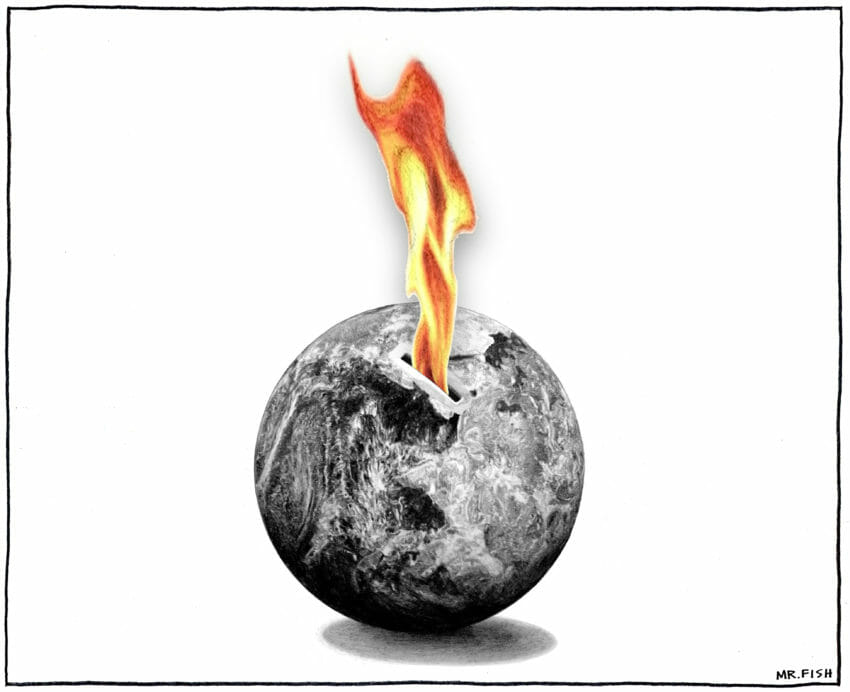
“’DON’T PANIC!!!!’ Just 6.9% off of the most offensive valuation extreme in history.” – Tweet from John Hussman, Hussman Funds
The above quote from John Hussman was a shot at the financial media, which was freaking out over the sell-off in the stock market on Wednesday and Thursday last week. As stock bubbles become more irrational, the rationalizations concocted to explain why stocks are still cheap and can go higher become more outrageous. The financial media was devised to function as a “credible” conduit for Wall Street’s deceitful, if not often fraudulent, sales-pitch.
Perhaps the biggest fraud in the last 10 years perpetrated on investors was the Dodd-Frank financial “reform” legislation. The Dodd-Frank Act was promoted by the Obama Government as legislation that would protect the public from the risky and often fraudulent business practices of the big financial institutions – primarily the Too Big To Fail Banks. It was supposed to prevent another 2008 financial crisis (de facto financial collapse).
However, in effect, the Act made it easier for big banks to disguise or hide their predatory business operations. Ten years later it is glaringly apparent to anyone who bothers to study the facts, that Dodd-frank has been nothing of short of a catastrophic failure. Debt, and especially risky debt, is at record levels at every level of the economic system (Government, corporate, individual). OTC derivatives are at higher levels than 2008. This is without adjusting for accounting changes that enabled banks to understate their derivatives risk exposure. The stock market bubble is the most extreme in history by most measures and housing prices as a ratio to household income are at an all-time record level.
A lot of skeletons in the closet suddenly pop out of “hiding” when the stock market has a week like this past week. An article published by Bloomberg titled, “A $1 trillion Powder Keg Threatens the Corporate Bond Market” highlights the fact that corporate America took advantage of the Fed’s money printing to issue a record amount of debt. Over the last couple of years, the credit quality of this debt has deteriorated. More than 50% of the “investment grade” debt is rated at the lowest level of investment grade (Moody’s Baa3/S&P BBB-).
However, the ratings tell only half the story. Just like the last time around, the credit rating agencies have been over-rating much of this debt. In other words, a growing portion of the debt that is judged investment grade by the ratings agencies likely would have been given junk bond ratings 20 years ago. In fact, FTI Consulting (a global business advisory firm) concluded based on its research that corporate credit quality as measured by ratings distribution is far weaker than at the previous cycle peaks in 2000 and 2007. FTI goes as far as to assert, “it isn’t even close.”
I’ll note that FTI’s work is based using corporate credit ratings as given. However, because credit ratings agencies once again have become scandalously lenient in assigning ratings, there are consequences from relying on the judgment of those who are getting paid by the same companies they rate. In reality, the overall credit quality of corporate debt is likely even worse than FTI has determined.
The debt “skeleton” is a scary one. But even worse is the derivatives “skeleton.” This one not only hides in the closet but, thanks to regulatory “reform,” it’s been stashed in the attic above the closet. An article appeared in the Asia Times a few days ago titled, “Has The Derivatives Volcano Already Begun To Erupt?” I doubt this one will be reprinted by the Wall Street Journal or Barron’s. This article goes into the details about the imminent risk of foreign exchange derivatives to the global financial system. There’s a notional amount of $90 trillion in FX derivatives outstanding, which is up from $60 trillion in 2010.
Many of you have heard about the growing dollar “shortage” in Europe and Japan. Foreign entities issue dollar-denominated debt but transact in local currency. FX derivatives enable these entities to swap local currency for dollars with banks. However, these banks have to borrow the dollars. European banks are now running out of capacity to borrow dollars, a natural economic consequence of the reckless financial risks that these banks have taken, as enabled by the Central Bank money printing.
As it becomes more difficult for European and Japanese banks to borrow dollars, it drives up the cost to hedge local currency/dollar swaps. Compounding this, U.S. banks with exposure to the European banks are required to put up more reserves against their exposure, which in turn acts to tighten credit availability. It’s a vicious self-perpetuating circle that is more than partially responsible for driving 10yr and 30yr Treasury bond yields higher recently. Perhaps this explains why the direction of the Dow/SPX and the 10-yr Treasury have been moving in correlation for the past few weeks rather than inversely.
But it’s not just FX derivatives. There’s been $10’s of trillions on credit default swaps underwritten in the last 8 years. The swaps are based on the value of debt securities. For instance, Tesla bonds or home mortgage securities. As the economy deteriorates, the ability of debtors to service their debt becomes compromised and the market value of the debt declines. As delinquencies turn into defaults, credit default swaps are exercised. If the counter-party is unable to pay (AIG/Goldman in 2008), the credit default swap blows up.
And thus the fuse on the global derivatives bomb is lit. The global web of derivatives is extremely fragile and highly dependent on the value of the assets and securities used as collateral. As the asset values decline, more collateral is required (a “collateral call”). As defaults by those required to post more collateral occur, the fuses that have been lit begin to hit gunpowder. This is how the 2008 financial crisis was ignited.
In fact, given the financial turmoil in Italy, India and several other important emerging market countries, I find it hard to believe that we have not seen evidence yet of FX derivative accidents connected to those situations. My best guess is that the Central Banks have been able to diffuse derivative problems thus-far. However, the drop in the stock market on Wednesday surely must have triggered some equity-related derivatives mishaps. At some point, the derivative fires will become too large s they ignite from unforeseen sources – i.e.the derivatives skeletons come down from hiding in the attic – and that’s when the real fun begins, at least if you are short the market.
I would suggest that the anticipation of an unavoidable derivatives-driven crisis is the reason high-profile market realists like Jim Rogers and Peter Schiff have recently issued warnings that the coming economic and financial crisis will be much worse than what hit in 2008.
Are you tired of the boring 1988 Economist magazine cover art depicting a new world currency in 2018? Me too, so I gave it a slight overhaul with a golden (pun intended) halo of the sun and Earth in today’s headline graphic. Today is ground zero if you extrapolated the date engraved upon the future coin as prophetic. The truth of the matter is that currency and financial system resets occur over a period of time, then a D-Day eventually comes to pass upon the peasantry. The great financial crisis that transpired ten years ago was a financial system reset slow train wreck, and D-Day culminated over a weekend with the Lehman Brothers collapse decision at the NYFRB.
As a primer to the leading up of a potential reset, or a reset to avoid another salvage operation that does not fix underlying issues, consider reviewing Three (Four) Bankers of a Financial Armageddon Salvage Operation, published on Sep. 14. The reset topic came up at the end of my interview with Dr. Dave Janda this past weekend without much time to expound on it, so the following are my humble two cents. I do not know how or when it will come to fruition, but we can peek into the whys and roads that are building to facilitate it.
Here is a flow chart of sorts that lays out the backbone of our current financial order of core players, as I understand them to be. More entities can be added, but this synopsis serves the purpose. A portion of the following information incorporates insights covered by Kenneth Storey.
A large amount of press has surfaced about growing risks within the financial markets, despite efforts by several goldilocks power brokers to the contrary, and a few others included among the editorials in the link garden below to add color to the unfolding de-dollarization process.
The role of gold in a multicurrency reserve system – World Gold Council, Jul. 5
Ray Dalio Spells Out America’s Worst Nightmare… “The hedge fund titan warns the U.S. not to take its reserve currency for granted.” – Bloomberg, Sep. 12
BIS warns global economy risks crisis ‘relapse’… “There is little ‘medicine’ left to treat the patient a second time. ‘Things look rather fragile,’ BIS chief economist Claudio Borio told reporters in a conference call. The Basel-based BIS, considered the central bank for central banks, warned in its annual report that the recovery after the 2007-2008 global financial crisis had been ‘highly unbalanced’, with emerging economies especially facing mounting pressure… After years of ultra-accommodating monetary policy, the US Federal Reserve has begun hiking interest rates, while the European Central Bank (ECB) recently announced it would end its stimulus program at the end of this year. But amidst this normalization process, BIS noted a stark divergence between growth in the US market and the situation in emerging economies especially.” – The Business Times, Sep. 25
A Three-Way Train Wreck Is About to Derail the Markets… “Markets have been notably docile lately despite crises in Argentina, Turkey, Indonesia, Iran, China, Venezuela and elsewhere. Political crises related to Brexit and U.S. political dysfunction have not roiled global markets so far. The calm and low volatility are about to end. The China-Iran nexus in confrontation with the U.S. is the last straw.” – Jim Rickards at The Daily Reckoning, Oct. 1
Stan Druckenmiller sees ‘massive’ debt fuelling next financial crisis… “We tripled down on what caused the crisis. And we tripled down on it globally.” – Financial Review, Oct. 1
Chairman of the Economic and Development Review Committee at the OECD: Bad Financial Moon Rising… “In reality, all is not well beneath the surface. Should another financial crisis materialize, the subsequent recession might be even costlier than the last one, not least because policymakers will face unprecedented economic and political constraints in responding to it.” – Project Syndicate, Oct. 3
Trump’s Policies Will Displace the Dollar – Jeffrey Sachs, Sep. 3
World economy at risk of another financial crash, says IMF… “Debt levels are well above 2008 and failure to reform banking system could trigger crisis – ‘large challenges loom for global economy to prevent a second Great Depression’” – The Guardian, Oct. 3
World’s Most Important Bank Issues Urgent “Zombie Alert” – Nomi Prins at The Daily Reckoning, Oct. 3
The global economy not looking quite as rosy, IMF says…“International Monetary Fund cuts growth forecast for this year and next and said downside risks are now elevated” – MarketWatch, Oct. 9
Chinese currency set to explode internationally as IMF formally places it in the SDR’s basket of currencies… “The IMF had already announced the acceptance of the Yuan into their monetary reserves more than two years ago, but this week the currency became fully adopted and on equal par with the dollar, euro, pound, and yen… China has also been given sole authority to sell IMF (SDR) bonds, which when coupled with the fact that they are already the world’s largest banking entity means that transitioning the RMB into an international settlement currency is now just a mouse click away for Beijing…” – Shotgun Economics, Oct. 8
*TRUMP SAYS HE DOESN’T LIKE WHAT THE FED IS DOING – Oct. 9
Turkish President Erdogan calls on African countries to use local currencies for trade and businesses with Turkey – “dependence on USD dollar is becoming more of a burden instead of a convenience.” – China Xinhua News, Oct. 10
Jim O’Neill: Kingpin’ role of the dollar is ‘idiotically’ outsized – CNBC, Oct. 5
The following list of circumstances is priming the pump for a currency reset scenario. A majority have already taken place to some degree, are ongoing, or are in the process of surfacing and are not listed in any particular order, although some require another for implementation with reason.
√ Low-intensity conflicts proliferate into hot regional wars
√ The consolidation of and creation of currency blocks (i.e. EUR within the European Union)
√ U.S. drains the swamp and attempts are made to roll back the globalist agenda
√ U.S. demands the world fund its fair share of U.N., NATO, and war on terror expenses
√ U.S. reduces or eliminates aid to foreign countries and organizations
√ Diminishing role of the USD as a global reserve currency (2Q18 at 62%)
√ Fed initiates Quantitative Tightening (QT) w/o Quantitative Easing (QE) or increase of cash in circulation
√ Yuan and IMF SDRs increase in use as reserve currencies
√ Sanctions, tariffs, and trade wars escalate with some resolution
√ U.S. trade pacts renegotiated; trade balance must shrink to near zero and exports increase
√ E.U. and Japan begin QT w/o QE or increase of cash in circulation
√ U.S. citizens forced to purchase or convert existing retirement accounts to include U.S. Treasury Bonds
√ Countries implement currency controls as cash bleeds into alternative safe havens, such as gold
√ IMF increases SDR liquidity via a QE-like program
√ Global oil and gold to be priced in SDRs, USD, yuan
√ EURO dollars and petrodollars replaced by SDRs flow back to U.S., causing inflation
√ IMF adjusts SDR basket, with the yuan having a larger percentage leading to being on par
√ Massive U.S. military base closures overseas
A liquidity crisis beyond the central banks’ ability to subdue a total blowout could force an injection of SDRs by the IMF. A debt jubilee restructure of sovereign debts prior to a liquidity crisis would help ward off the worst of consequences but would take place anyways post-crisis to facilitate the restructuring of existing debt and monetary systems. A new world currency (backed by what as a guarantee?) and multi-reserve system will surface for international trade and settlements. The Federal Reserve would eventually liquidate, while a new U.S. Treasury notes system is implemented and a domestic USD backed by gold and/or silver could replace current Federal Reserve notes. No matter the outcome, an upward revaluation in the price of gold is highly likely.
Since the formation of the Federal Reserve and IRS in 1913, the USD has depreciated by a stunning 95%.
It is unlikely that the power brokers who formulated the Bretton Woods Agreement in 1944 following WWII expected the USD to dominate the global reserve forever, but it is difficult to ascertain a forward-looking mindset dominated by a Keynesian Economics theory. In the U.S. alone, monetary standards have shifted many times since 1770, with the Nixon Shock in 1971 as a standout that ended the ability to exchange USD for gold as set forth at Bretton Woods.
Because of U.S. fiscal and monetary mismanagement, the Bretton Woods financial system collapsed and was a key factor that influenced Europe to form a monetary union and launch of the euro in 1999. U.S. debt is currently over $21 trillion and growing daily, and it does not include $200+ trillion in unfunded liabilities. In 2011, Standard & Poor’s downgraded U.S. sovereign debt for the first time, from AAA to A, and the U.S. Treasury’s printing press continued unabated with a USD “exorbitant privilege” intact. Fast-forward to present day and financial pundits such as Jeffrey Sachs believe that “America’s monetary stewardship has stumbled badly over the years, and Trump’s misrule could hasten the end of the dollar’s predominance.”
The lack of sound fiscal and monetary policy telegraphs to the world that nothing has changed, with China and Russia taking the lead by diversifying their foreign reserves and taking decisive measures to reduce their dependence upon the USD hegemony. The USD still accounts for approximately 85% of all forex transactions, despite making up only 25% of the world economy.
Winds of change are blowing, and it would be foolish to focus on the when and whys for a global currency reset event. The global debt bomb is chiming in at $250 trillion and counting. It would be prudent to prepare your financial house ahead of time, rather than finding yourself in this casino situation with your capital crushed through inflation and devaluation and seeing access to safe haven assets are sparse and priced beyond your means when you need them the most while the house wins.
During the financial crisis of 2008, the world’s central banks, including the Federal Reserve, injected trillions of dollars of fabricated money into the global financial system. This fabricated money has created a worldwide debt of $325 trillion, more than three times global GDP. The fabricated money was hoarded by banks and corporations, loaned by banks at predatory interest rates, used to service interest on unpayable debt or spent buying back stock, providing millions in compensation for elites. The fabricated money was not invested in the real economy. Products were not manufactured and sold. Workers were not reinstated into the middle class with sustainable incomes, benefits and pensions. Infrastructure projects were not undertaken. The fabricated money reinflated massive financial bubbles built on debt and papered over a fatally diseased financial system destined for collapse.
What will trigger the next crash?
The $13.2 trillion in unsustainable U.S. household debt?
The $1.5 trillion in unsustainable student debt?
The billions Wall Street has invested in a fracking industry that has spent $280 billion more than it generated from its operations?
Who knows. What is certain is that a global financial crash, one that will dwarf the meltdown of 2008, is inevitable. And this time, with interest rates near zero, the elites have no escape plan. The financial structure will disintegrate. The global economy will go into a death spiral. The rage of a betrayed and impoverished population will, I fear, further empower right-wing demagogues who promise vengeance on the global elites, moral renewal, a nativist revival heralding a return to a mythical golden age when immigrants, women and people of color knew their place, and a Christianized fascism.
The 2008 financial crisis, as the economist Nomi Prins points out, “converted central banks into a new class of power brokers.” They looted national treasuries and amassed trillions in wealth to become politically and economically omnipotent. In her book “Collusion: How Central Bankers Rigged the World,” she writes that central bankers and the world’s largest financial institutions fraudulently manipulate global markets and use fabricated, or as she writes, “fake money,” to inflate asset bubbles for short-term profit as they drive us toward “a dangerous financial precipice.”
“Before the crisis, they were just asleep at the wheel, in particular, the Federal Reserve of the United States, which is supposed to be the main regulator of the major banks in the United States,” Prins said when we met in New York. “It did a horrible job of doing that, which is why we had the financial crisis. It became a deregulator instead of a regulator. In the wake of the financial crisis, the solution to fixing the crisis and saving the economy from a great depression or recession, whatever the terminology that was used at any given time, was to fabricate trillions and trillions of dollars out of an electronic ether.”
We could have provided free college tuition to every student or universal health care, repaired our crumbling infrastructure, transitioned to clean energy, forgiven student debt, raised wages, bailed out underwater homeowners, formed public banks to invest at low interest rates in our communities, provided a guaranteed minimum income for everyone and organized a massive jobs program for the unemployed and underemployed. Sixteen million children would not go to bed hungry. The mentally ill and the homeless—an estimated 553,742 Americans are homeless every night—would not be left on the streets or locked away in our prisons. The economy would revive. Instead, $29 trillion in fabricated money was handed to financial gangsters who are about to make most of it evaporate and plunge us into a depression that will rival that of the global crash of 1929.
“One-sixth of this could provide a $12,000 annual basic income, which would cost $3.8 trillion annually, doubling Social Security payments to $22,000 annually, which would cost $662 billion, a $10,000 bonus for all U.S. public school teachers, which would cost $11 billion, free college for all high school graduates, which would cost $318 billion, and universal preschool, which would cost $38 billion. National improved Medicare for all would actually save the nation trillions of dollars over a decade.”
An emergency clause in the Federal Reserve Act of 1913 allows the Fed to provide liquidity to a distressed banking system. But the Federal Reserve did not stop with the creation of a few hundred billion dollars. It flooded the financial markets with absurd levels of fabricated money. This had the effect of making the economy appear as if it had revived. And for the oligarchs, who had access to this fabricated money while we did not, it did.
The Fed cut interest rates to near zero. Some central banks in Europe instituted negative interest rates, meaning they would pay borrowers to take loans. The Fed, in a clever bit of accounting, even permitted distressed banks to use these no-interest loans to buy U.S. Treasury bonds. The banks gave the bonds back to the Fed and received a quarter of a percent of interest from the Fed. In short, the banks were loaned money at virtually no interest by the Fed and then were paid interest by the Fed on the money they borrowed. The Fed also bought up worthless mortgage assets and other toxic assets from the banks. Since Fed authorities could fabricate as much money as they wanted, it did not matter how they spent it.
“It’s like going to someone’s old garage sale and saying, ‘I want that bicycle with no wheels. I’ll pay you 100 grand for it. Why? Because it’s not my money,’ ” Prins said.
“These people have rigged the system,” she said of the bankers. “There is money fabricated at the top. It is used to pump up financial assets, including stock. It has to come from somewhere. Because money is cheap there’s more borrowing at the corporate level. There’s more money borrowed at the government level.”
“Where do you go to repay it?” she asked. “You go into the nation. You go into the economy. You extract money from the foundational economy, from social programs. You impose austerity.”
Given the staggering amount of fabricated money that has to be repaid, the banks need to build greater and greater pools of debt. This is why when you are late in paying your credit card the interest rate jumps to 28 percent. This is why if you declare bankruptcy you are still responsible for paying off your student loan, even as 1 million people a year default on student loans, with 40 percent of all borrowers expected to default on student loans by 2023. This is why wages are stagnant or have declined while costs, from health care and pharmaceutical products to bank fees and basic utilities, are skyrocketing. The enforced debt peonage grows to feed the beast until, as with the subprime mortgage crisis, the predatory system fails because of massive defaults. There will come a day, for example, as with all financial bubbles, when the wildly optimistic projected profits of industries such as fracking will no longer be an effective excuse to keep pumping money into failing businesses burdened by debt they cannot repay.
“The 60 biggest exploration and production firms are not generating enough cash from their operations to cover their operating and capital expenses,” Bethany McLean writes of the fracking industry in an article titled “The Next Financial Crisis Lurks Underground” that appeared in The New York Times. “In aggregate, from mid-2012 to mid-2017, they had negative free cash flow of $9 billion per quarter.”
The global financial system is a ticking time bomb. The question is not if it will explode but when it will explode. And once it does, the inability of the global speculators to use fabricated money with zero interest to paper over the debacle will trigger massive unemployment, high prices for imports and basic services, and a devaluation in which the dollar will become nearly worthless as it is abandoned as the world’s reserve currency. This manufactured financial tsunami will transform the United States, already a failed democracy, into an authoritarian police state. Life will become very cheap, especially for the vulnerable—undocumented workers, Muslims, poor people of color, girls and women, anti-capitalist and anti-imperialist critics branded as agents of foreign powers—who will be demonized and persecuted for the collapse. The elites, in a desperate bid to cling to their unchecked power and obscene wealth, will disembowel what is left of the United States.
*
Chris Hedges is a Pulitzer Prize-winning journalist, a New York Times best-selling author, a professor in the college degree program offered to New Jersey state prisoners by Rutgers University, and an ordained Presbyterian minister. He has written 12 books, including the New York Times best-seller “Days of Destruction, Days of Revolt” (2012), which he co-authored with the cartoonist Joe Sacco.
South Africa, famous for Great White sharks, could be the next focus for currency vigilantes.
2018 has been marked by various emerging market crises. From Turkey to Argentina, confidence has eroded, resulting in bond and currency chaos. There is a growing focus on South Africa, and our analysis suggests that will continue.
When examining whether an emerging market country is at risk of a currency crisis, the economic indicator of choice is Import Cover. This gives a measurement of the amount of a country’s foreign exchange reserves relative to its imports. It is usually expressed in terms of how many months of imports the foreign exchange reserves are able to buy before they run out. An emerging market country with 10 or more months of import cover is considered to be stable. South Africa’s Import Cover is 5.5 months, down from 7.2 months at the end of 2015. According to World Bank data, that’s about the same as Turkey. (For perspective, China’s Import Cover is 16 months.) What this means is that there is increasing pressure on South Africa’s foreign exchange reserves, which not only have to pay for imports but also have to service the country’s external debt. Reserves are also used to defend a currency from attack via intervention, but a country with low reserves has little defense. And once the currency market sharks get a sniff of blood in the water, it can get quite frenzied very quickly.
Thankfully, we do not have to guess about all the different economic variables that could or could not happen. We rely on what we consider to be the best lead indicator – the market price. The chart below shows the amount of South African rand needed to buy one U.S. dollar. The exchange rate hit a low of 11.5078 in February this year, and it currently hovers around 15. Our Elliott wave analysis is pointing to much higher levels in the exchange rate, meaning a depreciating rand. Expect fears of a South African rand crisis to grow.
About Murray Gunn
Murray Gunn is Head of Research for Elliott Wave International’s Global Market Perspective, a monthly summary of the firm’s 25 analysts’ views on every major freely-traded market in the world. After earning his Master of Arts (Honors) degree in Economics from the University of Dundee in Scotland in 1991, Gunn went into fund management. He quickly realized that textbook descriptions don’t apply to real-world markets, which in turn led him to technical analysis and the Elliott Wave Principle. He worked as a fund manager in global bonds, currencies and stocks, including long posts at Standard Life Investments and a five-year stint in the Middle East at the Abu Dhabi Investment Authority. Gunn then joined HSBC as Head of Technical Analysis. He has served on the board of the Society of Technical Analysts and delivered lectures on the Elliott Wave Principle to students at The London School of Economics, Queen Mary University and Kings College London. You can read Gunn’s commentary in Elliott Wave International’s GlobalMarket Perspective, Interest Rates and Currency Pro Services, and on deflation.com.
About Elliott Wave International
Elliott Wave International is the largest independent technical analysis firm in the world. Its award-winning publications provide useful insights and engaging commentary on all major financial asset classes and indexes around the globe. EWI’s unique perspective on market behaviour and cultural trends sets it apart from other financial publications.
This respected analyst is saying we’re likely to see a crisis like we haven’t seen in 50 years, but it’s more likely we’ll see a crisis like never before. Here’s why…
Josh Sigurdson talks with author and economic analyst John Sneisen about the recent warnings by JP Morgan’s top quant (quantitative analyst) Marko Kolanovic who claims we will soon see flash crashes and a great liquidity crisis.
Kolanovic claims that this will likely take place after the first half of 2019, but one cannot really say.
Like in 2010 and in 2018, we will see flash crashes occur he says. The DOW will take a massive hit.
Kolanovic says we will see a crisis the likes of which we haven’t seen in 50 years.
The thing is, we will likely see a crisis like we’ve never before seen in history. With the rate at which it has been propped up, it cannot sustain itself, we’ve seen countless crashes diverted with more centralization/manipulation, the very thing that created the problem in the first place.
The debt levels are enormous, the banking system is collapsing slowly but surely and the bubbles continue to grow throughout the markets based in investor confidence but not fundamental value.
All fiat currencies eventually revert to their true value of zero going back to 1024 AD in China, so there’s no doubt that the central banking system will inevitably come crashing down.
In the end it comes down to individuals sustaining themselves and protecting their purchasing power. Being self sustainable and independent rather than dependent on centralized entities to run their lives. Fonte: qui
10 YEARS AFTER THEFINANCIAL CRISIS
A decade after the collapse of Lehman Brothers, J.P. Morgan takes a look back at the response to the financial crisis that reshaped financial markets and the global economy.
The financial crisis brought the global economy to the brink, with many regarding the bankruptcy of investment bank Lehman Brothers in September 2008 as the seminal moment of the great recession. That same year, the U.S. housing market went under water, J.P. Morgan acquired Bear Stearns in record time as it too faced collapse, stock markets crashed and the Federal Reserve slashed interest rates to their lowest in history. Ten years on, the J.P. Morgan Research team explores what has changed and what the future could hold for the global economy and markets
What’s Changed?
Ten years ago, it wasn’t clear to investors that the worst economic downturn since the Great Depression was on the horizon. Four major long-term forces of globalization, deregulation, innovation and falling volatility had built up since the mid-1980s, ultimately creating a vulnerable system that was hard to detect. So how have things progressed since 2008?
Global Debt has Ballooned
Global sovereign debt has ballooned by 26 percentage points of GDP since 2007. The bulk of the rise is found in developed markets (DM) where debt-to-GDP has surged roughly 41 percentage points —compared to a 12 percentage point rise in emerging markets. With fiscal deficits still relatively elevated, there is no sign that debt levels will be declining in the foreseeable future. The fiscal lending position of DM as a share of GDP fell sharply by more than 8 percentage points to a post-World War II low of nearly -9% in 2009. Despite a substantial decline from its 7.3% peak in 2009, the global fiscal deficit remains elevated at 2.9% of GDP. In the U.S., the fiscal deficit is projected to reach 5.4% of GDP by the end of 2019.
Joseph Lupton, Senior Global Economist, J.P. Morgan
The Housing Bubble
In the years leading up to the crisis, the Fed substantially tightened monetary policy, hiking rates by 425 basis points between 2004-2006. At the same time, mortgage credit growth increased by nearly 45% on U.S. household balance sheets. The securitized products market was booming, particularly non-agency residential mortgages. Issuance rose from $125 billion in 2000 to over $1 trillion per annum in 2005-06. Particular lenders focused on weaker borrowers (subprime and alt-A) and were met with strong investor demand. Government sponsored enterprises Fannie Mae and Freddie Mac bought large volumes of these mortgages from banks and resold them as mortgage-backed securities to investors. This, along with excessive leverage, inadequate lending standards and poor risk controls ultimately led to a collapse of the housing market, the bailout of Fannie Mae and Freddie Mac and the financial crisis of 2008. Today, U.S. consumers are not nearly as exposed to rates as they used to be, with just about 15% of the outstanding mortgage market at an adjustable rate.
Matthew Jozoff, Securitized Products Research, J.P. Morgan
Central Bank Balance Sheets
Over the past decade, major central banks have bought trillions of dollars of bonds to nurse economies back to health. During quantitative easing (QE) the Federal Reserve (Fed) acquired Treasury securities and mortgage-backed securities, with its balance sheet hitting $4.5 trillion at one point. Last year, the Fed started letting some of its bond holdings mature to shrink its portfolio and is currently doing so to the tune of around $40 billion per month. J.P. Morgan Research expects the shrinking of the Fed’s balance sheet to be completed by 2021, with a move down to $3 trillion, but U.S. Treasury holdings will eventually rise above current levels to become the primary asset of their sustained large balance sheet. Outside of the U.S., the European Central Bank balance sheet will start shrinking in 2019, but the Bank of Japan’s balance sheet expansion will likely continue for a while longer.
Jay Barry, Fixed Income Strategy, J.P. Morgan
“Since QE has never been done on this scale and we don’t completely know the myriad effects it has had on asset prices, confidence, capital expenditures and other factors, we cannot possibly know all of the effects of its reversal.
Banks and sovereigns were not the only ones that loaded up on debt in the run up to the crisis; households did too - largely in the form of mortgages. In 2007, U.S. household debt peaked at 1.3 times their personal income, before collapsing during the Great Recession. In dollar terms, U.S. household debt is still climbing. But when factors such as inflation, population growth and income are taken into consideration, the picture looks very different, with the household debt-to-income ratio now 30% lower than its 2007 peak. Debt growth is slower and mortgage delinquencies are at all-time lows too. By contrast, corporations have seen their debt-to-EBITDA ratios increase steadily since the crisis, as issuers have taken advantage of lower interest rates to issue debt.
Matthew Jozoff, Securitized Products Research, J.P. Morgan
Tougher Regulation
In the aftermath of the crisis, international standard-setters introduced bank regulatory frameworks that took a systemic approach to risk. Banks became subject to higher risk-based capital, leverage capital, and liquidity requirements, and tools for resolution were created to protect taxpayers. New institutions were also established beyond the Basel Committee with the creation of the Financial Stability Board. Global regulatory and supervisory frameworks were introduced, such as Dodd Frank and the Comprehensive Capital Analysis and Review (CCAR) to regulate and supervise large banks. In the U.S. and Europe, stress testing requirements were also rolled out. Nearly 10 years on, the Trump administration and Republican lawmakers are now looking to make many post-crisis rules and regulations less onerous, particularly for small and medium-sized banks.
Alex Roever, U.S. Rates Strategy, J.P. Morgan
“Poorly conceived and uncoordinated regulations have damaged our economy, inhibiting growth and jobs. It is appropriate to open up the rulebook in the light of day and rework the rules and regulations that don’t work well.
Since 2008, a substantial amount of healing has taken place, but some legacy costs of the crisis remain. A key concern is the sharp deterioration in long-run growth potential and depressed productivity growth. J.P. Morgan analysis suggests that global potential growth has dropped to 2.7% over the past decade, a decline of 0.3 percentage points from its pace a decade earlier. This decline underestimates the actual damage, as regional drops are far greater. Potential growth in EM, for example, has dropped 1.6 percentage points in the last decade. Global annual productivity growth has also fallen by roughly 1 percentage point since 2012.
Bruce Kasman, Global Head of Economic Research, J.P. Morgan
Looking Ahead
Banks No Longer as Vulnerable
Global banks have faced an unprecedented level of regulatory scrutiny in the aftermath of the crisis and have never been better positioned from a solvency and liquidity perspective going into the next potential recession. “While the ability to foresee the exact sequence of events that could trigger another recession is limited, banks are unlikely to be the Achilles’ heel the next time around.”
Kian Abouhossein, Head of European Banks Research, J.P. Morgan
“We will enter the next crisis with a banking system that is stronger than it has ever been. The trigger to the next crisis will not be the same as the trigger to the last one – but there will be another crisis.
J.P. Morgan Equity Strategy’s end-2018 target is 3,000. Earnings momentum might justify an even higher S&P target, but trade conflict remains an obstacle.
US Stocks Keep Climbing
The S&P 500 peaked at an all-time high in late 2007, before collapsing to hit its financial crisis low in March 2009, sinking to close at 677 - a fall of over 50% from its peak, making it the worst recession fall since World War II. Since then, U.S. equity-market investors have seen huge gains, with stocks hitting fresh all-time highs in 2018, boosted by strong corporate earnings.
Dubravko Lakos-Bujas, Head of U.S. Equity Strategy and Global Quantitative Research, J.P. Morgan
The Rise of Passives
Investors are steadily moving into funds that passively track an index instead of being actively managed by a portfolio manager around this index. In equities alone, some $3.5 trillion of mutual funds are managed on a passive basis globally. In addition, end-investors are steadily moving into exchange traded fund (ETFs), most of which are passive, and which have the added advantage of liquidity. Investors like passive funds as they charge lower fees, create less turnover, and in a number of areas produce better after-fee returns than actively managed funds. However, this shift from active to passive, and specifically the decline in active value investors, reduces the ability of the market to prevent and recover from large drawdowns.
Marko Kolanovic, Global Head of Quantitative and Derivatives Strategy, J.P. Morgan
Total ETF assets hit $5 trillion globally, up from $0.8 trillion in 2008. Indexed funds now account for 35-45% of equity AUM globally.*
While the global bond market has more than doubled to $57 trillion since 2007, liquidity has deteriorated across fixed income markets as banks are playing a lesser role as market makers. Market developments that have taken place since 2008 have led to this severe disruption to liquidity, which could be a key attribute of the next crisis. While gross high-grade bond supply has increased by 50% for the past decade, turnover in the U.S. investment grade corporate bond market is 42% lower and dealer positions for investment grade bonds have fallen by some 75%. This decline in market liquidity alongside the rise in passive investment reduces the ability to prevent large drawdowns in the event of increased market volatility.
Joyce Chang, Global Head of Research, J.P. Morgan
The Perfect Hedge?
Ten-year Treasury yields declined nearly 300 basis points during the last recession and the U.S. Government Bond Index returned 14.3% in 2008, the third-strongest annual performance in history. Overall, heading into the next recession, the Fed will have less room to lower policy rates compared to previous recessions. But if form holds, Treasury yields, particularly on shorter-dated maturities, will decline as the market anticipates the onset of an easing cycle. J.P. Morgan Research expects 10-year Treasury yields to fall by half around the next recession, from a peak of 3.5%.
Jay Barry, U.S. Fixed Income Strategy, J.P. Morgan
We expect 10-year Treasury yields to fall by half around the next recession, from a likely peak of 3.5%.
Lessons Learned
Ten years ago, the financial system was fully exposed. Governments around the world invested taxpayers’ money to save banks from failure, central banks were forced to use unconventional monetary policy to prop up markets and regulators stepped in to try and ensure that a liquidity crisis of that scale could not take place again. Capital and leverage ratios for banks are now significantly stronger and the so-called “too big to fail” global banks have never been better positioned from a solvency and liquidity point of view going into the next potential recession. Banks are also less complex and face harsh stress tests annually to check their ability to withstand severe losses.
Compared to 2008, the U.S. consumer is also in much better shape. The household debt-to-income ratio is down, lending standards are vastly improved and households are not as exposed to rate hikes as they once were. Looking at what could trigger another crisis, most analysts agree that the weaknesses that caused the Great Recession will not be the cause of the next crisis, but other risks have emerged in their place. The rotation from active to passive investment reduces the ability of the market to prevent large drawdowns. The structure of the lending landscape has also transformed, with the share of non-bank U.S. mortgage lending surging to over 80% of the market, from under 20% before the crisis, raising questions about stability. Non-bank lenders are typically less capitalized than banks and there is no mechanism to determine who could take over the servicing role of non-banks if they were to go out of business. And for markets, tail risks are also likely to increase in 2019 as the impact of unprecedented monetary policy retreats.