9 dicembre forconi: Fiat Currency
Visualizzazione post con etichetta Fiat Currency. Mostra tutti i post

lunedì 17 settembre 2018

Conjuring Up the Next Depression

During the financial crisis of 2008, the world’s central banks, including the Federal Reserve, injected trillions of dollars of fabricated money into the global financial system. This fabricated money has created a worldwide debt of $325 trillion, more than three times global GDP. The fabricated money was hoarded by banks and corporations, loaned by banks at predatory interest rates, used to service interest on unpayable debt or spent buying back stock, providing millions in compensation for elites. The fabricated money was not invested in the real economy. Products were not manufactured and sold. Workers were not reinstated into the middle class with sustainable incomes, benefits and pensions. Infrastructure projects were not undertaken. The fabricated money reinflated massive financial bubbles built on debt and papered over a fatally diseased financial system destined for collapse.
What will trigger the next crash? 
The $13.2 trillion in unsustainable U.S. household debt? 
The $1.5 trillion in unsustainable student debt? 
The billions Wall Street has invested in a fracking industry that has spent $280 billion more than it generated from its operations? 
Who knows. What is certain is that a global financial crash, one that will dwarf the meltdown of 2008, is inevitable. And this time, with interest rates near zero, the elites have no escape plan. The financial structure will disintegrate. The global economy will go into a death spiral. The rage of a betrayed and impoverished population will, I fear, further empower right-wing demagogues who promise vengeance on the global elites, moral renewal, a nativist revival heralding a return to a mythical golden age when immigrants, women and people of color knew their place, and a Christianized fascism.
The 2008 financial crisis, as the economist Nomi Prins points out, “converted central banks into a new class of power brokers.” They looted national treasuries and amassed trillions in wealth to become politically and economically omnipotent. In her book “Collusion: How Central Bankers Rigged the World,” she writes that central bankers and the world’s largest financial institutions fraudulently manipulate global markets and use fabricated, or as she writes, “fake money,” to inflate asset bubbles for short-term profit as they drive us toward “a dangerous financial precipice.”
“Before the crisis, they were just asleep at the wheel, in particular, the Federal Reserve of the United States, which is supposed to be the main regulator of the major banks in the United States,” Prins said when we met in New York. “It did a horrible job of doing that, which is why we had the financial crisis. It became a deregulator instead of a regulator. In the wake of the financial crisis, the solution to fixing the crisis and saving the economy from a great depression or recession, whatever the terminology that was used at any given time, was to fabricate trillions and trillions of dollars out of an electronic ether.”
The Federal Reserve handed over an estimated $29 trillion of this fabricated money to American banks, according to researchers at the University of Missouri. 
Twenty-nine trillion dollars! 
We could have provided free college tuition to every student or universal health care, repaired our crumbling infrastructure, transitioned to clean energy, forgiven student debt, raised wages, bailed out underwater homeowners, formed public banks to invest at low interest rates in our communities, provided a guaranteed minimum income for everyone and organized a massive jobs program for the unemployed and underemployed. Sixteen million children would not go to bed hungry. The mentally ill and the homeless—an estimated 553,742 Americans are homeless every night—would not be left on the streets or locked away in our prisons. The economy would revive. Instead, $29 trillion in fabricated money was handed to financial gangsters who are about to make most of it evaporate and plunge us into a depression that will rival that of the global crash of 1929.
Kevin Zeese and Margaret Flowers write on the website Popular Resistance,
“One-sixth of this could provide a $12,000 annual basic income, which would cost $3.8 trillion annually, doubling Social Security payments to $22,000 annually, which would cost $662 billion, a $10,000 bonus for all U.S. public school teachers, which would cost $11 billion, free college for all high school graduates, which would cost $318 billion, and universal preschool, which would cost $38 billion. National improved Medicare for all would actually save the nation trillions of dollars over a decade.”
An emergency clause in the Federal Reserve Act of 1913 allows the Fed to provide liquidity to a distressed banking system. But the Federal Reserve did not stop with the creation of a few hundred billion dollars. It flooded the financial markets with absurd levels of fabricated money. This had the effect of making the economy appear as if it had revived. And for the oligarchs, who had access to this fabricated money while we did not, it did.
The Fed cut interest rates to near zero. Some central banks in Europe instituted negative interest rates, meaning they would pay borrowers to take loans. The Fed, in a clever bit of accounting, even permitted distressed banks to use these no-interest loans to buy U.S. Treasury bonds. The banks gave the bonds back to the Fed and received a quarter of a percent of interest from the Fed. In short, the banks were loaned money at virtually no interest by the Fed and then were paid interest by the Fed on the money they borrowed. The Fed also bought up worthless mortgage assets and other toxic assets from the banks. Since Fed authorities could fabricate as much money as they wanted, it did not matter how they spent it.
“It’s like going to someone’s old garage sale and saying, ‘I want that bicycle with no wheels. I’ll pay you 100 grand for it. Why? Because it’s not my money,’ ” Prins said.
“These people have rigged the system,” she said of the bankers. “There is money fabricated at the top. It is used to pump up financial assets, including stock. It has to come from somewhere. Because money is cheap there’s more borrowing at the corporate level. There’s more money borrowed at the government level.”
“Where do you go to repay it?” she asked. “You go into the nation. You go into the economy. You extract money from the foundational economy, from social programs. You impose austerity.”
Given the staggering amount of fabricated money that has to be repaid, the banks need to build greater and greater pools of debt. This is why when you are late in paying your credit card the interest rate jumps to 28 percent. This is why if you declare bankruptcy you are still responsible for paying off your student loan, even as 1 million people a year default on student loans, with 40 percent of all borrowers expected to default on student loans by 2023. This is why wages are stagnant or have declined while costs, from health care and pharmaceutical products to bank fees and basic utilities, are skyrocketing. The enforced debt peonage grows to feed the beast until, as with the subprime mortgage crisis, the predatory system fails because of massive defaults. There will come a day, for example, as with all financial bubbles, when the wildly optimistic projected profits of industries such as fracking will no longer be an effective excuse to keep pumping money into failing businesses burdened by debt they cannot repay.
“The 60 biggest exploration and production firms are not generating enough cash from their operations to cover their operating and capital expenses,” Bethany McLean writes of the fracking industry in an article titled “The Next Financial Crisis Lurks Underground” that appeared in The New York Times. “In aggregate, from mid-2012 to mid-2017, they had negative free cash flow of $9 billion per quarter.”
The global financial system is a ticking time bomb. The question is not if it will explode but when it will explode. And once it does, the inability of the global speculators to use fabricated money with zero interest to paper over the debacle will trigger massive unemployment, high prices for imports and basic services, and a devaluation in which the dollar will become nearly worthless as it is abandoned as the world’s reserve currency. This manufactured financial tsunami will transform the United States, already a failed democracy, into an authoritarian police state. Life will become very cheap, especially for the vulnerable—undocumented workers, Muslims, poor people of color, girls and women, anti-capitalist and anti-imperialist critics branded as agents of  foreign powers—who will be demonized and persecuted for the collapse. The elites, in a desperate bid to cling to their unchecked power and obscene wealth, will disembowel what is left of the United States.
*
Chris Hedges is a Pulitzer Prize-winning journalist, a New York Times best-selling author, a professor in the college degree program offered to New Jersey state prisoners by Rutgers University, and an ordained Presbyterian minister. He has written 12 books, including the New York Times best-seller “Days of Destruction, Days of Revolt” (2012), which he co-authored with the cartoonist Joe Sacco.
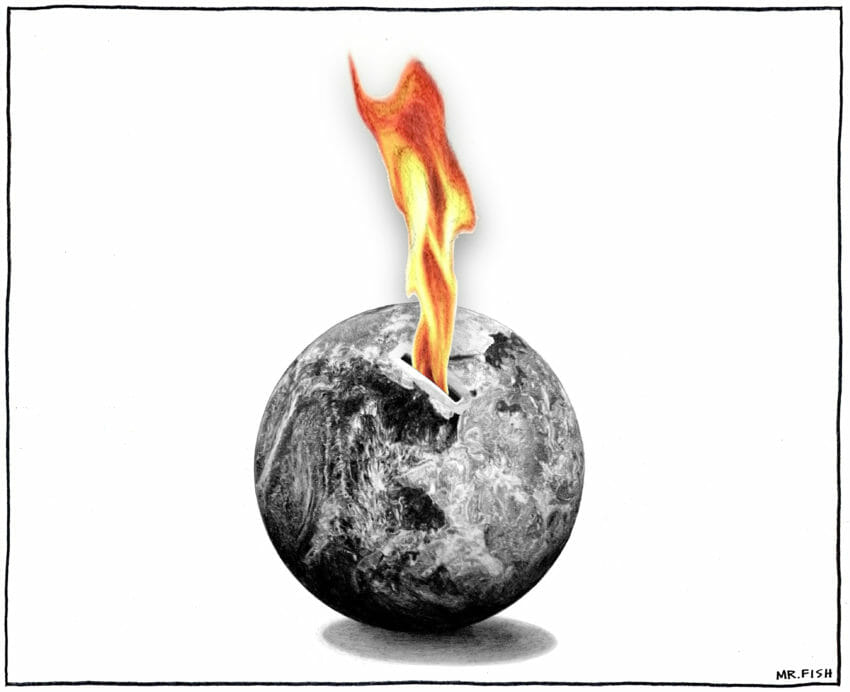
Featured image is from Mr. Fish/Truthdig.

martedì 10 aprile 2018

There Is No Escaping History: Fiat Currency Eventually Fails

Paper currency has led to the collapse of almost every economy that has tried to institute a fiat currency to trade for goods and services. It’s not looking very well for the once mighty dollar, either.
Throughout history, attempts at using fiat currency, even today, has failed. When the government prints fiat money that isn’t backed by any value, disaster inevitably ensues. Still, the long history of failed fiat currency is being ignored by today’s money printers.
At the start of the first century, the Roman denarius was a coin containing approximately 94 percent real silver. By the end of the century, the amount of silver was reduced to 85 percent. Devaluing the denarius meant Nero and succeeding emperors could pay off their bills more easily while becoming richer. A hundred years later, the denarius contained less than 50 percent silver, and in 244 A.D., Emperor Philip the Arab devalued the currency down to 0.05 percent silver content. By the time the Roman empire collapsed, the denarius was made of 0.02 percent silver, and it became useless as a currency.
Copper backed China’s initial paper currency. When copper became scarce, China began to make iron coins. The iron currency became overissued and soon became devalued. By the 11th century, a Szechuan bank issued another paper currency that could be exchanged for valuable goods such as rare metals or silk. Continuous war with neighboring Mongols caused economic inflation. China lost the war to Genghis Khan, who was too busy with other conquests to take much interest in China. Genghis’ grandson Kublai brought China and its finances under Mongolian control. Kublai used fiat currency for the vast China trade, including trade with Marco Polo. Kublai simply continued to print vast amounts of money as he continued his marauding and conquering. But infusing the economy with worthless monopoly money ruined many and chaos became the norm.
France has an interesting history with paper money. It may be the only country to face economic collapse not once, not twice, but three times by flooding the country with fiat currency.
High-living Sun King Louis XIV left a debt of 3 billion livres for his successor to deal with. Louis XV desperately needed incoming tax payments and demanded these be paid in paper currency. Predictably, the paper currency was quickly overprinted and became worthless.
In the 18th century, France began another attempt at printing paper currency called assignats. By the end of the century, the assignat suffered 13,000 percent inflation. Napoleon rode to the rescue by instituting the gold franc, which stabilized France’s erratic currency. One would think the French might have seen a connection between the stable economy and gold-backed currency. No such luck.
France reverted to paper currency in the 1930s, the paper franc. In just more than a decade, the fiat franc became devalued by 99 percent. France’s third attempt at printing worthless monopoly money proved to be a dismal failure.
Following WWI, Germany’s Weimar Republic faced historic debts. So, Germany put the printing presses to work – a total of 133 printing companies were kept busy. The mark became more than worthless. It was used to heat furnaces. Burning the paper currency to keep warm was more efficient than using it for trade.

A wheel barrel became a wallet.
Throughout the 20th century, many other countries flooded their economy with fiat currency – and collapsed as a result. The direct correlation between government interference with money and the devaluation of currency seems to escape many.
Has the US learned anything about fiat money? The Colonies happily jumped on the fiat currency bandwagon and began flooding the land with their own paper money. When these currencies quickly became overissued, they became – surprise! – devalued. Like the marc to come a few centuries later, colonial currency made for excellent bathroom tissue. The Revolutionary War was financed with a paper currency called the continental. It, too, crashed on a grand scale. This, finally, brought about some healthy American distrust for fiat currency. The US dollar was now backed by actual gold and saw the most splendid and richest economic growth in history. People came from all parts of the globe to be a part of such a success story.
As if on schedule, the Federal Reserve appeared. Currency once again fell under the aegis of government control and manipulation. In 1933, President Roosevelt made ownership of gold illegal. The ties between the US dollar and the country’s gold reserves were severed gradually until President Nixon eliminated the gold standard entirely in 1971. The once mighty US dollar instantly turned into fiat currency. This was followed by a decade of disastrous inflation.
The US has followed the historical pattern of paper money. The government is currently printing dollars with abandon to pay off its record debt (sound like a familiar refrain?). Following a long historical precedence, the US dollar is losing value at an alarming rate as we head into a period of high inflation.
As history has demonstrated, inflation is a guaranteed devaluer of currency. Following WWII, Greece saw an increase in inflation of 18 percent per day. The country’s deficit tripled within a year. And then things got really bad. An invasion by the Axis powers saw income plummet by 70 percent. Like so many other countries in the past, Greece started printing worthless currency and experienced one of the worse hyperinflations in history.

As previously stated, Germany’s Weimar Republic faced unprecedented debt in the wake of WWI. No country would accept its worthless mark as repayment, forcing Germany to sell off marks for other foreign currencies at any price. This lead to Germany’s famous hyperinflation of 29,500 percent.
Zimbabwe is famous for its 100 trillion-dollar note during its period of catastrophic hyperinflation. Prices doubled daily as Zimbabwe faced hyperinflation of 79 billion percent in 2008. A loaf of bread was priced at 35 million Zimbabwe dollars. Government intervention can invariably be found as the source of any hyperinflation.
There is no escaping history. Paper money and out-of-control national debts have always devalued the currency and caused massive inflation. The US dollar remains on the cusp. It is anyone’s guess which way it will go. But the roadmap to a financial disaster was printed thousands of years ago. Is anyone paying attention?

giovedì 14 dicembre 2017

Bitcoin vs Fiat Currency: Which Fails First?

What if bitcoin is a reflection of trust in the future value of fiat currencies?
I am struck by the mainstream confidence that bitcoin is a fraud/fad that will soon collapse, while central bank fiat currencies are presumed to be rock-solid and without risk. Those with supreme confidence in fiat currencies might want to look at a chart of Venezuela's fiat currency, which has declined from 10 to the US dollar in 2012 to 5,000 to the USD earlier this year to a current value in December 2017 of between 90,000 and 100,000 to $1:
On 1 December, the bolivar traded in the parallel market at 103,024 VED per USD, a stunning 59.9% depreciation from the same day last month.
Analysts participating in the LatinFocus Consensus Forecast expect the parallel dollar to remain under severe pressure next year. They project a non-official exchange rate of 2,069,486 VEF per USD by the end of 2018. In 2019, the panel sees the non-official exchange rate trading at 2,725,000 VEF per USD.

Gordon Long and I discuss Fiat Currency Failure (The Results of Financialization - Part IV) in a new 31-minute video.
 The bottom line is that fiat currencies are debt-based claims on future profits, energy production and wages, claims that are expanding far faster than the real economy and the productivity of the real economy.If this is your idea of rock solid, I'll take my chances with bitcoin, which currently buys more than 1 billion bolivars. Of course "it can't happen here," which is precisely what the good people of Venezuela thought a decade ago.
In effect, fiat currencies and debt are like inverted pyramids resting on a small base of actual collateral.
If you look at the foundations of fiat currencies, you find loose sand, not bedrock. Massive mountains of phantom wealth have been created by central-bank inflated bubbles, bubbles based not on actual expansion of net income earned from producing goods and services, but on financialization, the pyramiding of debt and leverage on a small base of real assets.
"Free money" that accrues interest isn't free. Eventually the interest eats debtors alive, regardless of the debtor's size or supposed wealth.
Creating "free money" in unlimited quantities impoverishes everyone who holds the currency. In the initial boost phase, the issuance of "nearly free money" to borrowers, qualified or not, generates the illusion of prosperity. But once the boost phase ends, reality sets in and marginal borrowers default, inflation moves from assets (good inflation) to real-world essentials (bad inflation), and creating more "free money" ceases to be the solution and becomes the problem
Yes, cryptocurrencies are risky--but so are fiat currencies. Illusory "wealth" evaporates, and expanding credit-based "risk-free money" at rates that exceed the rate of expansion of the real economy reduces the purchasing power of all those holding the currency. Eventually trust in the currency, and in the authorities who control its issuance, erodes, and a self-reinforcing feedback loop turns the rock-solid currency into sand.
What if bitcoin is a reflection of trust in the future value of fiat currencies? Those dismissing bitcoin as a fad might be missing the point: trust in the authorities who control the expansion of fiat currencies might be eroding fast in a certain segment of the populace.
And more importantly, they might be right, and everyone who placed their trust in the authorities who control the expansion of fiat currencies ends up holding a handful of sand.
Fonte: qui