9 dicembre forconi: Crisis
Visualizzazione post con etichetta Crisis. Mostra tutti i post

giovedì 1 novembre 2018

Has The Derivatives Volcano Already Begun To Erupt?

The cure for the last crisis always turns into the cause of the next one...
The economies of southern Europe – Greece, Italy, Spain and Portugal – nearly collapsed in 2011, and Europe’s monetary authorities responded with negative interest rates. So did Japan.
Europeans and Japanese pay to hold cash or own 10-year German government bonds, which means that every pension fund and insurer will fold in a finite time horizon. They responded by exporting more, saving more, and buying American assets that still pay a positive, if low, real yield.
Hedging the foreign exchange risk in this half-trillion-dollar per year business has exhausted the balance sheet of the global banking system. That explains a large part of the jump in the US 10-year note yield to 3.2% last Friday from 2.85% in early September. Hedging the foreign exchange risk in these massive flows created a derivatives mountain, and it has started to spew smoke and lava.
Banks are rationing foreign-exchange swap lines, making hedges so expensive that German and Japanese investors can no longer afford to buy US bonds. If the foreign bid for US debt dries up, the cost of financing America’s $1 trillion annual budget deficit will rise, and so will interest costs around the world.
The mechanics of hedging trillions of dollars of capital flows are complex, but the economics are simple. Germany and Japan together export half a trillion dollars a year of goods and services more than they import. America imports more than half a trillion dollars of goods and services more than it exports.
Germany and Japan have negative real interest rates, so their investors buy American bonds at positive real interest rates. But Germans and Japanese have to pay out Euros and yen, not dollars. They go to their banks to swap dollar income into local-currency income. The banks borrow dollars in the United States, sell them in the forward market and receive Euros and yen.
European banks are running out of borrowing capacity. After five years of negative short-term rates, their profitability is low, their stock prices are falling and their credit is deteriorating. They can no longer borrow the dollars required to construct the hedges that local investors need.
Foreign exchange derivatives form the biggest mountain of obligations in the world financial system – a notional amount of about $90 trillion, up from $60 trillion in 2010. Breaking down the numbers, Bank for International Settlements (BIS) economists showed that the foreign exchange derivatives taken on by non-financial corporations tracked the growth of world trade, and the derivative obligations of nonbank financial institutions – money managers and insurance companies – tracked international securities investments (see chart below).
The BIS economists led by Robert McCauley note that non-US banks now owe $10.7 trillion in US dollars, most of which reflects the hedging requirements of these global flows. The banks don’t report foreign exchange swaps with their customers on their balance sheets, but the BIS estimates that these obligations amount to $13 or $14 trillion.

The US

For more than one year, international bank regulators and the International Monetary Fund have warned that the banking system no longer can support these enormous flows. The Federal Reserve is tightening liquidity in the US, and in a volatile market, European banks might not be able to roll over nearly $11 trillion of short-term obligations – and might default.
As the BIS warned in September 2017: 
The combination of balance sheet vulnerabilities and market tightening could trigger funding problems in the event of market strains. Market turbulence may make it more difficult for banks to manage currency gaps in volatile swap markets, possibly rendering some banks unable to roll over short-term dollar funding. Banks could then act as an amplifier of market strains if funding pressures were to compel banks to sell assets in a turbulent market to pay their liabilities that are due.
Funding pressure could also induce banks to shrink dollar lending to non-US borrowers, thus reducing credit availability. Ultimately, there is a risk that banks could default on their dollar obligations.
The market turbulence of which the BIS warned in its September 2017 quarterly report is now upon us: Italy’s populist government threatens to increase the country’s sovereign debt, already at an unsustainable 130% of GDP. Yields on Italy’s debt have soared, and bank stocks have collapsed. 
The creditworthiness of some of Europe’s largest banks has deteriorated. In the case of Deutsche Bank, the cost of hedging against bond defaults over the next five years has doubled since the Italian crisis erupted in May.
As the credit of European banks deteriorates, US regulators require American banks who lend to them to put up more reserves against their exposure. That raises the cost of refinancing the $12 trillion or so of European bank borrowings from American banks, and it probably has led to a reduction in credit lines. European banks, in return, have to charge exorbitant rates to customers for hedging.
The crunch hit at the end of the third quarter, when European banks’ short-term credit line in US dollars had to be renewed. Data for the volume of interbank lending aren’t available yet, but the cross-currency “basis swap” between Euros and US dollars – the spread that banks charge their customers for expanding their balance sheets to provide foreign exchange hedges – suddenly widened.
The 0.3%, or 30 basis points, shift in the so-called basis swap was big enough to wipe out any advantage that European investors might obtain from buying US dollar securities and swapping the cash flows back into euro.
Meanwhile, Deutsche Bank researchers noted in an October 3 report: “On 27 September, the cost of dollar-denominated forex-hedged investments from Japan jumped to 315bp, the highest level since the 2008 financial crisis .”
Effectively, that wiped out the incentive for Japanese investors to buy US bonds. Japanese 10-year notes yield about 0.14% and US Treasuries yield 3.23%, so the 3.15% cost of hedging wipes out the yield advantage for Japanese investors. The reason for the shift was a 0.46% jump in the yen-dollar basis swap in a single business day. Dollar loans are getting scarce for Japanese banks as well.
If overseas investors can’t recycle the half-trillion-dollar US current account deficit into dollar-based securities because the banking system can’t provide the foreign exchange hedges, US yields will rise, perhaps sharply. It will be harder for the US Treasury to borrow the $1 trillion it requires each year, and the cost of debt service will add to the US budget deficit – every 1% increase in borrowing costs adds $200 billion in debt service to the budget.
I doubt that European governments would allow their banks to default on dollar obligations; long before that could happen, European regulators would arrange shotgun mergers and emergency recapitalizations. But the risk remains that dollar credit will seize up globally, with disastrous consequences for countries that have to borrow dollars to cover deficits.
10/10/2018

venerdì 21 settembre 2018

"How Long Til All Hell Breaks Loose": This Is Now The Strongest Ever Rally During A Fed Tightening Cycle

The US stock market just keeps crushing historical records: longest bull market ever, S&P rising above 2,900, two trillion-dollar stocks, an unprecedented divergence between US stock and the rest of the world, and now - the strongest ever rally during a Fed tightening period.
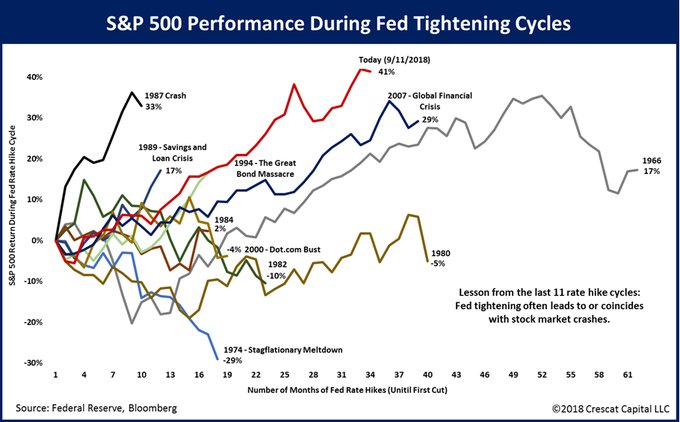
According to an analysis by Crescat Capital's Tavi Costa, since the first rate hike by the Fed in December 2015, some 34 months ago, the S&P has risen by 41%: that puts this post-hike rally in the top spot of all previous market advances in a time when the Fed has been tightening financial conditions.


This is the strongest rally ever during a Fed tightening period, and now we are at record valuations. How long until all hell breaks loose?
Of course, the reason for this relentless rally has been discussed extensively and has to do with fungible global liquidity, largely as a result of the ECB and BOJ still injecting liquidity, not to mention the SNB and various sovereign wealth funds recycling petrodollars and buying US stocks directly.
The question, however, as Costa puts it "How long until all hell breaks loose?"
This is a good question, because as Bloomberg writes, "the downfall that has often followed these rallies in the past" could - or rather should - be cause for concern. For example, the second-strongest rally before the current one, came just before the crash of 1987, with the S&P 500 rising 33% between the first interest rate increase and the first cut. Black Monday followed.
Since 2015, the Fed has raised seven times since 2015 and analysts predict it’s set to boost rates again when the central bank’s open market committee meets this month. However, one week ago Stifel's Barry Bannister calculated that the Fed will only be able to hike at most two more times before triggering a bear market, as the Fed Funds rate rises above the neutral rate of inflation in early 2019.
In a similar vein, earlier this year, Bank of America joined Deutsche Bank in warning that "every Fed tightening cycle has created a crisis."
More recently, on Tuesday SocGenchief economist Klaus Baader said that risks are growing as the global economic expansion ages, and noted factors such as trade tensions, emerging-market fragility, and monetary policy tightening.
“As the cycle matures, so exceptional monetary accommodation is being wound back, lessening the tailwinds for the U.S. economy,” he said.
Alternatively, some have suggested that a decade of persistently low interest rates and quantitative easing may make this time around different, although it is unclear if that means an even more violent crash when one finally does come.
Responding to the $64 trillion question, Natixis' chief economist, Joseph LaVorgna, said that how long this market can keep on running will depend on future central bank’s policies.
"What I tell people is, ‘The Fed no longer has your back,”’ LaVorgna said in an interview at Bloomberg’s New York headquarters. "We’re exiting a period of extraordinary monetary easing and going to a period where monetary policy is less accommodative."
This is shown in the chart below, a reminder that in the next few months the global liquidity injection will turn negative for the first time since the crisis.

Whether the algos will notice is a different question.
Fonte: qui

lunedì 17 settembre 2018

Conjuring Up the Next Depression

During the financial crisis of 2008, the world’s central banks, including the Federal Reserve, injected trillions of dollars of fabricated money into the global financial system. This fabricated money has created a worldwide debt of $325 trillion, more than three times global GDP. The fabricated money was hoarded by banks and corporations, loaned by banks at predatory interest rates, used to service interest on unpayable debt or spent buying back stock, providing millions in compensation for elites. The fabricated money was not invested in the real economy. Products were not manufactured and sold. Workers were not reinstated into the middle class with sustainable incomes, benefits and pensions. Infrastructure projects were not undertaken. The fabricated money reinflated massive financial bubbles built on debt and papered over a fatally diseased financial system destined for collapse.
What will trigger the next crash? 
The $13.2 trillion in unsustainable U.S. household debt? 
The $1.5 trillion in unsustainable student debt? 
The billions Wall Street has invested in a fracking industry that has spent $280 billion more than it generated from its operations? 
Who knows. What is certain is that a global financial crash, one that will dwarf the meltdown of 2008, is inevitable. And this time, with interest rates near zero, the elites have no escape plan. The financial structure will disintegrate. The global economy will go into a death spiral. The rage of a betrayed and impoverished population will, I fear, further empower right-wing demagogues who promise vengeance on the global elites, moral renewal, a nativist revival heralding a return to a mythical golden age when immigrants, women and people of color knew their place, and a Christianized fascism.
The 2008 financial crisis, as the economist Nomi Prins points out, “converted central banks into a new class of power brokers.” They looted national treasuries and amassed trillions in wealth to become politically and economically omnipotent. In her book “Collusion: How Central Bankers Rigged the World,” she writes that central bankers and the world’s largest financial institutions fraudulently manipulate global markets and use fabricated, or as she writes, “fake money,” to inflate asset bubbles for short-term profit as they drive us toward “a dangerous financial precipice.”
“Before the crisis, they were just asleep at the wheel, in particular, the Federal Reserve of the United States, which is supposed to be the main regulator of the major banks in the United States,” Prins said when we met in New York. “It did a horrible job of doing that, which is why we had the financial crisis. It became a deregulator instead of a regulator. In the wake of the financial crisis, the solution to fixing the crisis and saving the economy from a great depression or recession, whatever the terminology that was used at any given time, was to fabricate trillions and trillions of dollars out of an electronic ether.”
The Federal Reserve handed over an estimated $29 trillion of this fabricated money to American banks, according to researchers at the University of Missouri
Twenty-nine trillion dollars! 
We could have provided free college tuition to every student or universal health care, repaired our crumbling infrastructure, transitioned to clean energy, forgiven student debt, raised wages, bailed out underwater homeowners, formed public banks to invest at low interest rates in our communities, provided a guaranteed minimum income for everyone and organized a massive jobs program for the unemployed and underemployed. Sixteen million children would not go to bed hungry. The mentally ill and the homeless—an estimated 553,742 Americans are homeless every night—would not be left on the streets or locked away in our prisons. The economy would revive. Instead, $29 trillion in fabricated money was handed to financial gangsters who are about to make most of it evaporate and plunge us into a depression that will rival that of the global crash of 1929.
Kevin Zeese and Margaret Flowers write on the website Popular Resistance,
“One-sixth of this could provide a $12,000 annual basic income, which would cost $3.8 trillion annually, doubling Social Security payments to $22,000 annually, which would cost $662 billion, a $10,000 bonus for all U.S. public school teachers, which would cost $11 billion, free college for all high school graduates, which would cost $318 billion, and universal preschool, which would cost $38 billion. National improved Medicare for all would actually save the nation trillions of dollars over a decade.”
An emergency clause in the Federal Reserve Act of 1913 allows the Fed to provide liquidity to a distressed banking system. But the Federal Reserve did not stop with the creation of a few hundred billion dollars. It flooded the financial markets with absurd levels of fabricated money. This had the effect of making the economy appear as if it had revived. And for the oligarchs, who had access to this fabricated money while we did not, it did.
The Fed cut interest rates to near zero. Some central banks in Europe instituted negative interest rates, meaning they would pay borrowers to take loans. The Fed, in a clever bit of accounting, even permitted distressed banks to use these no-interest loans to buy U.S. Treasury bonds. The banks gave the bonds back to the Fed and received a quarter of a percent of interest from the Fed. In short, the banks were loaned money at virtually no interest by the Fed and then were paid interest by the Fed on the money they borrowed. The Fed also bought up worthless mortgage assets and other toxic assets from the banks. Since Fed authorities could fabricate as much money as they wanted, it did not matter how they spent it.
“It’s like going to someone’s old garage sale and saying, ‘I want that bicycle with no wheels. I’ll pay you 100 grand for it. Why? Because it’s not my money,’ ” Prins said.
“These people have rigged the system,” she said of the bankers. “There is money fabricated at the top. It is used to pump up financial assets, including stock. It has to come from somewhere. Because money is cheap there’s more borrowing at the corporate level. There’s more money borrowed at the government level.”
“Where do you go to repay it?” she asked. “You go into the nation. You go into the economy. You extract money from the foundational economy, from social programs. You impose austerity.”
Given the staggering amount of fabricated money that has to be repaid, the banks need to build greater and greater pools of debt. This is why when you are late in paying your credit card the interest rate jumps to 28 percent. This is why if you declare bankruptcy you are still responsible for paying off your student loan, even as 1 million people a year default on student loans, with 40 percent of all borrowers expected to default on student loans by 2023. This is why wages are stagnant or have declined while costs, from health care and pharmaceutical products to bank fees and basic utilities, are skyrocketing. The enforced debt peonage grows to feed the beast until, as with the subprime mortgage crisis, the predatory system fails because of massive defaults. There will come a day, for example, as with all financial bubbles, when the wildly optimistic projected profits of industries such as fracking will no longer be an effective excuse to keep pumping money into failing businesses burdened by debt they cannot repay.
“The 60 biggest exploration and production firms are not generating enough cash from their operations to cover their operating and capital expenses,” Bethany McLean writes of the fracking industry in an article titled “The Next Financial Crisis Lurks Underground” that appeared in The New York Times. “In aggregate, from mid-2012 to mid-2017, they had negative free cash flow of $9 billion per quarter.”
The global financial system is a ticking time bomb. The question is not if it will explode but when it will explode. And once it does, the inability of the global speculators to use fabricated money with zero interest to paper over the debacle will trigger massive unemployment, high prices for imports and basic services, and a devaluation in which the dollar will become nearly worthless as it is abandoned as the world’s reserve currency. This manufactured financial tsunami will transform the United States, already a failed democracy, into an authoritarian police state. Life will become very cheap, especially for the vulnerable—undocumented workers, Muslims, poor people of color, girls and women, anti-capitalist and anti-imperialist critics branded as agents of  foreign powers—who will be demonized and persecuted for the collapse. The elites, in a desperate bid to cling to their unchecked power and obscene wealth, will disembowel what is left of the United States.
*
Chris Hedges is a Pulitzer Prize-winning journalist, a New York Times best-selling author, a professor in the college degree program offered to New Jersey state prisoners by Rutgers University, and an ordained Presbyterian minister. He has written 12 books, including the New York Times best-seller “Days of Destruction, Days of Revolt” (2012), which he co-authored with the cartoonist Joe Sacco.
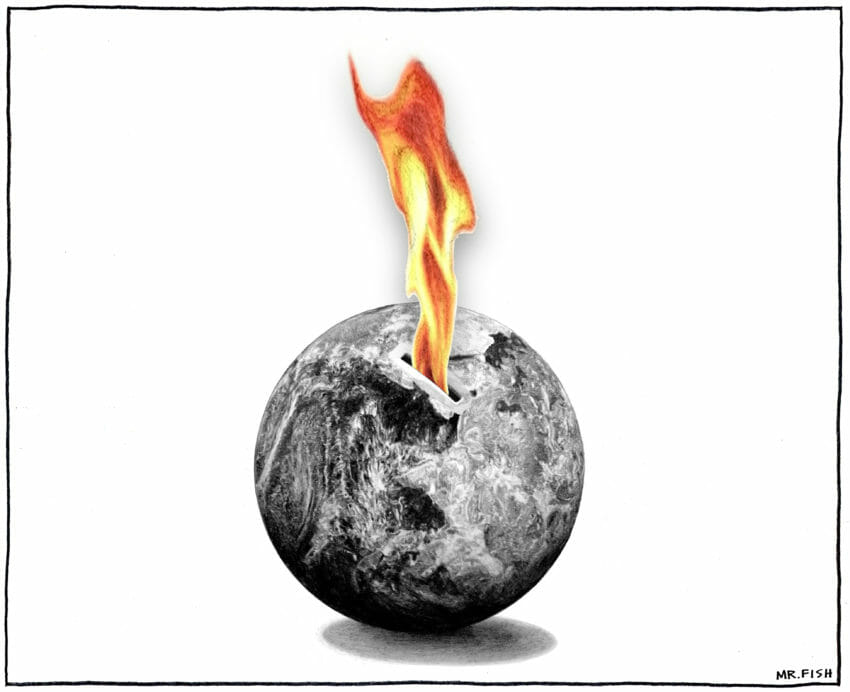
Featured image is from Mr. Fish/Truthdig.

domenica 16 settembre 2018

Is South Africa The Next Currency Crisis?

South Africa, famous for Great White sharks, could be the next focus for currency vigilantes.
2018 has been marked by various emerging market crises. From Turkey to Argentina, confidence has eroded, resulting in bond and currency chaos. There is a growing focus on South Africa, and our analysis suggests that will continue.
When examining whether an emerging market country is at risk of a currency crisis, the economic indicator of choice is Import Cover. This gives a measurement of the amount of a country’s foreign exchange reserves relative to its imports. It is usually expressed in terms of how many months of imports the foreign exchange reserves are able to buy before they run out. An emerging market country with 10 or more months of import cover is considered to be stable. South Africa’s Import Cover is 5.5 months, down from 7.2 months at the end of 2015. According to World Bank data, that’s about the same as Turkey. (For perspective, China’s Import Cover is 16 months.) What this means is that there is increasing pressure on South Africa’s foreign exchange reserves, which not only have to pay for imports but also have to service the country’s external debt. Reserves are also used to defend a currency from attack via intervention, but a country with low reserves has little defense. And once the currency market sharks get a sniff of blood in the water, it can get quite frenzied very quickly.
Thankfully, we do not have to guess about all the different economic variables that could or could not happen. We rely on what we consider to be the best lead indicator – the market price. The chart below shows the amount of South African rand needed to buy one U.S. dollar. The exchange rate hit a low of 11.5078 in February this year, and it currently hovers around 15. Our Elliott wave analysis is pointing to much higher levels in the exchange rate, meaning a depreciating rand. Expect fears of a South African rand crisis to grow.
Sud Africa la prossima crisi valutaria
About Murray Gunn
Murray Gunn is Head of Research for Elliott Wave International’s Global Market Perspectivea monthly summary of the firm’s 25 analysts’ views on every major freely-traded market in the world. After earning his Master of Arts (Honors) degree in Economics from the University of Dundee in Scotland in 1991, Gunn went into fund management. He quickly realized that textbook descriptions don’t apply to real-world markets, which in turn led him to technical analysis and the Elliott Wave Principle. He worked as a fund manager in global bonds, currencies and stocks, including long posts at Standard Life Investments and a five-year stint in the Middle East at the Abu Dhabi Investment Authority. Gunn then joined HSBC as Head of Technical Analysis. He has served on the board of the Society of Technical Analysts and delivered lectures on the Elliott Wave Principle to students at The London School of Economics, Queen Mary University and Kings College London. You can read Gunn’s commentary in Elliott Wave International’s Global Market PerspectiveInterest Rates and Currency Pro Services, and on deflation.com.
About Elliott Wave International
Elliott Wave International is the largest independent technical analysis firm in the world. Its award-winning publications provide useful insights and engaging commentary on all major financial asset classes and indexes around the globe. EWI’s unique perspective on market behaviour and cultural trends sets it apart from other financial publications.