9 dicembre forconi: rate
Visualizzazione post con etichetta rate. Mostra tutti i post

lunedì 11 giugno 2018

Jim Rickards: A Recession Is Coming And The Fed Is Not Prepared For It

Jim says the Fed is preparing by praying and doing this, which could actually bring on the next recession in and of itself. Here’s the details…
Is the Fed ready for the next recession?
The answer is no.
Extensive research shows that it takes between 300 and 500 basis points of interest rate cuts by the Fed to pull the U.S. economy out of a recession. (One basis point is 1/100th of 1 percentage point, so 500 basis points of rate reduction means the Fed would have to cut rates 5 percentage points.)
Right now the Fed’s target rate for fed funds, the so-called “policy rate,” is 1.75%. How do you cut rates 3–5% when you’re starting at 1.75%? You can’t.
Negative interest rates won’t save the day. Negative rates have been tried in Japan, the eurozone, Sweden and Switzerland, and the evidence is that they don’t work to stimulate the economy.
The idea of negative rates is that they’re an inducement to spend money; if you don’t spend it, the bank takes it from your account — the opposite of paying interest. Yet the evidence is that people save more with negative rates in order to meet their lifetime goals for retirement, health care, education, etc.
If the bank is taking money from your account, you have to save more to meet your goals. That slows down spending or what neo-Keynesians call aggregate demand. This is just one more example of how actual human behavior deviates from egghead theories.
The bottom line is that zero means zero. If a recession started tomorrow, the Fed could cut rates 1.75% before they hit zero. Then they would be out of bullets.
What about more quantitative easing, or “QE”? The Fed ended QE in late 2014 after three rounds known as QE1, QE2 and QE3 from 2008–2014. What about QE4 in a new recession?
The problem is that the Fed never cleaned up the mess from QE1, 2 and 3, so their capacity to run QE4 is in doubt.
From 2008–2014, over the course of QE1, 2 and 3, the Fed grew its balance sheet from $800 billion to $4.4 trillion. That added $3.6 trillion of newly printed money, which the Fed used to purchase long-term assets in an effort to suppress interest rates across the yield curve.
The plan was that lower long-term interest rates would force investors into riskier assets such as stocks and real estate. Ben Bernanke called this manipulation the “portfolio channel” effect.
These higher valuations for stocks and real estate would then create a “wealth effect” that would encourage more spending. The higher valuations would also provide collateral for more borrowing. This combination of more spending and lending was supposed to get the economy on a sustainable path of higher growth.
This theory was another failure by the eggheads.
The wealth effect never emerged, and the return of high leverage never returned in the U.S. either. (There is a lot more leverage overseas in emerging-market dollar-denominated debt, but that’s not what the Fed was hoping for. The EM dollar-debt bomb is another accident waiting to happen that I’ll explore in a future commentary.)
The only part of the Bernanke plan that worked was achieving higher asset values, but those values now look dangerously like bubbles waiting to burst. Thanks, Ben.
The problem now is that all of that leverage is still on the Fed’s balance sheet. The $3.6 trillion of new money was never mopped up by the Fed; it’s still there in the form of bank reserves. The Fed has begun a program of balance sheet normalization, but that program is not far along. The Fed’s balance sheet is still over $4 trillion.
That makes it highly problematic for the Fed to start QE4. When they started QE1 in 2008, the balance sheet was $800 billion. If they started a new QE program today, the they would be starting from a much higher base.
The question is whether the Fed could take their balance sheet to $5 trillion or $6 trillion in the course of QE4 or QE5?
In answering that question, it helps to bear in mind the Fed only has $40 billion in capital. With current assets of $4.4 billion, the Fed is leveraged 110-to-1. That’s enough leverage to make Bernie Madoff blush.
To be fair to the Fed, their leverage would be much lower if their gold certificates issued by the Treasury were marked to market. That’s a story for another day, but it does say something significant about the future role of gold in the monetary system.
Modern Monetary Theory (MMT) led by left-wing academics like Stephanie Kelton see no problem with the Fed printing as much money as it wants to monetize Treasury debt. MMT is almost certainly incorrect about this.
There’s an invisible confidence boundary where everyday Americans will suddenly lose confidence in Fed liabilities (aka “dollars”) in a hypersynchronous phase transition. No one knows exactly where the boundary is, but no one wants to find out the hard way.
It’s out there, possibly at the $5 trillion level. The Fed seems to agree (although they won’t say so). Otherwise they would not be trying to reduce their balance sheet today.
So if a recession hit tomorrow, the Fed would not be able to save the day with rate cuts, because they’d hit the zero bound before they could cut enough to make a difference. They would not be able to save the day with QE4, because they’re already overleveraged.
What can the Fed do?
All they can do is raise rates (slowly), reduce the balance sheet (slowly) and pray that a recession does not hit before they get things back to “normal,” probably around 2021. What are the odds of the Fed being able to pull this off before the next recession hits?
Not very good.
Have a look at the chart below. It shows the length of all economic expansions since the end of World War II.
The current expansion is shown with the orange bar. It started in June 2009 and has continued until today. It is the second-longest expansion since 1945, currently at 107 months. It is longer than the Reagan-Bush expansion of 1982–90.
It is longer than the Kennedy-Johnson expansion of 1961–69. It’s longer than any expansion except the Clinton-Gingrich expansion of 1991–2001. Just on a statistical basis, the odds of this expansion turning to recession before the end of 2020 are extremely high.
In short, there’s a very high probability that the U.S. economy will go into recession before the Fed is prepared to get us out of it.
That means once the recession starts, the U.S. may stay in the situation for decades, which is exactly what happened to Japan beginning in 1990. By the way, Japan’s most recent GDP report for the first quarter of 2018 showed negative growth. Japan has had three “lost decades.” The U.S. is just finishing its first lost decade and may have two more to go.
The situation is even worse than this dire forecast suggests. The reason is that by preparing to fight the next recession, the Fed may actually cause the recession they’re preparing to cure. It’s like trying to run a marathon while being chased by a hungry bear.
The Fed needs to raise rates and reduce their balance sheet in order to have enough policy leeway to fight a recession. If they move too quickly, they’ll cause a recession. If they move too slowly, they’ll run out of time and get eaten by the bear.
This is the ultimate monetary finesse. This mess was caused by Bernanke’s failure to raise rates in 2010 and 2011 when the economy was in the early stages of an expansion and in a better position to absorb rate hikes. It was also caused by Bernanke’s insistence on QE2 and QE3 despite zero evidence then or now that it does any good. (QE1 was actually needed to deal with a liquidity crisis, but that was over in 2009. There’s no excuse for what came later.)
A recession is coming, the Fed is unprepared and it’s extremely unlikely the Fed will be prepared in time.
The Fed may not be ready, but you can be. This is a time to reduce your exposure to risky assets such as stocks, increase your allocation to safe assets such as cash and allocate 10% of your portfolio to gold and silver as insurance against a collapse scenario much worse than a recession.
The only other recommendation is to do what the Fed is doing… pray.

giovedì 7 dicembre 2017

The Cost Basis of our Economy is Spiraling Out of Control

What will it take to radically reduce the cost basis of our economy?
If we had to choose one "big picture" reason why the vast majority of households are losing ground, it would either be the stagnation of income or the spiraling out of control cost basis of our economy, that is, the essential foundational expenses of households, government and enterprise.
Clearly, both rising costs and stagnating income cause households to lose ground, i.e. their income buys fewer goods and services every year.
I've often covered the dynamics of stagnating income for the bottom 95%, and real-world inflation, i.e. a decline in purchasing power.
But neither of these dynamics fully describes the relentless upward spiral of the cost basis of our economy, that is, the cost of essentials and the foundations of the economy: education, healthcare, energy and labor.
These expenses are pushing the costs of virtually every good and service, public and private, higher in a self-reinforcing spiral. The costs of education are spiraling out of control, stripping households of income as an entire generation is transformed into debt-serfs by student loan debt. The soaring costs of healthcare are a core driver of higher costs in the education complex (and government in general), and to cover these higher costs, counties raise property taxes, which add additional cost burdens to households and enterprises as rents rise.
Rising rents push the cost structure of almost every enterprise and agency higher.
Then there's the asset inflation created by central bank ZIRP (zero interest rate policy) which has inflated a second echo-bubble in housing that has pushed home ownership out of reach of many, adding demand for rental housing that has pushed rents into the stratosphere in Left and Right Coast cities.
Let's look at a few charts that illustrate the relentless rise in the cost basis of our economy:
Do you reckon these two charts are connected--soaring costs and ballooning administrative payrolls?
Student loan debt is soaring above $1 trillion, guaranteeing profits to lenders and debt-serfdom to the students exiting with degrees that are in over-supply, i.e. possessing little scarcity value in an over-credentialed economy:
The echo housing bubbles in many locales exceed the nosebleed valuations of the previous bubble:
And how do we pay for these spiraling out of control costs? By borrowing more, of course:
Courtesy of Lance Roberts, here's a chart depicting how households are filling the widening gap between income and expenses with debt. This is another self-reinforcing spiral of rising costs, as debt accrues interest, adding costs at every turn of the spiral.
What will it take to radically reduce the cost basis of our economy? A fundamental re-ordering that breaks up all the cartels and quasi-monopolies that push prices higher even as they deliver lower quality goods and services would be a good start.
Fonte: qui

domenica 24 settembre 2017

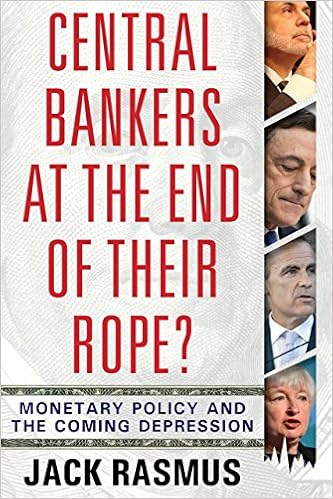
The US Federal Reserve 4.5 Trillion Sell-Off. “Central Bankers at the End of Their Ropes”

This past week the US central bank, the Federal Reserve, announced it would begin selling off its $4.5 trillion debt that it accumulated since 2008 by buying up investors’ toxic mortgage and T-bonds at above market rates.
The Fed has continually argued ever since 2008 this was necessary in order to ‘bail out the banks’. But the banks were bailed by 2010, and the free money from the Fed continued another six years. The Fed $4.5 trillion bond buying spree then drove down interest rates at which banks could borrow from the Fed to historic lows of 0.1%-0.25%, in effect further subsidizing the banks for 8 more years.
What was originally a bank bailout in 2008-09 thus became a more or less permanent ‘banking system subsidization’ program by the Fed, which has resulted in banks becoming addicted to the virtual free money. The Fed’s just announced start of selling its debt–which will have the effect of raising interest rates–is a mere token effort and won’t succeed in any serious reduction of its debt.
As I predict, and explain in my recent book, ‘Central Bankers at the End of Their Ropes’, Clarity Press, August 2017, the Fed now cannot raise rates beyond 2% (now at 1.25%) much without precipitating another financial crisis, or without collapsing currencies and economies in emerging markets, or without causing US multinationals offshore a major profits contraction, or without seriously undermining US exports and thus an already fragile US economy that already shows signs of slowing in 2018.
Thus the recent Fed announcement of sell off of its $4.5 trillion debt is a ‘token’ and a ‘fiction’. The Fed will be stuck with more than $4 trillion in debt by 2019, and will soon have to add even more to it when the next recession occurs circa 2019-20 or perhaps even sooner.
The Fed itself knows this. That’s why the announcement was a token $10 billion sell off per month, and marginally more thereafter. Before it reaches $.5 trillion in sales, and the 2% ceiling interest rate, it will have to stop, or even reverse its balance sheet selling. That means when the next recession or financial crisis occurs, the Fed will open the money spigot again and add still more to its debt–and now on top of the $4 trillion or so debt that will still remain. The US central bank is doomed to go ever deeper in debt in order to continue its program of private banking system ‘subsidization’, which has become a major characteristic of 21st century capitalism and banking. The private sector is becoming more and more dependent on the capitalist state and its central banks to prop up and support its long run faltering investment and profit trends. What was once termed a bank bailout function (called ‘lender of last resort’) has become a banking system ‘subsidization’ function.
This new role of the central bank in the 21st century has also contributed greatly to the growing financialization of global capitalism, as the central bank free money flows not into real investment to produce infrastructure and real goods but rather is increasingly diverted to financial asset markets creating bubbles in stocks, bonds, derivatives, foreign exchange, and property prices–an argument, with evidence, I provided in detail in my 2016 book, ‘Systemic Fragility in the Global Economy’, Clarity Press, January 2016′.
What follows are a couple of excerpts from my ‘Central Bankers at the End of Their Ropes’ book, specifically the chapter 14 on the Yellen Fed, that discusses how the Federal Reserve under Yellen–and before that under Bernanke and Greenspan as well–have evolved into the ‘subsidization’ function as a consequence of its decades-long free money injections into the banks have led to accelerating ‘financialization’ of the global capitalist system, and in turn more frequent and severe financial bubbles, crashes, and consequent recessions.

Excerpts from Jack Rasmus, “Central Bankers at the End of Their Ropes”
1. On Banking System Subsidization by the Fed
“Central bank financial subsidization policy raises the question as to whether the primary function of the central bank in the 21st century is more than just lender of last resort, or money supply management, or bank supervision, as has been the case in the past before 2008. Certainly those primary functions continue. But a new primary function has demonstrably been added: the subsidization of finance capital rates of return and profitability—regardless of whether the financial system itself is in need of bailout or not. Globalization has intensified inter-capitalist competition and that competition compresses prices and profits. So the State, in the form of the institution of the central bank, now plays an even more direct role in ensuring prices for financial assets are not depressed (or prevented from rising) by inter-capitalist global competition; and that global competition is more than offset by central banks becoming a primary source of demand for private sector financial assets. Excess liquidity drives demand for assets, which drives the price of assets and in turn subsidizes price-determined profitability of financial institutions in particular but also of non-financial corporations that take on the characteristics of financial institutions increasingly over time as well.
“Long after banks were provided sufficient liquidity, and those in technical default (Citigroup, Bank of America, etc.) were made solvent once again, the Yellen Fed has continued the Bernanke policy of massive and steady liquidity injection. Whether the tools are QE or open market operations, modern central bank monetary policy is now about providing virtually free money (i.e. near zero and below rates). Targets are mere justifications providing an appearance of policy while the provision of money and liquidity is its essence. Tools are just means to the end. And while the ‘ends’ still include the traditional primary functions of money supply and liquidity provision, lender of last resort and banking system supervision—there may now be a new function: financial system subsidization.
“The ideological justification of QE, ZIRP and free money for banks and investors has been that the financial asset markets need subsidization (they don’t use that term however) in order to escalate their values in order, in turn, to allow some of the vast increase in capital incomes to ‘trickle down’ to perhaps boost real investment and economic growth as a consequence. They suggest there may be a kind of ‘leakage’ from the financial markets that may still get into creating real things that require hiring real people, that produce real incomes for consumption and therefore real (GDP) economic growth. But this purported financial trickle down hardly qualifies as a ‘trickle’; it’s more like a ‘drip drip’. It’s not coincidental that the ‘drip’ results in slowing real investment and therefore productivity and in turn wage growth. This negative counter-effect to central bank monetary policy boosting financial investment and financial markets now more than offsets the financial trickle-drip of monetary policy. The net effect is the long term stagnation of the real economy.
“The Fed’s function of money supply management may be performing well for financial markets but increasingly less so for the rest of the real economy. That was true under Bernanke, and that truth has continued under Yellen’s Fed as well. Central bank performance of the money supply function is in decline. The Fed is losing control of the money supply and credit—not just as a result of accelerating changes in global financialization, technology, or proliferation of new forms of credit creation beyond its influence. It is losing control also by choice, as it continually pumps more and more liquidity into the global system that causes that loss of control.”
2. The Fed’s $4.5 Trillion Balance Sheet Sell-Off
“From 2008 through May 2017, QE and other Fed liquidity programs raised the Fed’s balance sheet from $800 or so billion to $4.5 trillion. The QE programs ended in October 2014. Since then payments on bonds to the Fed could have reduced the Fed’s balance sheet. However, the Fed simply reinvested those payments again and kept the balance sheet at the $4.5 trillion level. In other words, it kept re-injecting the liquidity back into the economy—in yet another form indicating its commitment to keep providing excess liquidity to bankers and investors.
“Throughout the Yellen Fed discussions and debates have continued about whether the Fed should truly ‘sell off’ its $4.5 trillion and stop re-injecting. That would mean taking $4.5 trillion out of the economy instead of putting it in. It would sharply reduce the money supply and liquidity. It has a great potential to have a major effect raising interest rates across the board, with all the consequent repercussions—a surge in the US dollar, reducing US exports competitiveness and GDP; provoking a ‘tantrum’ in EMEs far more intense than in 2013, with EME currency collapse, capital flight, and recessions precipitated in many of their economies. It would almost certainly also cause global commodity prices to further decline, especially oil, and slow global trade even more.
“Finally, no one knows for sure how sensitive the US economy may be, in the post-2008 world, to rapid or large hikes in interest rates. Over the past 8-plus years, the US economy has become addicted to low rates, dependent on having continual and greater injections. Weaning it off the addiction all at once, by a sharp rise in rates due to a sell-off of the Fed’s $4.5 trillion, may precipitate a major instability event. The US economy may, on the other hand, have become interest-rate insensitive to further continuation of zero rates, or even forays into negative rates(as in Europe and Japan) as a result of the 8 year long exposure to ZIRP.. In contrast, that same addiction may mean the economy is now also highly interest rate sensitive to hikes in interest rates. As economists like to express it, it may have become interest-rate inelastic to reductions in rates but interest-rate highly elastic to hikes in rates. But it is not likely that Fed policymakers, or mainstream economists, are thinking this way. Their ‘models’ suggest it doesn’t matter if the rates are lowered or raised, the elasticities are the same going up or going down. But little is the same in the post-2008 economy.
“Notwithstanding all the possible negative economic consequences of disposing of the $4.5 trillion, this past spring 2017 the Fed reached an internal consensus of to begin doing so. That consensus maintained that an extremely slow and pre-announced reduction of the balance sheet would not disrupt rates significantly. But as others have noted, “such an assessment is complacent and dangerously incomplete”.
Selling off the $4.5 trillion would mean lost interest payments to the US Treasury amounting to more than $1 trillion, according to Treasury estimates. That’s $1 trillion less for US spending, with all it implies for US fiscal policy in general as the Trump administration cuts taxes by $trillions more and raises defense spending. In other words, sell-off may result in a further long-term slowing of US GDP and the real economy.

giovedì 22 dicembre 2016

LE BIG DELL’AUTO USA CHIUDONO IMPIANTI; CALANO LE VENDITE E 6 MILIONI DI AMERICANI NON PAGANO LE RATE DELLE AUTO

LA SFIDA DI TRUMP SARA’ FAR CRESCERE L’ECONOMIA REALE. QUELLA FINANZIARIA VA DA SOLA SENZA ALCUNA RELAZIONE CON LE CONDIZIONI ECONOMICHE DEL PAESE


Rodolfo Parietti per il Giornale

toro wall streetTORO WALL STREET
La festa a Wall Street e le catene di montaggio ferme. L' America dei contrasti forti, quella che oscilla tra gli eccessi finanziari e il passo claudicante dell' economia reale, è ora plasticamente rappresentata dalla corsa senza ostacoli della Borsa di New York, ormai a un soffio dall' abbattere il muro dei 20mila punti, e dalla strategia difensiva delle big dell' auto, Ford, GM e Fca, costrette a far fronte al calo delle vendite con il più classico degli interventi, la chiusura temporanea di alcuni impianti.

È la doppia faccia di un Paese che, forse, Donald Trump riuscirà a rimodellare equilibrandone i connotati. In fondo, è proprio su questa scommessa che il mercato sta consolidando i rialzi.

WALL STREETWALL STREET
Dalla vittoria alle presidenziali del tycoon, lo scorso 8 novembre, il Dow Jones ha guadagnato quasi il 10% senza fare un plissé neppure davanti ai tre giri di vite ai tassi messi in canna per il 2017 dalla Fed. E se Janet Yellen col piumaggio del falco non spaventa, gli occhi della finanza brillano davanti alla prospettiva di utili che la Trumponomics farà lievitare grazie all' abbattimento delle aliquote dal 35 al 15% e dalle opportunità di business generate dagli investimenti, fino a 1.000 miliardi di dollari, per ammodernare le infrastrutture. Con ricadute positive anche sulla domanda interna.

JANET YELLENJANET YELLEN
Nessuno, al momento, sembra preoccuparsi di ciò che potrebbe accadere in caso di ulteriore apprezzamento del dollaro (ieri l' euro è scivolato a quota 1,037, ai minimi da gennaio 2003). Non solo in termini di maggiore inflazione, ma anche di reazione da parte dei Paesi emergenti, di quelli petroliferi legati a filo doppio con il biglietto verde e di nazioni cariche di T-bond come Cina e Giappone.

È probabile che Wall Street sia in fondo convinta che anche la mina del greenback verrà in qualche modo disinnescata. Proprio come successo con la crisi cinese dello scorso gennaio, con il crollo del greggio sotto i 30 dollari il mese dopo, con la Brexit in giugno e la consegna a The Donald della chiavi della Casa Bianca il mese scorso.
general motorsGENERAL MOTORS

Eppure, a fronte di un mercato azionario capace di scansare i pericoli, l' economia reale continua a mandare segnali di debolezza. L' anno intero di attesa prima di arrivare alla stretta decisa la scorsa settimana dalla Fed ne è già una prova, ma è l' industria dell' auto, l' unico settore della manifattura capace di brillare negli ultimi anni, ad avere la spia rossa accesa.

Colpa di vendite sempre più fiacche, unite al nodo dei 6 milioni di americani che hanno smesso di pagare le rate sui veicoli acquistati, che stanno costringendo le big di Detroit a correre ai ripari. 

Così, dopo che Ford aveva annunciato alcune settimane fa il fermo temporaneo di quattro impianti, anche Fca e General Motors hanno compiuto la stessa mossa. Il gruppo guidato da Sergio Marchionne ha allungato di quattro giorni lo stop già previsto per il 2 gennaio della fabbrica di Windsor (Ontario), da cui esce il nuovo mini-van ibrido Pacifica, e di quella di Brampton che produce la Chrysler 300C.
FABBRICA CHRYSLERFABBRICA CHRYSLER

Più drastici i provvedimenti di GM: da gennaio, cancelli chiusi tra una e tre settimane per due impianti in Michigan e tre nel Kentucky, nel Kansas e nell' Ohio, con il coinvolgimento a turno di 14mila lavoratori. Si tratta di segnali da non sottovalutare. Se la contrazione della domanda di auto dovesse continuare, sarebbe infatti probabilmente inevitabile una recessione nel manifatturiero che neppure Wall Street potrebbe ignorare.

Fonte: qui