9 dicembre forconi: burst
Visualizzazione post con etichetta burst. Mostra tutti i post

mercoledì 14 novembre 2018

Peter Schiff: "The Truth Is We Don't Have A Booming Economy"

Peter Schiff doesn’t mince words when he declared the precarious state the United States economy has found itself in. As SHTFplan.com's Mac Slavo notes, Schiff says “the truth is we don’t have a booming economy,” and he’s not the only one who has noticed.
October was the worst month for global equities in more than six years. Globally, stock markets lost 7.5%, their worst month since May 2012. Even with the late rally, it was the biggest monthly decline in the Nasdaq since 2008.
“All of the bulls were out in force on the financial networks claiming that the correction is over. Everybody was confident that the lows are in, that the big back-to-back rally is proof and you better buy now, otherwise you’re going to miss the rally, and this is the typical correction and now it has run its course. And you know what? If this really was the end of the correction, most likely there wouldn’t be so many people that were so confident that it’s over. You’d have a lot more fear, especially on Halloween. The fact that there is no fear, to me, shows that it’s more likely that this is not the end of the correction, but the beginning of the bear market and that this rally is a correction.” –Peter Schiff via Seeking Alpha

Schiff is well-known for predicting the 2008 financial crisis, but that becomes slightly more real when hearing him say that the job market if a gigantic bubble. Schiff says that jobs are just one more bubble that’s about to burst.

Two hundred thousand jobs a month in an economy the size of ours, especially given how few people, or what a large percentage of the workforce is not working, we should be creating a lot more than 200,000 jobs per month. But we’re not.”
Even though wages are rising for people that have jobs, the cost of living is rising faster. But the cost of servicing their debt is rising even faster than that.”
As far as the job growth goes, the mainstream keeps pointing to it as a sign of a booming economy. But as Peter pointed out, we’re borrowing a tremendous amount of money to get this jobs growth.
Clearly, if we’re running record budget deficits, and record trade deficits, and everybody is levered up, you know, spending all of that borrowed money creates some jobs. But those jobs are not sustainable because the debt is not sustainable. The consumption based on debt is not sustainable.”
Increasing prices is a direct result of a decade of Federal Reserve easy money policy, Schiff accurately says. Over the last 10 years, the Fed has printed trillions of dollars out of thin air.
The point is we’re running record trade deficits. We’re running huge government budget deficits. The GOP cut income taxes. We’re giving everybody money to spend, so people are spending.
And in the short-run, yes, you can goose up the economy and you can create some unsustainable jobs. But just because we have these jobs today doesn’t mean these jobs are going to be here tomorrow.”
And remember, Schiff concludes: "that every boom has been followed by a bust.”
Fonte: qui

giovedì 30 novembre 2017

The Grand Illusion Is That More QE and Interest Rate Cuts Will Re-Start The Economy If It Falls

Charles Hugh Smith says this is illusion because it ignores how much of the market is dependent on…
Beware the Marginal Buyer, Borrower and Renter
Bubbles always look unstoppable, yet they always burst.
When times are good, the impact of the marginal buyer, borrower and renter on the market is often overlooked. By “marginal” I mean buyers, borrowers and renters who have to stretch their finances to the maximum to afford the purchase, loan or rent.
In bubble manias, buyers of real estate reckon the potential appreciation gains are worth the risk of buying a house they really can’t afford with the intention of flipping the home for a profit.
Workers moving to high-rent cities reckon they’ll either make more money going forward or find a cheaper flat later, so they pony up the high rent.
When there’s steady overtime or generous tips adding to the household income, buying a new car or getting a new auto lease looks do-able.
It’s difficult to assess how many recent buyers, borrowers and renters are marginal, but given the stagnation in household incomes and rising debt loads, it seems reasonable to guess that a substantial number of recent buyers, borrowers and renters are one lay-off or one missed bonus or one unexpected expense away from being unable to pay their mortgage, loan payment or rent.
On the surface, home and auto sales and the rental market all look robustbecause there’s no differentiation in sales data between people paying cash, qualified buyers/renters and marginal buyers/renters for whom every month is a stretch.
There have been times in my life when I was down to my last $100, and if things don’t turn up very quickly and in a sustained fashion when finances are that fragile, then payments will be missed at the first unexpected drop in income or first unexpected expense. Budget-killers include medical emergency, illness/lost work time, major car repairs and a host of other everyday risks.
There’s another layer of recent buyers who don’t feel they’re marginal–but their financial stability is more contingent than they realize. Their employment seems solid, but their employers sales and profits are more contingent and fragile than they realize.
When good times reverse to bad times, every enterprise with marginal sales takes a hit, and layoffs follow as night follows day. When times are good, layoffs are not even on the horizon. But when the economic tides recede, skittish, hollowed-out, and/or debt-burdened employers push the layoff button sooner rather than later because their own financial structure is so fragile.
Those laid off assume they will find another job quickly because in good times, there appears to be a labor shortage. But when the tide ebbs, the job offers dry up seemingly overnight.
The Grand Illusion being pushed by central bankers and conventional pundits is that another round of interest rate cuts and quantitative easing (QE) will restart the economy should it falter. This is illusion because it ignores how much of the market is dependent on marginal businesses, buyers, borrowers and renters who will not benefit from QE or a tiny decline in interest rates.
Conventional economists don’t quantify marginal businesses, buyers, borrowers and renters, and so the rapidity of the next drop in the economy will come as a great surprise to them. There is little to no awareness of how many enterprises, buyers, borrowers and renters are hanging on by a slender thread–and how many who reckon their finances are robust are one layoff away from insolvency.
Bubbles always look unstoppable, yet they always burst. The symmetry in this chart of the Case Shiller Housing Index for San Francisco suggests the clock is ticking on markets being propped up by marginal buyers, borrowers and renters:

domenica 29 ottobre 2017

Is the Everything Bubble About to Burst?

While the financial media “high fives” over stocks hitting new high, something far more important is brewing in the bond markets.
Bonds are the “smart money” in the financial system. The bond markets are not only much larger, but much more liquid than stocks. As such, when a major change begins to unfold, bonds usually “get it” much faster than stocks.
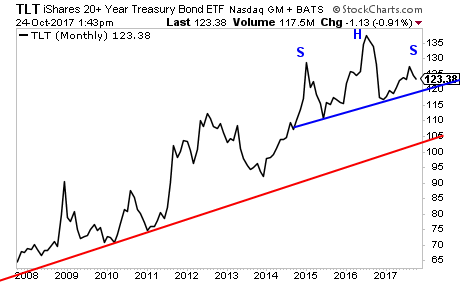
With that in mind, take a look at the UGLY Head and Shoulders pattern forming in the long-Treasury.
GPC102417
This is a serious topping pattern. And it suggests that bonds are about to reprice much lower.

What could cause such a drop?
INFLATION.
Inflation forces bond prices lower as yields have to rise to compensate for a loss of purchasing power (bond yields rise when bond prices fall). In light of this, that topping pattern in bonds is a major warning to the Bond Bubble (which we call The Everything Bubble) that the financial system is going to be in very serious trouble soon.
Globally the Bond Bubble is well north of $200 trillion. And when you include derivatives trade based on bond yields, it’s north of $550 TRILLION.
This is many multiples larger than the housing bubble or the tech bubble of the last 20 years. And because bonds are the bedrock of the financial system, when the Bond Bubble bursts, EVERYTHING will have to adjust accordingly.
GPC1018172.png
The time to prepare your portfolio for this is NOW before this hits truly gets out of control!
Imagine if you’d prepared your portfolio for a collapse in Tech Stocks in 2000… or a collapse in banks in 2008? 
Imagine just how much money you could have made with the right investments.
Fonte: qui